As it did for so many other designers and manufacturers of specialty audio gear, the current occupation of Basis owner/designer A.J. Conti began as a hobby and personal quest. A longtime audiophile and home-based dealer of brands like Krell and Quicksilver, Conti decided to build his own "killer" turntable using a fluid-damped suspension.
I won't debate here how to make a turntable's platter go around. Choose your favorite: belt vs direct drive, idler wheel vs belt, spring-windup vs wind power, whatever. As far as I'm concerned, there's nothing to debate. Each of these technologies has its pluses and minuses, but none can produce CD's accuracy of speed and inherent freedom from wow and flutter.
Enticing more music lovers to try vinyl requires a foolproof, plug'n'play solution. Asking a member of the digital generation to install a cartridge in a tonearm and then set up the VTA, SRA, VTF, etc. is asking too much. It's easier to make such a request of someone already bitten by the analog bug, but with turntables, wishing someone beginner's luck will not guarantee success.
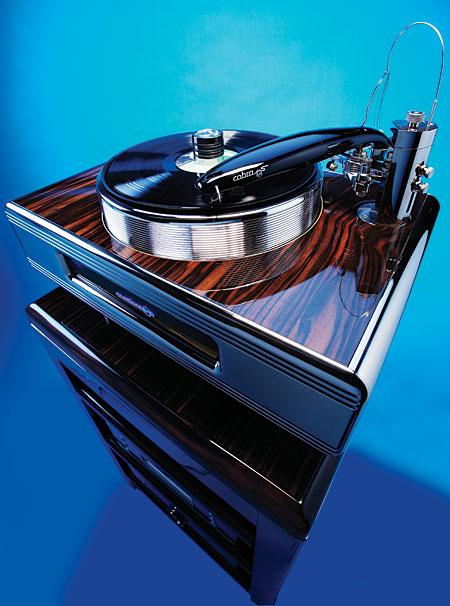
Part New Jersey diner, part Wurlitzer jukebox, with a snakelike tonearm that at certain angles looks vaguely lewd, this boxy, man-sized creation from Australia seems to have been built around its distinctive looks rather than for any functional purpose. Combine that with its sky-high price—itself almost obscene—and the result is apparently the sort of product that envious, cynical, self-loathing audiophiles love to hate, and reviewers love to write about.
Conceptually audacious, elegantly designed, executed with space-age precision, and remarkably compact, Grand Prix Audio's direct-drive Monaco turntable ($19,500) aims to turn the tables on the belt-drive designs that have dominated analog playback for three decades.
Almost immediately on entering the analog marketplace in 1982, Franc Kuzma, a mechanical engineer based in Slovenia, then part of the former Yugoslavia, established a reputation for manufacturing finely engineered, high-performance products that sold at reasonable prices. Kuzma's early industrial designs, however, while serviceable, looked less than distinguished.
An Analogplanet.com reader emailed to ask if I'd like to spend a week with his Gale turntable. I knew the Gale loudspeaker from the 1970s but was unfamiliar with the turntable so I figured, "why not"?
Long before the Swedes at Ikea did it, the singular Scotsman Ivor Tiefenbrun began giving his products funny-sounding names. For some reason positively phobic about the letter c, he banned its use in any of those names. Someone once told me his real last name is Tiefencrun, but since it wouldn't sound any different with a k, he settled for a b. "I could have been Ivor Tiefendrun, or Tiefenfrun, or Tiefengrun, for that matter," he's quoted as having said once while krunching a krakker.
The Pro-Ject brand began as vinyl lover's pipe dream. Vienna based audio distributor Heinz Lichtennegger believed as did many of us back in the 1990s, that vinyl was not dead. It just needed a defibrillator in the form of an inexpensive, well-made and reliable turntable.
It's now been eight years since a Rega P3 turntable passed through my listening room. While the new P3-24 superficially resembles the P3 (and virtually every other Rega 'table), the company has made some significant changes, including upgrading to the high-quality, low-voltage (24V), electronically adjusted motor used in the more expensive P5, P7, and P9. As in those models, an electronic circuit trims the phase angle of the P3-24's motor coils, thus substantially reducing motor vibrations. In 1998, during a factory tour, a Rega engineer demonstrated the circuit's effectiveness to me. As he adjusted the circuit board's pot, vibrations from the motor dramatically decreased, until it was difficult to tell if the motor was spinning or not. Back then, this "hand-trimmed" motor technology was available only in the P9. The P3-24 uses a less sophisticated version of the same basic idea.
I literally dropped everything when Rega's new Planar 25 turntable arrived a few weeks ago. I'd heard the 'table compared with the Planar 3 at designer Roy Gandy's house when I visited Rega last fall—see "Analog Corner" in the January '99 Stereophile—and was anxious to audition it in my own system and tell you what I heard.
Andy Payor hurls a briefcase full of engineering and scientific mumbo-jumbo at in an attempt to justify the $73,750 price of the latest and greatest edition of his Rockport Technologies turntable, but really—isn't this all-air-driven design a case of analog overkill? After all, defining a turntable's job seems rather easy: rotate the record at an exact and constant speed, and, for a linear tracker, put the stylus in play across the record surface so that it maintains precise tangency to a radius described across the groove surface. By definition, a pivoted arm can't do that, so the goal there is to minimize the deviation. That's basically it. Right?
"My original goal was simply to design a better turntable than the Linn because at that time in the UK, Ivor Tiefenbrun was the man—he was the patron saint and all that. And all the hi-fi mags were full of Linns. He did for turntables, in a way, what Mark Levinson (the man) did for amplifiers."