That Crazy Little Thing Called "Azimuth" Part 1

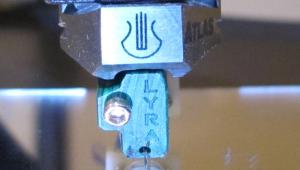
"Azimuth" is generally defined as the perpendicularity of the cantilever to the record surface. Some tonearms, including most (but not all) gimbaled tonearms (ones with fixed bearings like Rega and fixed head shell SME's) don't allow you to adjust that parameter. You are at the mercy of the cartridge manufacturer, but that doesn't mean you shouldn't check your cartridge's performance even if you can't adjust it.

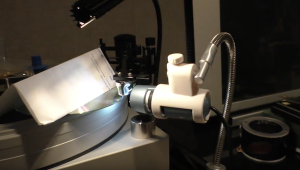
In the ideal world of perfect cartridge manufacturing, proper azimuth set up would be to have the cantilever perpendicular to the record surface. Setting it is easy, therefore: put a mirror on the platter, lower the arm onto the mirror and adjust so the cantilever and its reflection form a straight line.

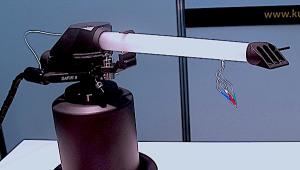
VPI turntables feature a small diameter headshell groove cut perpendicular to the cantilever into which you place a supplied thin metal rod that protrudes on both sides sort of like a high wire walker's balancing stick. You're instructed to measure the distance from the record surface to the rod and adjust the arm's horizontal tilt until the distance is equal on both sides.

Either that, or a mirror will work and produce identical results. Unfortunately, both results will more likely than not be wrong!

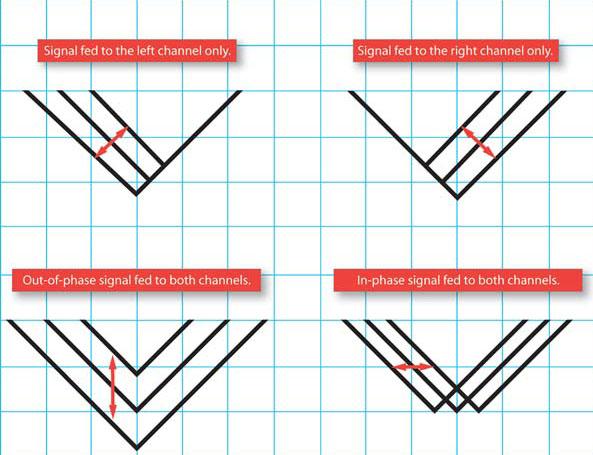
Before explaining why, let's get into why azimuth matters as much if not more than SRA. The Westrex 45/45 system that's used to produce stereo from a single record groove uses lateral, vertical and angular stylus motion for both lacquer cutting and playback. In phase information sent to both channels (mono) produces lateral motion. Out of phase information sent to both channels produces vertical information. Information fed onto to the left or right channels produces deflection as seen in the graphic below.

Clearly we want the playback stylus to reproduce the groove modulations produced by the cutting stylus but if the stylus isn't perfectly aligned to vertical, the left channel modulation might affect the right channel and vice-versa. That unwanted modulation is called "crosstalk." That's when the right channel modulation modulated the left channel and vice-versa.

In the real world, there is always some crosstalk but minimizing it maximizes channel separation and maximizing channel separation maximizes soundstage width and soundstage symmetry. So we want the stylus to sit perfectly centered in the groove. Were the stylus perfectly aligned with the cantilever, cantilever perpendicularity to the record surface would guaranty minimum crosstalk and correct setting of azimuth.

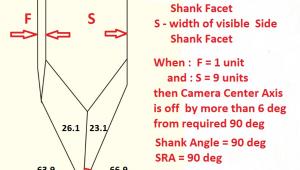
But as we described in our discussion of SRA, styli are rarely set correctly in the cantilever in terms of SRA and that's also true with azimuth. Usually the stylus is canted slightly to one side or the other, thus, cantilever perpendicularity to the record surface is no guaranty of correct azimuth setting.

Also, what are the odds that the coil assembly will be perfectly aligned and symmetrically placed between the 45/45 angle of the record grooves? Not great. And for cartridges where the motor is a complete assembly that's affixed within a separate body, what are the odds of that being symmetrical? Not great!

And that's why it is virtually impossible to correctly set azimuth by eye or with a mirror or with a balancing beam.

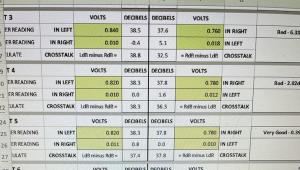
So how do you do it correctly? Electrically. Now that does not mean putting the channels out of phase with each other, summing to mono and adjusting azimuth until the signal "nulls" out a is suggested on some test records. That does not adjust azimuth! That simply balanced the outputs of the channels. It does not guaranty that you've minimized crosstalk and maximized separation, which is what you're really trying to do.

So how does one correctly set azimuth? That will be explained in Part II!

Share | |
Comments
dbowker3d's picture
Great topic!

But please, along with whatever you offer for the "best" or most accurate method, also include the DIY "on the cheap method" if there is one. Not many of us can justify buying something to help measure something that will likely get used less than once a year.


Many thanks for your helpful columns!

marlofat's picture
Wow i can say that this is

Wow i can say that this is another great article as expected of this blog.Bookmarked this site.. Viagra ohne Rezept Erfahrung

hopar111's picture
Great Article it its really

Great Article it its really informative and innovative keep us posted with new updates. its was really valuable. thanks a lot.
I was reading this

Mikey Likes It's picture
Azimuth outa you

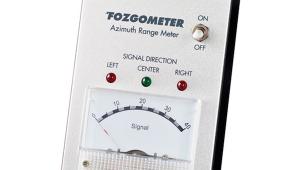
Get a Fozzy Go Meter! its a couple bucks, but it won't break the bank sad Besides do ya really want to peer into an Oz scope and watch sinal levels ? Pleasse!

faetivlyouhs's picture
Wow! I really appreciate the

Wow! I really appreciate the thought that you put into this article. This topic has been something I have been looking into for a few hours and your post is one of the best I have read.
Clarion Car Stereo Reviews

Mustgais34's picture
Azimuth

I like this article , It was an additional knowledge about Azimuth and I think I can use this article in my paper works. Thanks for sharing!

Ryan L. Bethea

Tarlow Design

troy55's picture
Thanks for your post. I’ve

Thanks for your post. I’ve been thinking about writing a very comparable post over the last couple of weeks, I’ll probably keep it short and sweet and link to this instead if thats cool. Thanks.
guitar cover

rain1122's picture
Thanks for taking the time to

Thanks for taking the time to discuss that, I feel strongly about this and so really like getting to know more on this kind of field. Do you mind updating your blog post with additional insight? It should be really useful for all of us.
play zuma

rax1122's picture
Nice to read your article! I
Nice to read your article! I am looking forward to sharing your adventures and experiences.
Learn More About G-Junior