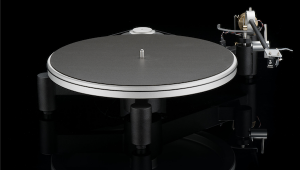
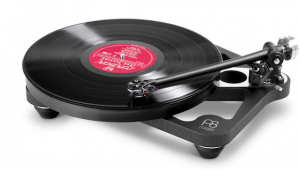
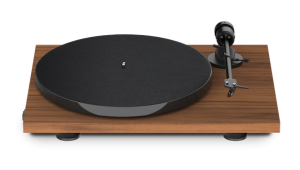
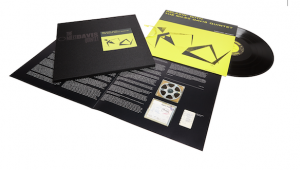
VPI Classic 3 turntable & Classic-JMW tonearm Specifications

Sidebar 1: Specifications

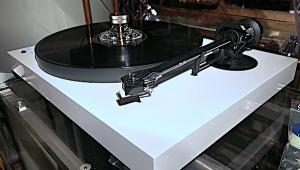
Description: Belt-driven turntable with tonearm. No specifications given. Dimensions: 22" (559mm) W by 10" (254mm, including wire loop) H by16" (407mm) D. Weight: 81 lbs (36.8kg) with ring and record weight.
Finishes: Piano black base with wrinkle graphite color top.
Serial Number Of Unit Reviewed: 3265.
Price: $6000. Approximate number of dealers: 69. Warranty: 5 years.
Manufacturer: VPI Industries, 77 Cliffwood Ave. #3B, Cliffwood, NJ 07721. Tel: (732) 583-6895. Fax: (732) 946-8578. Web: www.vpiindustries.com.

Company Info
VPI Industries
77 Cliffwood Ave. #3B
Cliffwood, NJ 07721
(732) 583-6895
Article Contents
Share | |
Comments
anonymous's picture
Tonearm-to-cartridge matching?

It’s always helpful to give credit where credit is due and since there were no comments on this VPI Classic review, I thought I’d add one…..or two …. or so very brief comments.


Turntable:  Using the same stereo system for all tests my friend and I tried the VPI Classic 3 against a Clearaudio Innovation (XV-1s/1t), Brinkmann Bardo (Lyra Titan), and a couple other turntables and it really held its’ own.  The Classic 3 has great pitch stability and a lively presentation that is rather addictive, making it quite the bargain compared to this stiff competition.

Tonearm:  Using the 10.5i unipivot arm we tried a Soundsmith Zephyr and Dynavector 17D3, each around $1k,  and the 17D3 was the hands down favorite with a greater amount of detail, dynamics, larger soundstage, and wider frequency range.  Moving up to the $5k range with the Benz Micro LP S-MR and Dynavector XV-1s, the Dyna was again the favorite primarily due to the unrestrained dynamics, clear separation around each instrument (wow!), and wonderful musicality.

Options:  In the Classic 1 the stainless steel arm tube and Nordost Valhalla wiring options will bring it up to near Classic 3 status, without the on-the-fly adjustable VTA, and are both highly recommended if looking towards the less expensive Classic 1 vs. the more expensive 2/3/4 models.  With that said, the center weight and outer edge ring are must haves since they really lock down the soundstage – try it, the difference is pretty amazing.  What about the SDS to better control the speed?  Using a strobe the VPI is awfully close to dead-on, so the SDS seems more of a like to have than need to have. 


We were both surprised the Benz LP S-MR didn’t do as well as the Dyna XV-1s given the recent reviews we’ve read (we each bought an XV-1s after listening), but it really highlights the need to listen and trust your own ears.  (At least we can say the Classic/17D3 and Classic/XV-1s sound like great synergistic matches to us.)  I suspect the tonearm/cartridge interaction was the key deciding factor here, but maybe the kind Mr. Fremer can shed some light on tonearm/cartridge matching?

ballyg45's picture
000-569 || HP0-M51 || 000-822
TexasLending's picture
Good points. You have

Good points. You have expressly evaluated some points which are really relevant in the matter of choosing the right kind of system. I can honestly say that I have thought of the same ideas s well.- Texas Lending

Hussy's picture
It's fun to play new records

It's fun to play new records on unauditioned gear—you can assess the performance without prejudice. You might say that not knowing anything about the recording leaves you adrift  000-121 || 000-129 || 000-463 || 000-780 || 1Z0-058 || 1Z0-584 || 9L0-064 || 9L0-410 || 70-487 || 74-679

sandra's picture
ome buyers have been using as

ome buyers have been using as a record mat the thin rubber mat that protects the platter surface during shipping. Weisfeld is agnostic about whether this is a good idea or not. JN0-380 || JN0-633 || 70-341 || 70-342 || 70-521 || MB4-873 || MB4-874 || MB5-700 || ML0-320 || MSC-241