


Marillion’s Steve Rothery Tells Us All About Bioscope’s Gentō, an Immersive, New Ambient Prog Collaboration With Tangerine Dream’s Thorsten Quaeschning That Arrives as a 2LP Set on August 22
Sometimes, a band name and an album title combine to tell you everything you need to know about the music you’re getting ready to spin on your turntable. This premise is perfectly delineated by a new partnership called Bioscope and their debut 2LP set that’s been duly dubbed Gentō, which is coming out via earMUSIC this upcoming Friday, August 22, 2025.
Let’s define some terminology first, before getting into the grooves. Bioscope comes from blending the Greek bios (life) and skopeein (to look). Before the film era came to the fore, the term Bioscope was mostly taken to represent “a view or survey of life,” something that could also be a fitting allegory for how this super-cool ambient-prog project flows and unfurls across all four of its sides. (More on all that in a bit.) As for the album title itself, Gentō as I’ve been told, rhymes with “bento” and is Japanese for “magic lantern,” one of the systems used in the 18th century to project moving images.
All of this preamble leads us to who comprises Bioscope — a) Steve Rothery, co-founder of and guitarist for Britain’s perennial prog stalwarts Marillion, and b) Thorsten Quaeschning, musical director of German ambient pioneers Tangerine Dream, and a maestro of electronic music who is also known for his work on film and game soundtracks. (Tangerine Dream founder Edgar Froese personally chose Quaeschning to take charge of the TD reins before his passing in January 2015.) As the Bioscope PR team puts it, the Rothery/Quaeschning connection “is not just a fusion of styles, but a thoughtful dialogue between two established musical identities — a true ‘bioscope’ in the sense of offering a view of life through music.” Hard to argue with that. To complete their aural picture, the Bio-pair selected Elbow drummer Alex Reeves to handle the percussive side of things.
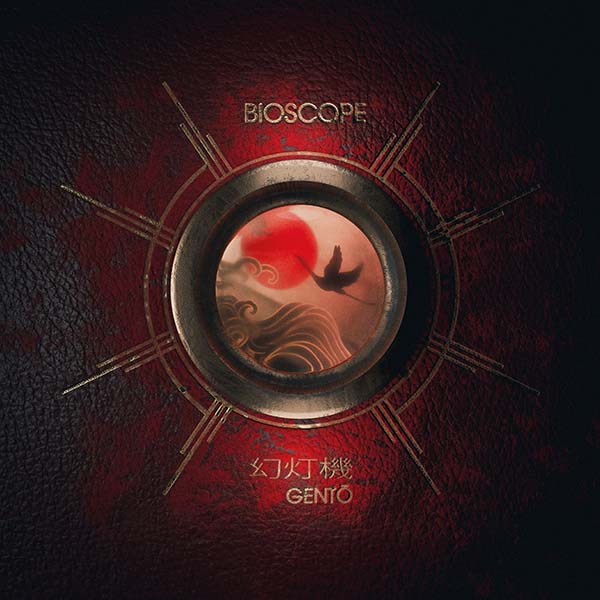
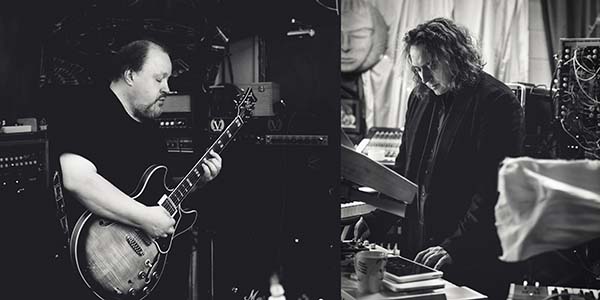
The Bioscope project began in earnest in early 2020, gradually developing through select, nonconsecutive five-day sessions held in both Berlin on Quaeschning’s home turf and at Rothery’s home studio in Southwest England. The sonic synergy betwixt and between Rothery/Quaeschning can be heard throughout all 58 minutes of Gentō, which comprises five songs in total, three of which get spread out across one full LP side apiece. Given the, well, scope of this wholly absorbing ethereal music as combined with Rothery’s personal fascination with the moving image, Gentō can be heard as a fully formed soundtrack to a movie that unfolds in your own mind’s eye in real time as you listen to the playback.
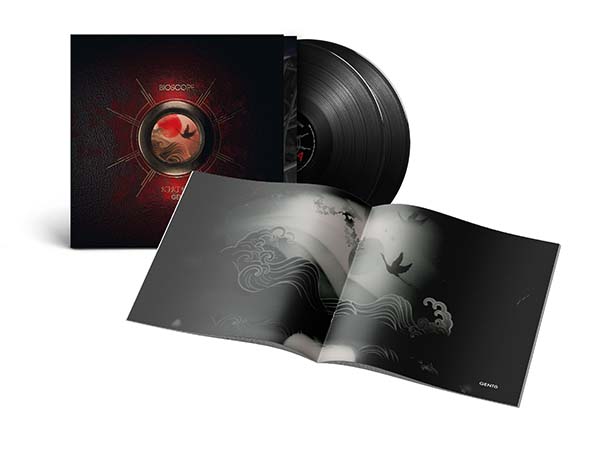
Based on the telltale etchings in the deadwax, Miles Showell cut the Gentō lacquers at half-speed at Abbey Road Studios — and he did it all just right, remaining true to Rothery and Quaeschning’s core aural intentions. The volume dynamics vary just as they should all throughout the course of each song/segment, side after side. Both of my deep black Gentō LPs were flat and well-centered, and I experienced nary a playback issue of any sort — always a plus. The glossy gatefold cover itself is nicely designed, with the credits and an exhaustive list of the gear used by both Thorsten and Steve appearing on the inner-left sleeve, and the full-size 16-page saddle-stitched booklet is as visually inclined as to be expected, mostly in B&W tones. My ratings for Gentō put the Music at a solid 9.5, and the Sound at 8.5. The more I hear of it, the more I get in deeper tune with it.
The SRP for the 2LP Gentō set is a quite reasonable $39.98, and you can preorder it here.
To get more insight into the making of Gentō, I went directly to the source and did the Zoom thing across the Pond with Rothery earlier this month. In the following Q&A, Rothery, 65, and I discuss the overall sonic goals for Bioscope, his appreciation of half-speed mastering and film soundtracks, and which Marillion LPs he suggests the AP faithful and newbies alike should spin on their turntables to get a sense of their musical intentions and inclinations.
Mike Mettler: Hey, Steve. In these topsy turvy times, Gentō sure gives off a lot of positive vibes — something we can all use right now, to be honest. Was that an underlying theme of what you and Thorsten were trying to do with this music?
Steve Rothery: Hi, Mike. Yeah — it is quite uplifting, isn’t it? It wasn’t designed to be, but maybe “Kaleidoscope” (LP1, Side B, Track 2) was. [Check it out below.] I think that was always quite an “up” track. But, yeah, there’s quite a lot of joy in all the album, I think, which is really cool. And, like you say, it’s much needed in the world we’re living in. (chuckles)
Mettler: Yeah, so true. I’m just curious — did you know, in terms of the album length, that it was gonna be a double record at first, or did it just evolve along the lines of, “let’s work together, and we’ll see what makes sense”?
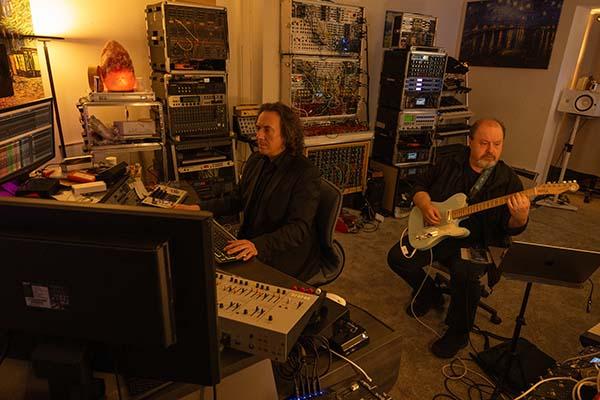
Rothery: Yeah, no, we just kind of — it was a slow process. In total, even though it’s taken five or six years to put Gentō together, it’s maybe only been about five weeks where we’ve been in the same physical space together. That usually meant me flying over to Berlin for a week at a time [to work with Thorsten in person], and we just slowly evolved the ideas — but we had no idea what it was going to be until quite recently, really. I mean, it was the last session we did in December [2024] where we thought, “You know, we’ve gotta finish this, because this pretty much sounds like we have an album here. So how about some real drums?” And then we found Alex [Reeves], who did an amazing job. He did all the drums on the album in two days — and we finished up with what you hear.
Mettler: I’m glad I’ve been able to spin the double vinyl for Gentō quite a few times already. And I love the fact that parts of the title track (LP1, Side B, Track 1) remind me of a certain scene in a film that Tangerine Dream scored, [1983’s] Risky Business. It feels like you’re alluding to that sound more than a little bit — what we hear in that movie’s on-the-train scene, I mean. And then there’s maybe a little bit of an allusion to “Baba O’Riley” [the opening track on The Who’s August 1971 LP on Track/Decca, Who’s Next] in there at the outset as well. Were both of those wink/nods purposeful, or subconscious? What was the thought process there?
Rothery: The Tangerine Dream one was purposeful, yes. It’s what I said to Thorsten when we started developing that idea. I said, “It’d be really cool to have something in 7/8 that’s very much like a train journey — a bit like the Tangerine Dream bit in Risky Business,” so that’s kind of how that evolved. [The TD track we’re both referring to here is “Love on a Real Train (Risky Business).”] And then I instructed my daughter to do this video that’s now up on YouTube, actually. It’s got time-lapse footage of Tokyo, including lots of train stuff. You see the visuals with the music, and it’s all very evocative.
Mettler: Oh yeah, yeah — it’s perfect. There are also some train sounds when this track ends. Did you go record that somewhere yourselves, or did you pick that up from a sample library? Where’d you get them?
Rothery: Yeah, I bought it from a library. It is actually a Tokyo train, so it fits in. [See the “Gentō” video treatment for yourself, via the official YouTube clip below.]
Mettler: Did you get test pressings of Gentō to check out? Did you do QC on the vinyl yourself?
Rothery: I didn’t, but Andy Bradfield [who mixed the album] did. Andy came to the mastering with me at Abbey Road [Studios] where they [i.e., Miles Showell] did the half-speed mastering — and he did an amazing job. It sounds quite wonderful, really. So, yeah, I’m excited for people to hear Gentō on vinyl.
Mettler: Me too! I think being able to get all of “Vanishing Point” on one side (LP1, Side A), and then likewise for “Kinetoscope” (LP2, Side C) and “Bioscope” (LP2, Side D) apiece, is critical to the integrity of hearing those songs as you guys intended them. You didn’t have to compromise any of the arrangements to fit them on one side each, did you?
Rothery: No, not at all. I’m very, very pleased with it. And we were so fascinated about the half-speed mastering — especially because, with the high frequencies, it’s not having to vibrate at the same speed for when they were cutting the lacquers. It was fascinating to watch the process. Obviously, it’s more expensive if you’re cutting two albums as opposed to one — but it’s worth it for the end result, I think.
Mettler: I agree. I don’t think there’s any way you could put all of this music on one piece of vinyl. It just wouldn’t work.
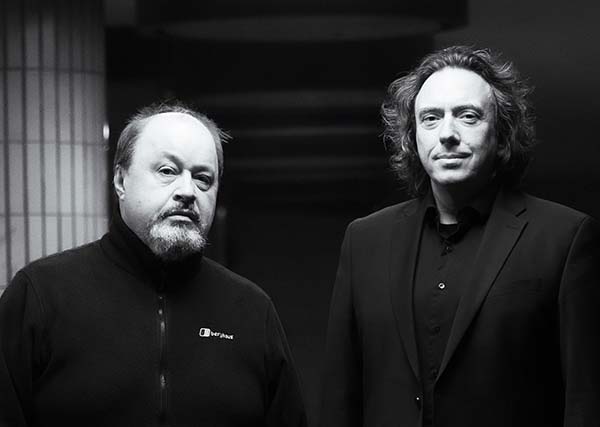
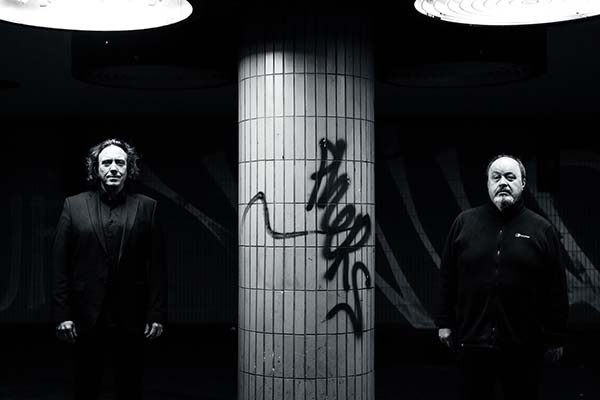
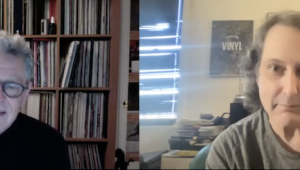
Rothery: No, it wouldn’t. [In the photo below, Rothery is at the right, and Quaeschning is at the left.]
Mettler: Since we’re talking about vinyl, what were the first records you bought as a kid — the first ones you got for yourself where you felt like they were truly “yours”?
Rothery: I remember buying loads of film soundtracks — the John Barry stuff for the [James] Bond films. I also got albums by the English composer Ron Goodwin, who did a lot of war movies — [1969’s] Battle of Britain and [1964’s] 633 Squadron — and that was all very stirring. He also did the soundtrack to [1968’s] Where Eagles Dare — great soundtrack. And then the first rock record I bought was A Saucerful of Secrets, by Pink Floyd [released in June 1968 on EMI/Columbia].
Mettler: Oh, yeah — well, that’s a hell of a way to start! That’s an amazing piece of rock royalty to get yourself into, for starters.
Rothery: (laughs) Definitely!
Mettler: Do you still have any of those albums, or did you have to rebuy those LPs over the years? Do you have a collection?
Rothery: I have some vinyl, but it’s been gathering dust since I moved house. I’ve got a great Linn Sondek record deck. I should try and get it together and hook up a system in here so we can listen to some of that stuff.
Mettler: I know you’ve been busy, but I wholly agree about setting up your system, because that’s an absolute must.
Rothery: Yeah. I think with the right album, you can lose yourself in it, either on headphones or if you’ve got a great sound system. It makes the world go away, and all your troubles go away. That’s the best kind of music to play on vinyl, as a sort of escape from all those other things in life you’d rather not deal with! (laughs)
Mettler: Yeah, yeah — which is like almost everything, at this point. (both laugh) Do you have what we could call Steve’s favorite albums for doing that? Could you list a couple of LPs that we could “escape” with, from your point of view?
Rothery: For me, my favorite sort of “escaping” albums would probably be Pink Floyd, Wish You Were Here [released in September 1975 on Harvest/Columbia], and one of the Vangelis soundtracks, maybe, like the Blade Runner soundtrack [which was finally released in June 1994 on East West/Atlantic, a decade-plus after the movie came out in 1982]. I love that album.
But other than that — Ry Cooder, the Paris, Texas soundtrack [released by Warner Bros., in 1985], I love. And the soundtrack to a French film called Betty Blue [released in 1988 on Virgin Movie Music, and credited to Gabriel Yared]. Oh, it’s really an amazing soundtrack with really soulful saxophone, and a great piano theme as well.
Mettler: Nice. I’m gonna have to look up Betty Blue, because I don’t know it. It’s interesting that, essentially, you connected with instrumental music first, as opposed to vocal stuff — and maybe that plays into your arrangement skills, since a lot of your music is very cinematic. Plus, the Bioscope record is literally about dealing with the moving image and not stasis, so maybe that’s always been in your DNA.
Rothery: Maybe so!
Mettler: Now that you’re done with Gentō, will you and Thorsten continue to work together? Do you think, “Hey, we’ve got something here. We’ve got more ideas that we can carry on with”?
Rothery: Oh, absolutely. We will do another album, hopefully next year. For now, we have some live shows in December. We’ve got five European shows — two in the Netherlands, two in Germany, and one more in Poland. [Go here for the Bioscope / Vanishing Point Tour specifics.] And when we play those shows, the album’s only an hour long, so we’ll be playing half an hour of additional new music, some of which is probably gonna be based on some of the jams we did at one of the earlier sessions.
So, yeah, we’ll definitely do another album. We had too much fun not to. But I’m really at the mercy of how long the next Marillion album takes, because we’re back in the studio, and we’re trying to finish that one. It depends how long it takes us, really.
Mettler: Speaking of Marillion, could you recommend some Marillion LP starting points, both from the Fish era and the “other” Steve [Hogarth, a.k.a. “h”] era, for our readers to get into on wax? [Fish was Marillion’s lead singer from 1981-88, and “h” has been the band’s lead singer from 1989 to the present, and counting.]
Rothery: I’d say Misplaced Childhood, from the Fish era [released in June 1985 on EMI]. Some people might think that Clutching at Straws [released in June 1987 on EMI] is a better record, but I think Misplaced has got a lot of great songs on it.
From the “h” era — that’s really difficult. I mean, there are so many fantastic songs. Afraid of Sunlight [released in June 1995 on EMI], I think, is a great album. And Marbles [released in May 2004 on Intact] is also probably a good way of introducing people to him.
Mettler: Yes, on all counts. Well, I have all of those LPs, and the care you guys have taken with the vinyl reissues for each of them shows. Please keep doing that, because we want more of it.
Rothery: Yeah, we will. We’re not gonna be stopping anytime soon.
Mettler: That’s good to hear. Well, I don’t wanna overload your time here today, but what I like to do to wrap things up is, I’m gonna send us 50 years into the future so that we’re in 2075. And, as I like to say, unless some weird science is going on, we may not physically be around at that point. Maybe you will, I don’t know, but. . . (both laugh) Anyway, if people type “Marillion,” “Steve Rothery,” “Wishing Tree,” or “Bioscope” into their listening device, what kind of listening experience do you want a future listener to get from the music you’ve made in your lifetime?
Rothery: You always just hope that your music is gonna endure past your lifetime. So, if they find it uplifting, or it takes them on a journey and makes them think about things, or maybe it helps them relax or get them through a troubled time, that’s all you can hope for — that the music will carry on, resonating with people throughout the years.
BIOSCOPE
GENTŌ
2LP (earMUSIC)
LP1, Side A
1. Vanishing Point (Parts 1, 2 & 3)
LP1, Side B
1. Gentō
2. Kaleidoscope
LP2, Side C
1. Kinetoscope (Parts 1 & 2)
LP2, Side D
1. Bioscope (Parts 1, 2 & 3)











 |
Equipment Reviews | |
The Gruvy Awards | |
Blogs Analog Tips | Columns Music | |
Show Reports | |
News Resources |
 © 2026 AnalogPlanet
AVTech Media Americas Inc.
All rights reserved