


Fluance RT82 Turntable
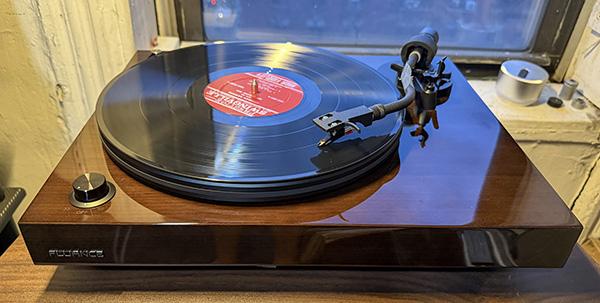
Whenever I talk to newbies about turntables, the Canadian brand Fluance inevitably comes up. Founded in 1999 by Deepak Jain in Niagara Falls, Ontario, Fluance has carved out a smart niche for the uninitiated — i.e., those who simply want an affordable, no-fuss entry into vinyl enjoyment. The brand offers at least seven turntable models, as well as speakers and phono preamps. Notably, several of those tables arrive without onboard phono stages, which signals that Fluance take analog playback seriously. Their midprice machine, the RT82 Reference High Fidelity Vinyl turntable, comes in at $349.99, and it is the subject of this review.
Before I get into the RT82’s nitty-gritties, check out my official unboxing video for this new table over on our YouTube channel, which you can also watch below.
Specs & Features
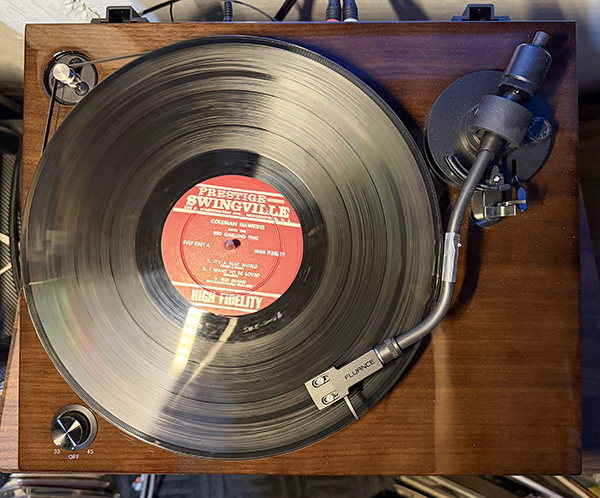
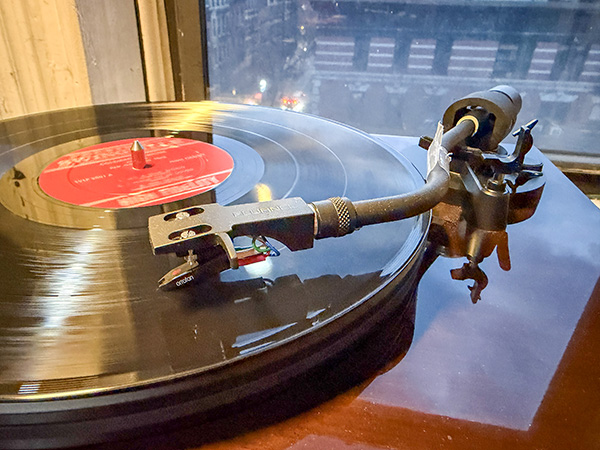
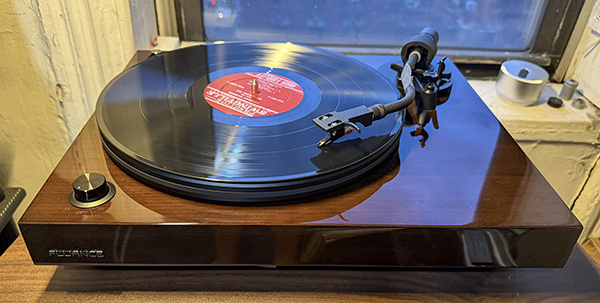
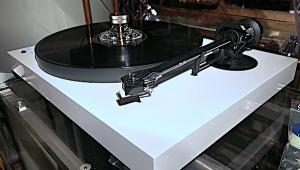
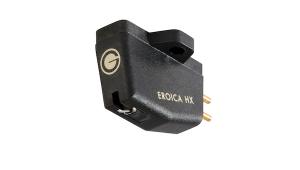
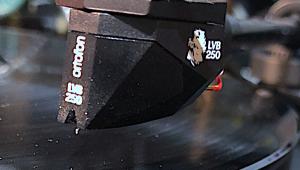
The Fluance RT82 turntable measures 16 x 6 x 14in (w/h/d), and it weighs a solid 15lb. The package is generous for the price: dust cover and hinges, a bubble level, a detachable headshell pre-mounted with an Ortofon OM 10 moving magnet (MM) cartridge, counterweight, aluminum platter with rubber belt, rubber platter mat, AC power adapter, a pair of 3-foot RCA interconnects, ground wire, 45rpm adapter, motor pulley cap, white cotton gloves, user manual, and a 2-year manufacturer’s direct warranty. Not bad for three-and-a-half bills.
Inside and underneath this table, Fluance have packed in a fair amount of engineering. The RT82 rides on three rubber-spiked adjustable feet, and it sits atop what the company calls a “high mass MDF wood plinth.” Make of that marketing language what you will — but we can educatedly assume it’s MDF, not solid wood.
This table also features an under-mounted 7-point silicone isolation system with a decoupling isolation ring, gold-plated RCA outputs, an S-shaped aluminum tonearm, a two-speed servo-controlled belt-drive motor with an optical speed sensor, and an autostop function. (Yay for the latter!) Anti-skate adjustment is included; azimuth and VTA adjustments are not.
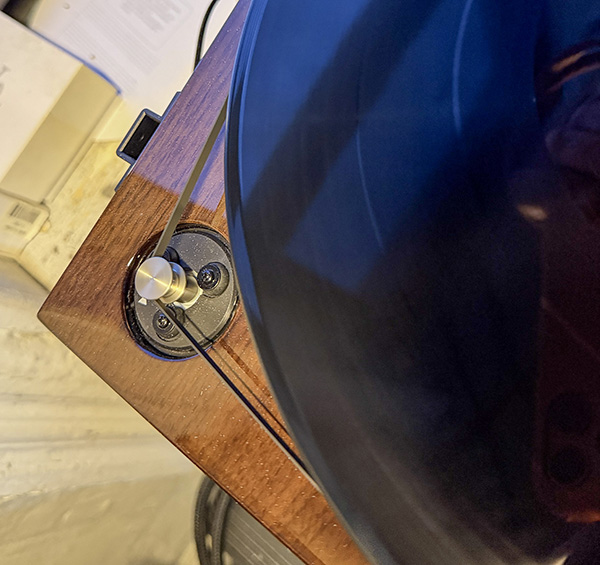
Fluance’s site makes its case for the engineering beneath the hood: “The mass-loaded multi-layered MDF wood chassis inhibits the transfer of unwanted resonance through the system. The [three] rubber, spike-type height-adjustable isolation feet minimize surface contact under the turntable resulting in immunity to environmental vibrations, allowing for greater low-frequency signal pickup and improved imaging.”
As to the motor, they claim: “The precision servo-controlled belt-drive motor with speed regulating optical sensor continuously measures and adjusts variances in linear velocity and acceleration within a few hundredths of a percent at a wow and flutter of 0.07%. The decoupling of the drive from the plinth suppresses motor vibrations and noise from reaching the stylus. This maintains accurate speed and significantly reduces rumble so your records sound perfect at every play.” Other reported specs appear to back this up: speed variation is given as 0.13%, and signal-to-noise ratio as 76dB.
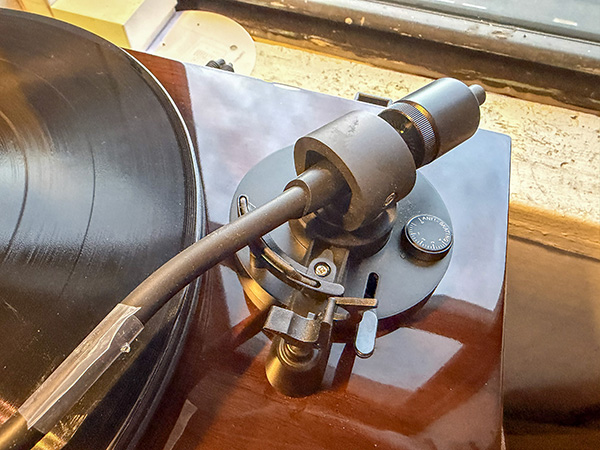
Tonearm specs round out the picture: 36 AWG 7-strand Litz cable tonearm wire, effective tonearm mass of 0.77oz (21.78g), overhang of 0.76in (19.2mm), and effective tonearm length of 8.82in (224mm).
Setup
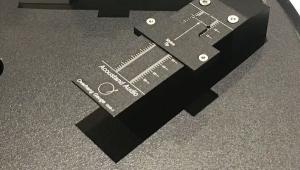
Setup of the RT82 turntable was painless. My Dr. Feickert protractor confirmed correct cartridge alignment straight out of the box — a genuinely good sign. More expensive turntables have arrived at Chez Micallef with alignment that needed some serious corrective work, so when a budget table lands properly dialed in, it signals the company takes accurate turntable specs seriously.
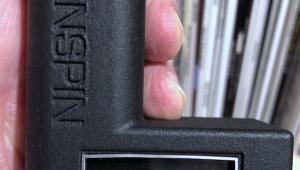
I connected the RT82 table to my Tavish Design Adagio phono preamp that went into a Unison Research S6 Black Edition integrated amp driving Wharfedale Super Linton stand-mount loudspeakers, the latter of which are in for review over at our sister site, Stereophile. AudioQuest and Triode Wire Labs comprised cabling. My new Shaknspin device measured the RT82’s speed at 33.37.
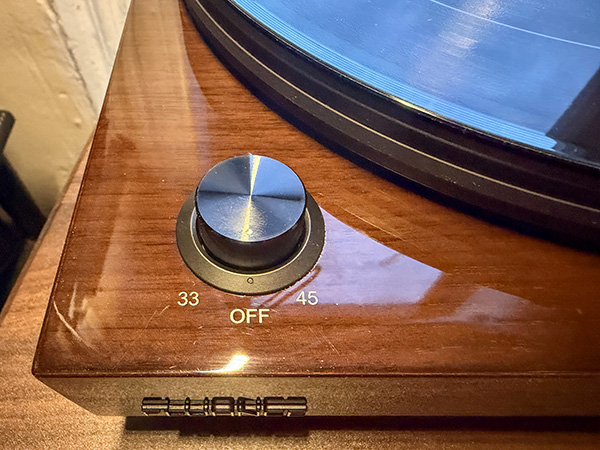
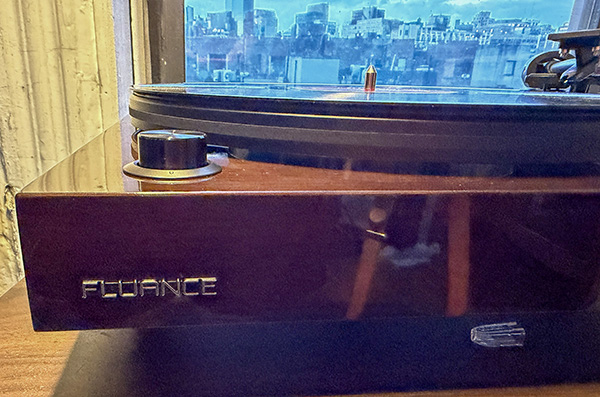
The RT82 table felt solid enough for just a penny under $350 and the power knob felt moderately chunky, though it didn’t click into place for the two speeds. The tonearm seems a bit lightweight, and the cueing lever felt somewhat flimsy. The finish was strong and sleek, with a laminated glossy look that didn’t look cheap; not an afterthought. The adjustment lines on the counterweight were nearly impossible to read, even with a strong flashlight. (I’m getting older, yes, but I’m not blind.) These were the faintest adjustment lines I’ve ever seen.
Listening Sessions
A turntable’s sole mission — its reason for existing — is to unlock the groove, rhythmic complexity, and atmospheric mojo buried in a vinyl record’s grooves. Fail that test, and it’s not a turntable; it’s a very expensive coaster. I’ve heard obscenely priced mass-loaded slabs and bargain-bin spinners blow this basic assignment. The Fluance RT82? It passed with flying colors. It damn near shocked me.
I mean, you’re telling me a $350 turntable — cartridge included — can nail ZZ Top’s highway boogie, the swampy backwoods voodoo of the first Allman Brothers Band record, the gleeful Afro-Cuban strut of Paul Simon’s “Late in the Evening,” and the hard-swinging bop of saxophonist Jim Snidero? I’d tell you to put down the Kool-Aid and sleep it off.
But here we are.
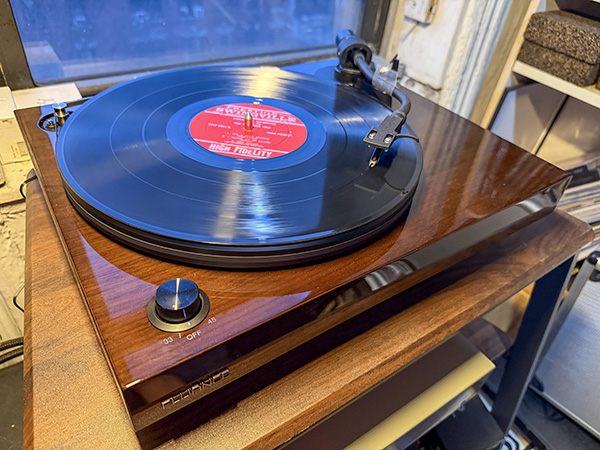
The RT82 knocked me flat. It pelted me with rhythmic ferocity. It swung like the ghost of Jo Jones haunting a late-night jam. It got out of its own way, planted its flag on the 2 and 4 and kept it there — album after album, style after style — making everything it touched feel urgent and alive. That said, Cream’s Disraeli Gears (1967; ATCO SD 33-232) opened its session a bit thin and smallish. Yes, there was a decent stereo spread and acceptable layering, but not exactly a statement of intent. Fair enough.
But then Paul Simon’s One-Trick Pony (1980; Warner Bros. WB 56 846) set the room on fire. Steve Gadd’s drums and Ralph MacDonald’s percussion exploded from a wide, well-layered stage; punchy, ferocious, and fully charged. The Fluance strutted its mojo here in grand fashion. Rhythms were fiery and full-scale. The stage was ample, and the imaging surprisingly potent. The bass drum was tight, but deep bass was simply MIA — nothing below the belt, and no subterranean weight to anchor the music to the earth. This was the RT82 table’s consistent limitation: warmth in the midbass, yes; real low-end tonnage, forget it. And beyond the initial impact of a note, things got a little thin.
Next up, alto saxophonist Jim Snidero’s newly released Best of the Trio Recordings (2026; Savant SLP 2240) swung hard, dry, heaving, and rhythmically right, but lacked ultimate physicality. Peter Washington’s acoustic bass almost compensated for the low-end deficit, and the music was well-detailed and well-sorted within the slightly mono-ish stage. But the dryness nagged.
ZZ Top’s Tejas (1976; London LDU 1) proved the Fluance table to be largely transparent, revealing this Texas boogie treatise in a panoramic, churning soundstage that bucked like a bronco and choogled (to modify a John Fogerty term) with reckless abandon. “It’s Only Love” (Side 1, Track 1) stomped me into the carpet, as it was unruly and downright nasty. There was no serious bass depth, but the music rocked with such relentless rhythmic ferocity, I pumped my fist and reached for the milk.
Oddly, Ella Fitzgerald’s Like Someone in Love (1957; Verve MGV-4004) sounded somewhat puny and small, with similar curious miniaturization as with Disraeli Gears. Puzzling. But overall, I was pleased with what the RT82 had to offer.
Conclusions
Thing is, the Fluance RT82 is not a quiet turntable. At times, it’s downright noisy. The treble can turn brash and combative. And while its soundstage layering is generally impressive, it can buckle into clutter — especially when the noise floor rises. If classical music, hushed soundtracks, and intimate acoustic recordings are at the forefront of your playback, look elsewhere.
But for $349, and with an Ortofon OM 10 MM cartridge included, I get it. The Fluance RT82 turntable is a rhythmic wrecking ball: gritty, full-bore, and analog-to-the-bone, pinning you to the wall with a groove-first ferocity that embarrasses turntables costing twice as much. It’s loud, brash, and occasionally messy. Its stage is foreshortened, and occasionally cluttered. But inside that rowdy package is a world-class, entry-level record spinner that most humans on the planet can actually afford. And that’s not nothing. That’s everything. And thus, the Fluance RT82 turntable is quite worthy of your entry-point consideration.
For more about Fluance, go here.
To find out how to purchase Fluance gear, go here.


















 |
Equipment Reviews | |
The Gruvy Awards | |
Blogs Analog Tips | Columns Music | |
Show Reports | |
News Resources |
 © 2026 AnalogPlanet
AVTech Media Americas Inc.
All rights reserved