


Glenn Tilbrook Tells Us How Squeeze Reclaimed a Batch of Songs From a 52-Year-Old Demo Cassette to Cut Their All-New Trixies LP

Sometimes going into the vaults can result in painful memories. Tape quality may be compromised, demos are clearly found to not be up to snuff, and the reasons for shelving all those tracks in the first place soon enough re-emerge as being the right call. Let sleeping songs lie, in other words.
But UK alt-pop stalwarts Squeeze have never quite followed the rules of disengagement, so when they unearthed a 52-year-old demo tape from 1974 featuring a nightclub-oriented song cycle penned by the band’s then-teenage songwriting duo — Chris Difford and Glenn Tilbrook — they actually found something worth salvaging. The 13 songs Squeeze retrieved from the vaults were all given new life, and they now comprise the band’s 16th studio album Trixies, which was released on a variety of color vinyl options on March 6, 2026, via Love/BMG.
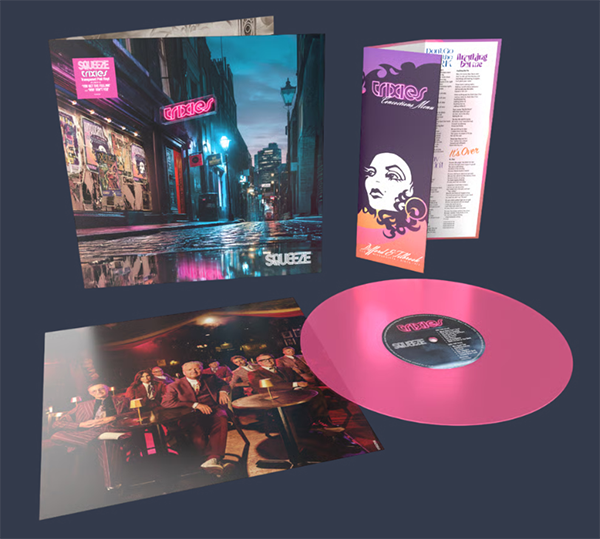
As befits the vibe and overall design concept of the album itself, the Trixies gatefold LP comes in a variety of wax options: 1) standard black vinyl; 2) transparent red vinyl; and 3) transparent pink vinyl (as seen above). The SRP for the first two options of this 1LP set — black and red — is a quite reasonable $29.99 respectively, and they can be ordered from Music Direct here, and/or via the MD link graphic that appears ahead of the tracklisting section below; just click on the option you want. (Or get ’em both!)
If you prefer the pink vinyl — the version I purchased, btw! — you can order that edition directly from Squeeze’s official site store here for a slightly higher SRP of $39.99. For the Squeeze completists amongst us, a deluxe downloadable digital edition that includes track-by-track video dissertations from both Difford and Tilbrook goes for $8.99, and it can be purchased here. Both the 1CD edition and the 2CD/1BD edition, the latter of which includes an Atmos mix, are both sold out at the Squeeze store as of this posting. (Luckily, I preordered my own copy of the 2CD/1BD edition, and have been quite enjoying the clublike atmosphere of the Atmos tracks that were mixed by Bob Clearmountain and mastered by Matt Colton.)

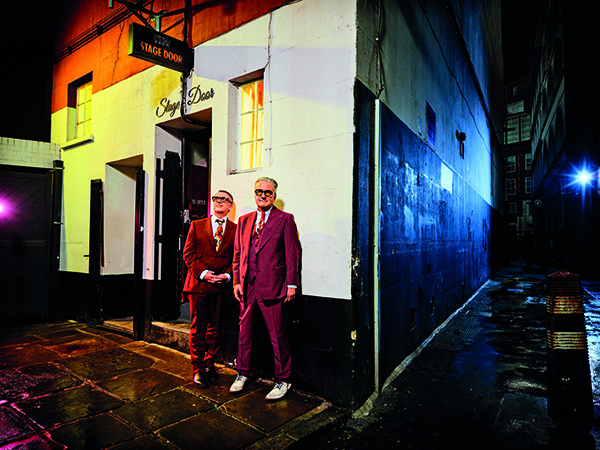
From the clever wink/nudge observations by Tilbrook (above right, flanking Difford at the bar) on the come-hither call of “The Jaguars” (Side Two, Track 4) to the narrative growl of Difford’s “The Dancer” — replete with ghost organ, Mellotron, and delay-treated Moog accents (Side One, Track 4) — not to mention the patented high/low D&T vocal blending on the choruses to “Good Riddance” (Side One, Track 5) and the two-part title track treatise that ends the story and the LP proper (Side Two, Tracks 5-6), Trixies finds Squeeze at the top of their current game. My pink LP was flat and well-centered, and I only detected a few stray pops and clicks in the runout grooves. My ratings reflect Squeeze’s 2026 acumen — and thus, the Music of Trixies gets a 9.5. The Sound is also quite fab, so I give it an 8.5.
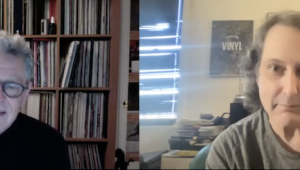
In one of my upcoming Sound Chaser columns that will appear over on our sister site Stereophile, Tilbrook and I talked about the origins of the 1974 demo tape in question, how composing on piano is different than composing on guitar, and which vintage Squeeze track he still enjoys listening to for what it is. (Once that post goes live, I’ll add a direct link to it here.) In addition to those topics, Tilbrook, 68, and I discussed a number of additional, analog-related things that do not appear in that story whatsoever, so I share them with you here now. During our recent Zoom interview across the Pond, Tilbrook and I discussed why he’s always loved vinyl, the art of sequencing, and how two of Squeeze’s most classic songs came together. It’s oh so instrumental / I don’t have to sing another line. . .
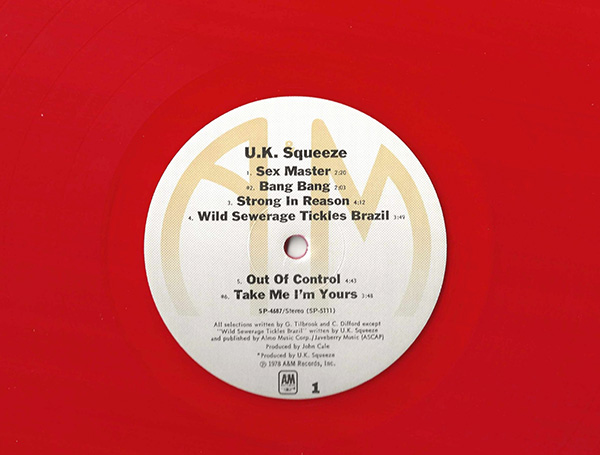
Mike Mettler: Before we get into Trixies, I have to ask you about the red vinyl version of the U.K. Squeeze LP (1978; A&M SP-4687). How did that come about? Did you guys have any involvement in that decision?
Glenn Tilbrook: That was up to the record company, and it was a very “in” thing to do at that time. It would give you a little “in” to people, you know? That’s what they do. It’s a bit like now! (chuckles)
Mettler: Right, and with Trixies, we have three color vinyl variants. I ordered the pink version, and I really like the vibe of that one since it matches the album’s color scheme. Did you make the variant color choices yourselves, or did the label suggest them?
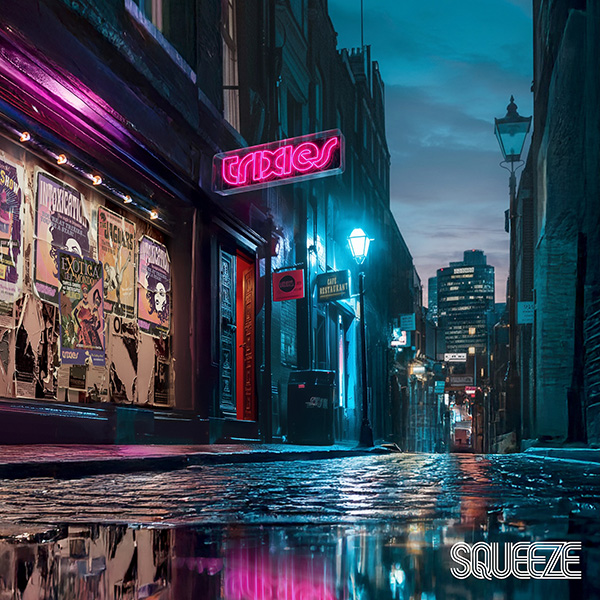
Tilbrook: That part’s almost all to do with the record company. I mean, we’ve been very involved with the cover. What we did was very stylized — and that’s not a word you would normally associate with Squeeze, for one thing. But it’s good for us to move into that area and take ourselves seriously. Trixies is a serious record. It has all the good points of being really accessible and listenable — but it’s a serious record, and we’re really proud of it.
Mettler: And it’s on some pretty serious vinyl too.
Tilbrook: (laughs) Yes it is. It’s lovely that vinyl’s not gone away and has instead had the resurgence that it has, because it occupies a different area of the brain. Anything that requires a dedicated thought to go and do that — whether it’s to put on an album, read a book, or make a recipe — rather than it be an accessory to other things that you’re doing, I think that’s a fundamental change. That’s what makes vinyl so effective, because it’s never gonna accidentally play itself. You always have to make it happen.
Mettler: Good point — and I know you still play vinyl for pleasure, and not just put records on for critical listening. Do you still have those early records you bought as a kid in your collection?
Tilbrook: Yes. I never got rid of my vinyl.
Mettler: What was the first one that you either got or bought where you felt, “This is my record. This is my thing”?
Tilbrook: Well, it was The Monkees, “Last Train to Clarksville.” I was totally the ideal age for The Monkees — and that’s why I can never be against “manufactured” music, if you have good people doing it. There’s one side of me that goes, “I should think it’s evil to grasp into kids’ pockets to get their money out.” (chuckles) But there’s another part of it, which is, “Well, if it isn’t any good, it will never work.” You’ve got people who are very skillful to do that who may be way older than their target audience — but Boyce and Hart knew what they were doing. (Footnote 1)
The sound of the “Clarksville” record is great, and I have to say, I also love what The Monkees went on to do themselves when they began writing their own material — particularly between [Michael] Nesmith and [Micky] Dolenz, who were both great writers, I think. They did a lot of stuff that really impacted me — and still does. It’s still part of my DNA.
Mettler: Something else that is part of your DNA is good sequencing. If I have it right, the original sequencing you had for Trixies got changed around a bit by someone else involved with the project.
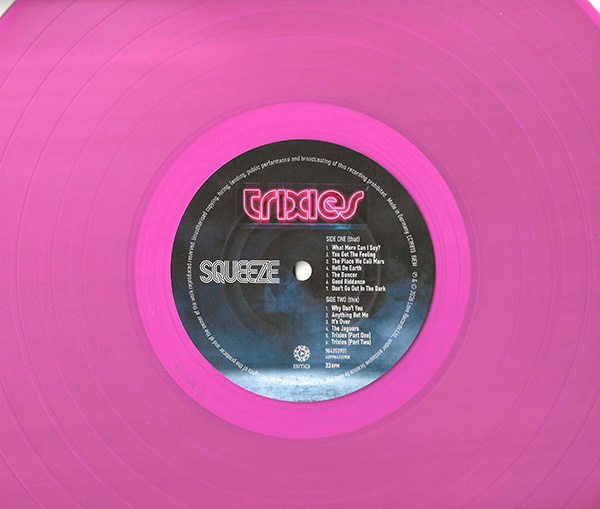
Tilbrook: It was Owen [Biddle], who did the majority of the production [and is also Squeeze’s bassist]. I did little bits and pieces, but at the end of it, Owen’s voice is so important to what we’ve done. It was his running order. At first, we were stymied by having “Trixies (Part One)” and “Trixies (Part One)” as Song 1 and Song 2. They’re not good openers, you know? Particularly, “Part One” is not a good opener. It was like, “Don’t do that.” So, to have it at the end [of Side Two] makes perfect sense, it being there. You’ve been through all that story.
Mettler: Yeah, I agree. Both parts work as good postscripts to the overall Trixies story. It’s like having the narrator come in and tell us, “Here’s what you just heard about, and here’s the bow on the whole thing.” It works much better that way, I think.
Tilbrook: (chuckles) Yes, very good. Thank you.
Mettler: Let’s talk about your guitar playing, which I feel is somewhat underrated. On “Don’t Go Out in the Dark” (Side One, Track 7), that’s you giving us that killer riff there, right?
Tilbrook: Oh yeah! Oh yeah. I like that one. And, obviously, “Let Me Roll It” was a big influence on that. (chuckles) (Footnote 2) I think that’s the only song on Trixies that was musically changed from what it was. We recorded it the way that it had been written. And, to be honest — can I just get a guitar for you?
Mettler: Yeah, please do.
Tilbrook: (picks up guitar) It was the least sophisticated song out of all of them. We recorded it like this (sings the opening lines to “Dark” while playing basic chords): “A taxi drew up at the Chelsea mews / In the cruel and wintry fo-o-og / All I could see were her lurex shoes.” Pretty dull. After we’d recorded it, I thought, “Why don’t I just change all the chords underneath it?” We kept the vocal tune, and the chords were much, much more interesting.
That’s the only Trixies song we did like that. It had to be helped. Sometimes, I thought I knew what I was getting at then [when we did the original demos], but it was just very unsophisticated — too unsophisticated. It would drive me nuts to listen to that. But the way that the song is now is actually true to the spirit of it, but not what we actually did with it then.
Mettler: “Dark” is one of my favorite tunes on the album. On another guitar note — I know you’re not classically trained, but I still have to say that the guitar solo on “Another Nail in My Heart” [from February 1980’s Argybargy] is still a classic to me. The placement of where it is in the song is quite interesting. It just felt like, “Yeah, this has to be where it is.” It just makes sense. It fits there.
Tilbrook: Yeah, and it’s an odd arrangement. There were two verses and two choruses, so it was like, “Well, why not? Let’s have a solo there.”
As a guitarist, I’ve been constructing solos going back to the [April 1979] Cool for Cats album, for the song “It’s So Dirty” (Side One, Track 5). That’s my first constructed solo. I began to think that that was a way for me, because I’m not a good enough guitarist to actually come out with absolute brilliance for every take. (chuckles) It’s quite a lot of the times not brilliant at all. But I could improvise and pick out bits for John Wood, who we worked with. [Wood was the producer on Cats and the album that followed it, the aforementioned Argybargy.] I was very taken with Amos Garrett, who was with Maria Muldaur and Geoff Muldaur, and his solos. (Footnote 3) John Wood had worked with Amos Garrett, and I was so impressed by that. I said, “Oh, I bet he didn’t drop in” [i.e., comp his solos, rather than do them in one take]. And John Wood said, “Actually, he dropped in a lot,” during the time he had worked with him.
That was my key to freedom. I could come up with two bars, and then construct whatever I was gonna do next. So, “Another Nail” took like four hours or something to work it out. But I knew I could learn it — and I also knew that, “That will be the solo.” I would never do anything different, and I’m happy with that.
Mettler: It’s etched in stone. Another song of yours I’m thinking of is “Black Coffee in Bed” [from April 1982’s Sweets From a Stranger] and its original, “slower” tempo. I think you’ve long since said, “Why should we keep doing it that way,” so you’ve adapted it to a different pace when you play it live, because certain songs evolve over time. The studio recording is the first stamp on it, and then you’ve taken it and modified it for when you bring it out to the world nowadays.
Tilbrook: Yeah, and you know what? On “Black Coffee,” we did a version with [producer] Gus Dudgeon before the one that appears on the album. Gus Dudgeon edited about five different takes of it together — and it was perfect. And I think I said, “No, it’s not us! We can do it better than that.” But we didn’t. I came across that tape two or three years ago, and I put up the Gus Dudgeon version. It’s about 10 times better than the record. It really is.
Mettler: Ahhh, I’d love to hear that! So, is it time for a Squeeze box set, Glenn? Can we get a big vinyl box set with all those alternate takes? It could be another version of Sp0t the Difference, so to speak. (Footnote 4)
Tilbrook: Well, I used to take home reel-to-reel tapes from the studio, so I can lift it. I have an extensive collection of roughs from all the stuff we’ve done. I’ve kept all that, and I’ve also transferred a lot of my demos into Pro Tools. But I need to get all that other stuff transferred to save it.
I used to love the sound of my TEAC 4-track and the internal compression of recording on tape, until I got [Alesis] ADAT recorders. Before all that I had a Revox — but the first thing I bought when I got my first royalty check was the TEAC 4-track, which was like a luxury.
Mettler: This all reminds me that I still have to get my Akai reel-to-reel cleaned to get up and running again. But anyway — the last thing before we roll is, since Trixies was born from something that you made 50-odd years ago, I wanna jump us ahead 50 years into the future, where we’re gonna be in 2076. And, as I like to say, unless there’s some weird science going on, you and I may not physically be on the planet then. (both laugh) So, however people are listening to music all those years from now and they type in “Squeeze” or “Glenn Tilbrook” into a listening device, what kind of experience do you want that future listener to get from your life’s work? No pressure now, Glenn. (chuckles)
Tilbrook: No, absolutely none. (laughs) I love the question, but I don’t even know where to start with that, or where to finish. (slight pause) I’m sorry that my answer is not up to it.
Mettler: Well, let me give you a springboard. A lot of people will say something like they just want people in the future to get some level of enjoyment out of hearing their music — that it will give them a special kind of experience. Does that help?
Tilbrook: Oh, okay. Alright. I hope that our music represents its time. There was a time that I wasn’t interested in listening to the music that was made before I was born, but I’ve been lucky enough to be able to go back there and realign what I think of things from that time period before me. So, if you’re lucky enough to do that — to be able to represent the time you’re living in with your music — then that’s a great thing.

Author bio: Mike Mettler is the editor of Analog Planet in addition to being the Sound Chaser columnist and contributing music editor to one of our other sister sites, Stereophile, in addition to being the regular Vinyl Icons column scribe (and occasional Opinion columnist) for Hi-Fi News and author of numerous box set liner notes. Plus, he’s quite partial to vintage 1967 Mustang fastbacks, but that’s yet another story for a different time and place.
Footnote 1: Boyce and Hart are the notable ’60s songwriting duo Tommy Boyce and Bobby Hart. The Monkees’ version of their song “Last Train to Clarksville” was released as a single on August 16, 1966, on Colgems, and it reached No. 1 on the U.S. Billboard 100 singles chart, and No. 23 on the UK singles chart.
Footnote 2: “Let Me Roll It” is one of my personal favorite songs on Paul McCartney and Wings’ November 1973 album on Apple, Band on the Run — and it’s clearly one of Glenn’s favorites too!
Footnote 3: See especially Amos Garrett’s guitar solo on Maria Muldaur’s 1974 single on Reprise, “Midnight at the Oasis,” which reached No. 6 on the Billboard 100 singles chart.
Footnote 4: Squeeze’s Spot the Difference album was released on the XOXO label in August 2010, and it consists of completely new recordings of 14 vintage/classic tracks from the band’s catalog. It’s a fun exercise trying to do what the album title suggests!
SQUEEZE
TRIXIES
1LP (Love/BMG)
Side One
1. What More Can I Say?
2. You Get The Feeling
3. The Place We Call Mars
4. Hell On Earth
5. The Dancer
6. Good Riddance
7. Don't Go Out In The Dark
Side Two
1. Why Don’t You
2. Anything But Me
3. It’s Over
4. The Jaguars
5. Trixies (Part One)
6. Trixies (Part Two)












 |
Equipment Reviews | |
The Gruvy Awards | |
Blogs Analog Tips | Columns Music | |
Show Reports | |
News Resources |
 © 2026 AnalogPlanet
AVTech Media Americas Inc.
All rights reserved