


Intervention Records Does It Again With 180g 45rpm Mono 1LP Upgrade of Johnny Cash’s Classic 1957 Debut Album, With His Hot and Blue Guitar

He kept his eyes open all the time, and he also shot a man in Reno just to watch him die (or so he said). Of course, I’m talking about the one and only Johnny Cash, whose 1957 debut album on Sun Records, With His Hot and Blue Guitar, has just received a 180g 45rpm all-analog 1LP upgrade from Intervention Records.
The Intervention edition of With His Hot and Blue Guitar was released just a few short weeks back on February 20, 2026, and, per the label’s meticulously established M.O., it was sourced from flat transfers of ¼-inch monaural master reels culled from the Sun Records archive, which compiled the label’s original 7in single masters. Intervention’s head honcho Shane Buettner oversaw the entire process in order to ensure that this release is, quote, “the first vinyl edition of the album to be sourced from these tapes in decades.”
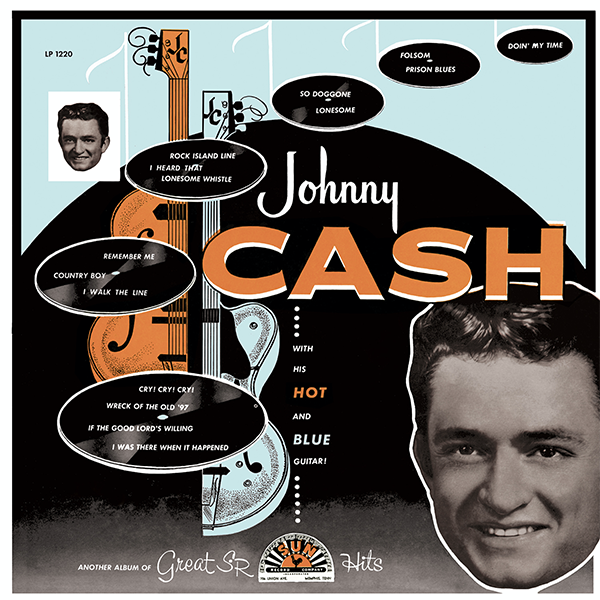
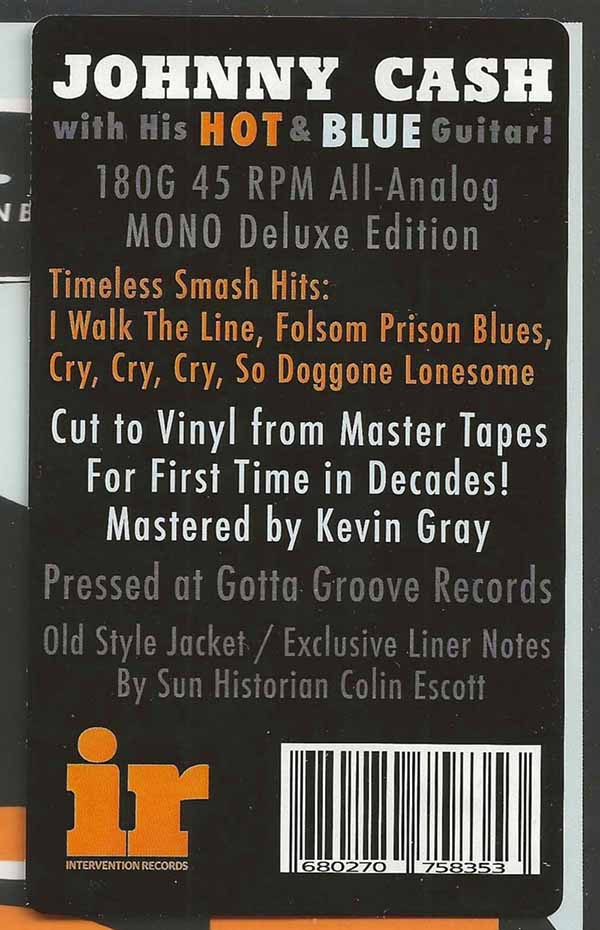
Mastering engineer Kevin Gray at CoHEARent Audio oversaw the pressing. The lacquers were plated using RTI’s three-step process and pressed on ultra-quiet 180g vinyl at 45rpm by boutique pressing plant Gotta Groove Records. The LP’s beautifully restored old-style jacket, which was manufactured by Stoughton Printing Co., features a two-sided insert with a new essay by noted Sun Records historian and two-time Grammy Award winner Colin Escott.
Intervention’s With His Hot and Blue Guitar LP sports an SRP of $43, and it can be ordered directly via the label’s official site store here. (Music Direct is also offering this LP here for $45.99, but, as of this posting, they are currently out of stock. That said, you can ask to be notified when MD have more copies available to order.)
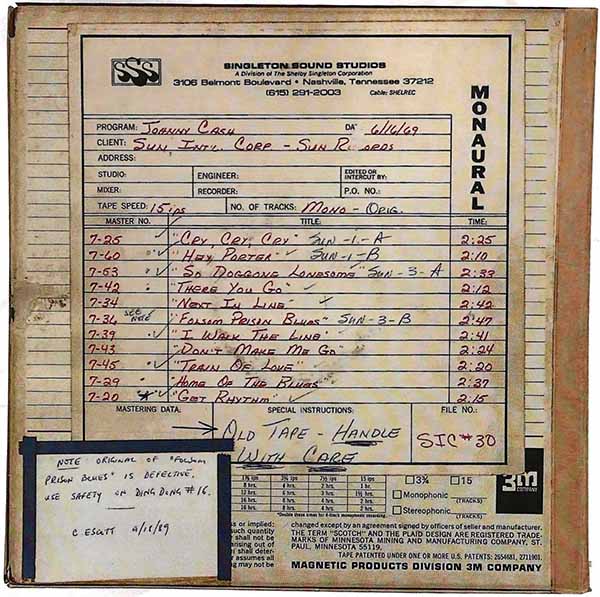
I reached out to Buettner directly to get more firsthand details about how Intervention’s With His Hot and Blue Guitar LP came together, starting with the source material. “On tape sourcing, there was a triumvirate: Me for IR, Chase Gregory for Sun Records, and Kelly Pribble’s team at Iron Mountain, where the tapes are stored,” he told me. “Chase and Sun had identified the best reels for each song, and they sent me images of the tape boxes and gave me access to raw 24-bit/192kHz WAV files of every tape. I listened on headphones, and agreed on almost every track as to what the best source was — but where I felt one source sounded better, we used that. Kelly, who apparently is no longer at Iron Mountain, and the team there then took that direction, and made the new A/B master tapes directly from the original 7in master reels.”
I then asked Buettner to elaborate on the “3-step” RTI process. He replied, “The shortest version is that Kevin Gray, myself, and many others unequivocally believe that a full 3-step plating and processing delivers the best sound, period. Better than 1-step, as counterintuitive as that is.”
Did Buettner find anything to QC when he listened back to the test pressings (i.e., the TPs)? “Regarding the TPs, here is the most important part: I attend every single mastering session, and Kevin Gray and I make sure we have it nailed every single time,” he continued. “In my humble opinion, if you’re not doing that, that’s how you end up taking 6-7 cuts at it. I view that as a bug, not a feature. I’m small, and I can’t afford it!” Besides that, Buettner confirmed, “I’ve only rejected 1-2 sides for sonic reasons over the entire 10+ years I’ve been doing this — so when I get TPs, it’s mostly to make sure we have quiet metal parts that will make quiet records.”
One other important thing Buettner wanted to point out: “I can also say that Kevin and I cut Carl Perkins and Johnny Cash over two days back-to-back, and we’ve never just sat there grinning at each other the way we did! The tapes were just mind-blowing, and such a piece of history.” (More on the Carl Perkins record he references in a bit.)
Buettner concluded his comments with this postscript of sorts: “Kevin also did something he’s never done in all our time together — he invited guitarist Deke Dickerson over just to listen with us, and Deke turned out to be a Sun Records savant and told me how to do the center labels authentically! The Sun labels with the rooster were only for singles, not LPs, so thanks, Deke!” (In case you don’t know, Dickerson is a modern rockabilly guitar maestro in his own right.)
My copy of the With His Hot and Blue Guitar LP was perfectly flat, deep black, and well-centered. The audiophile-grade plastic-lined inner sleeve from Gotta Groove did its protection job as expected, as there were no artifacts on either side of the LP upon my initial removal of it from said sleeve (though I, of course, cleaned both sides anyway before dropping the needle on them).
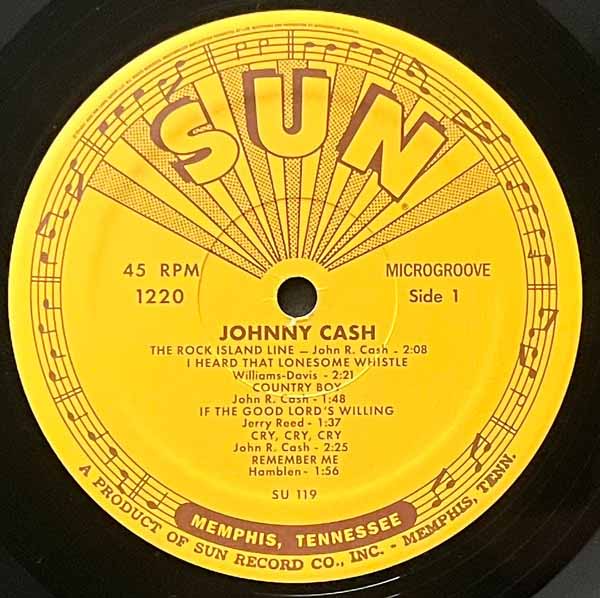
Ratingswise, it’s a pretty simple equation. The Music on With His Hot and Blue Guitar is an unabashed 11, and the Sound on the Intervention LP warrants a 10.5. This music set the tone for Johnny Cash’s career on vinyl, and each side — which respectively come in around 13(ish) minutes apiece — breathe just as they should at 45rpm. I love the clarity of Cash’s inflection on the word “line” in his opening narration on “The Rock Island Line” (Side 1, Track 1), and how the volume ratchets up a bit when the Man in Black choogles the pace up a notch during the “pickin’ up a little bit of steam” sequence (and his own acoustic guitar strumming rings clear as a bell while he does just that), not to mention how he speeds up his own diction to a frenzied pace as the track closes. A master storyteller in his prime, captured perfectly.
Marshall Grant’s double bass is supple and full on “Cry, Cry, Cry” (Side 1, Track 5), especially when Luther Perkins takes his electric guitar solo. Grant and Perkins, a.k.a. “The Tennessee Two,” are among the finest accompanists of Cash’s career — and you can hear exactly why that is on this LP.
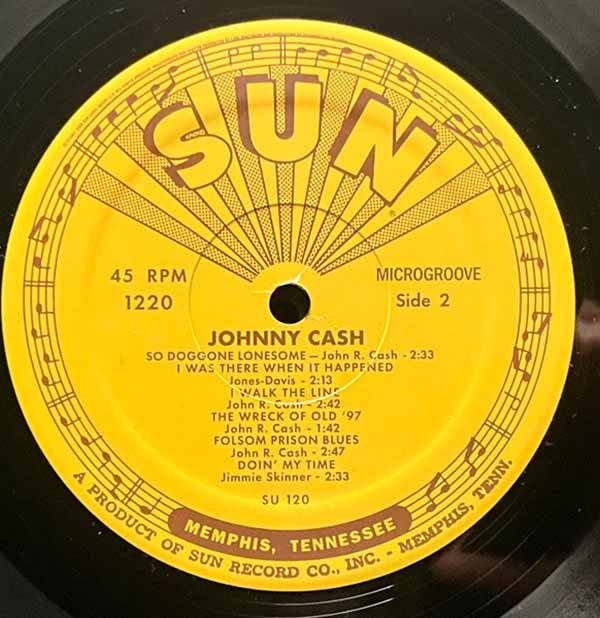
Over on Side 2, “I Walk the Line” (Track 3) and “Folsom Prison Blues” (Track 5) are both as thrilling and harrowing as you expect and want them to be. The shuffling push/pull backdrop of “Line” is an exercise in restraint but clear-eyed intent, while “Folsom” moves at its own train-pace, with the almost jaunty nature of Cash’s vocal delivery lending additional, yet subtly sinister undercurrents to deep-rooted lines like, “and that’s what tortures me.” Meanwhile, Sun producer/impresario Sam Phillips’ patented studio slapback is out in full force all throughout this stunning LP, enhancing all it touches.
Finally, I should note that Johnny Cash’s With His Hot and Blue Guitar is the second title in Intervention’s Sun Records Hi-Fi Series, following the debut release in the series (and Sun’s second-ever LP release), 1957’s Dance Album of Carl Perkins. I covered that crucial Perkins LP here on AP in this column back on October 29, 2025, and given how unabashedly great both of these Intervention LPs are, I can’t wait to hear what comes next.

Author bio: Mike Mettler is the editor of Analog Planet in addition to being the Sound Chaser columnist and contributing music editor to one of our other sister sites, Stereophile, in addition to being the regular Vinyl Icons column scribe (and occasional Opinion columnist) for Hi-Fi News and author of numerous box set liner notes. Plus, he’s quite partial to vintage 1967 Mustang fastbacks, but that’s yet another story for a different time and place.
JOHNNY CASH
WITH HIS HOT AND BLUE GUITAR
180g 45rpm1LP (Sun/Intervention)
Side 1
1. The Rock Island Line
2. I Heard That Lonesome Whistle
3. Country Boy
4. If The Good Lord’s Willing
5. Cry, Cry, Cry
6. Remember Me
Side 2
1. So Doggone Lonesome
2. I Was There When It Happened
3. I Walk The Line
4. The Wreck Of The Old ’97
5. Folsom Prison Blues
6. Doin’ My Time
















 |
Equipment Reviews | |
The Gruvy Awards | |
Blogs Analog Tips | Columns Music | |
Show Reports | |
News Resources |
 © 2026 AnalogPlanet
AVTech Media Americas Inc.
All rights reserved