


Mobile Fidelity’s 180g 45rpm 2LP Van Halen Reissue Series Has Been a Master Class in How to Present Ultradisc One-Step Original Master Recordings on Vinyl

Mobile Fidelity have been on quite a tear of late. If you received the annual Music Direct catalog in your mailbox in recent weeks (it’s edition No. 26, for those keeping count), you know exactly what I’m talking about. Just turn to the top quarter of page 126, where the company lays out its gameplan: “MoFi operates its own mastering studio with proprietary equipment than allows its engineers to execute the cutting process in-house and ensure that no artifacts are added to the final product: [resulting in] the best-sounding vinyl LPs and SACDs available.” The SACDs are indeed a story unto themselves for a digital-centric cite to discuss rather than us, but AP can readily say that their vinyl more than lives up to its billing.

In recent years, MoFi had to take care of some admittedly uncomfortable business before doubling down on becoming as transparent as possible about how they do what they do, and they have since re-emerged stronger than ever — and with better playback results too, to these ears. Their regularly released slate of Original Master Recordings LPs (a.k.a. OMRs) is but the tip of the proof spear. I’ve been more than impressed with how they’ve handled current OMRs such as those for Fleetwood Mac’s 1982 comeback LP Mirage and 1987’s benchmark Tango in the Night, not to mention multiple OMR titles from the likes of Miles Davis (ahh, the ongoing wonders of Bitches Brew), Joni Mitchell (Hejira, most especially), and Michael Jackson (Thriller was indeed worth the wait) — but it’s their signature Ultradisc One-Step 180g 45rpm 2LP OMR Van Halen reissue series that has caught the fancy of my ear the most of late.

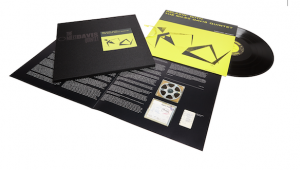
Between December 2023 and October 2025, VH’s first five LPs on Warner Bros. with David Lee Roth behind the mike — February 1978’s Van Halen, March 1979’s Van Halen II, March 1980’s Women and Children First, April 1981’s Fair Warning, and April 1982’s Diver Down — have all gotten the One-Step (a.k.a. UD1S) treatment. (More on that process in a bit.) The band’s final LP with Diamond Dave, January 1984’s megaplatinum height-of-MTV triumph known as 1984 (shown above), will be released in early 2026.
Will MoFi also get to do the Sammy Hagar-era VH LPs someday as well? “I wish we could put out everything,” MoFi President Jim Davis admitted to me with a laugh during an exclusive interview we conducted together in one of the company’s private listening rooms at AXPONA back in April 2025. No word on the Sammy stuff yet, alas, but the first six VH LPs are most certainly a jewel in the MoFi crown. “We’d been asking for the Van Halen catalog for years but kept getting told, ‘Not available, not available’ — and then, all of a sudden, it’s available,” Davis continued. “The process can be very frustrating — and also very time-consuming — when it comes to artists we’ve worked on getting for years. It can take a long, long time to push it across the finish line. Sometimes, it’s just a matter of convincing the artists and their management that these are worthwhile projects. Eventually, they buy into it and think it’s a good thing, because we take what is already great art and we make it better.”

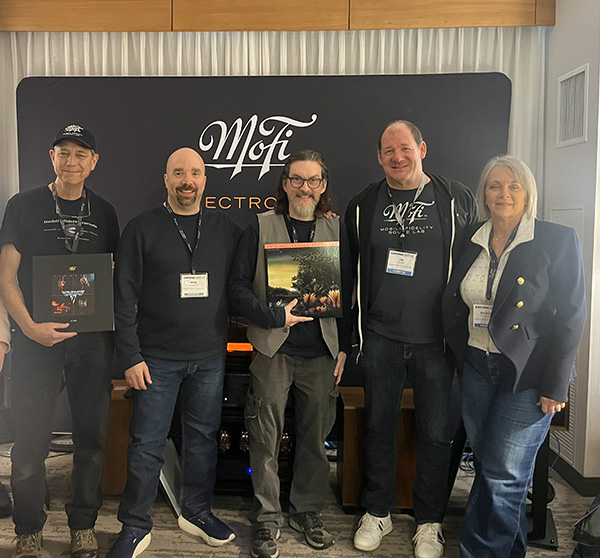
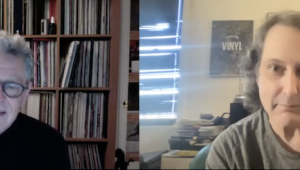
In addition to Davis (seen above), MoFi mastering engineers Rob LoVerde and Shawn R. Britton (the latter of whom recently retired after a long, storied career) were also part of that deep-dive 2-hour conversation at AXPONA, and the more VH-specific portions of our discussion will appear a few paragraphs below.
And thus, before we get on down into that Q&A section, here’s what you need to know from the tech side of things. Each UD1S in the VH series is sourced from the original master tapes and has been mastered by Krieg Wunderlich at MoFi’s Sebastopol, California, facilities, and then they get duly pressed on 180g MoFi SuperVinyl. The step-for-step One-Step process is as follows: the original quarter-inch (¼") analog masters — which are at 30ips for VHI, Women, Fair, and 1984, and 15ips for VHII and Diver — go to DSD 256 to analog console to lathe. Digital decriers can frankly put their aural handwringing aside here, because the needle-drop results are impeccable.
Each 2LP set in the VH UD1S series sports an SRP of $125 (their standard going rate, in case you don’t know), and they can all be ordered directly (pun intended) from Music Direct here, and/or via the MD graphic that appears at the end of this story. 1984 is still a preorder as of this posting, of course, but the other five VH UD1S entries can be ordered now, and they should arrive in time for holiday and/or New Year’s gifting.
Finally, do also note that each VH UD1S entry is a limited numbered edition. VHI is capped at 12,000 copies, while VHII, Women, Diver, and 1984 all round out at 7,500 copies apiece. For whatever reason, Fair has been capped at 5,000 (and it’s my personal favorite VH LP, truth be told).
Each of the 10 UD1S OMR VH LPs I put on my turntable (two discs per album, remember) was well-centered, deep black, perfectly flat, and sans pops and clicks. I’m appreciative that MoFi decided to slim down the width of their OMR-related releases this year to half the width of the company’s previous full-on box-set width. Each LP came in its own audiophile-grade plastic MoFi Original Master Sleeve adorned in folded white cardboard, though sometimes it was a mini-wrestling match to get those snug LPs out of the main LP sleeve. More than once, I had to flip them over with the back cover facing me so that I could remove them from the left side rather than the right. Ultimately no harm; I just had to be patient during the removal process. I’m also pleased a four-sided one-sheet featuring replicated original album art and related info is also include with each release.
I’ve spent the balance of the last year (on and off, of course!) listening to each VH UD1S LP as they’ve arrived, and I’ve also compared them to my original Warner Bros. LPs (and some of their subsequent reissues), and it’s pretty much been no contest. To go song-by-song would take a screed as massive as any balls-out EVH lead riff, but for now, I’ll cover a number of favorite tracks from each LP. Nobody rules these streets at night but me. . .

Van Halen I: Technically, the “I” is implied, since this is really “only” a self-titled LP, but I digress. Guitar maestro Edward Van Halen’s signature moment of arrival — all 102 seconds of the still jaw-dropping “Eruption” (LP One, Side One, Track 2) — tells you all you need to know about why the UD1S process works. You can practically see EVH’s two-handed tapping technique in action as each note and/or triad flies on by, and those added dollops of studio reverb (courtesy the Sunset Sound reverb room) are but icing on the cake. And speaking of icing, the tongue-out-of-cheek (yes, you read that right) take on John Brim’s “Ice Cream Man” (LP Two, Side Four, Track 2) walks the fine line between subtle (the acoustified lounge-lizard intro, a perfect blend of DLR’s scat-blues vocals along with his own acoustic guitar lines) and sledgehammer (the more metallic thrust of the second half, with EVH blazing away in the right channel). Guaranteed to satis-MoFi, says I.

Van Halen II: The hit track “Dance the Night Away” (LP One, Side One, Track 2) has as crisp and clean of a cowbell intro from Alex Van Halen as you’ll ever hear, and also listen for how DLR adds his signature yelp in the middle of the word “across” as he simultaneously laughs through the next two words, “the room.” The underrated two-man vocal harmonies on the title phrase — courtesy bassist Michael Anthony and EVH — are rich and fully present too. “Spanish Fly” (LP Two, Side Three, Track 2) is the classical guitar counterpoint to “Eruption” — not as tap-tastic as its predecessor, but yet another example of EVH’s fretboard dexterity, no matter the instrument he chooses.

Women and Children First: “And the Cradle Will Rock. . .” (LP One, Side One, Track 1) opens with a snarling riff in the right channel as fierce as Alex Lifeson’s calisthenic opening to Rush’s “The Spirit of Radio,” and it’s nicely countered by another EVH riffola in the left channel. A few lines later, the volume level dips and the band drops back to let Eddie’s dreamy chords hang in the air, center stage, before DLR sneers, “Have you seen junior’s grades?” — and then the second solo, along with full band accompaniment, takes over full-bore. The next track, “Everybody Wants Some!!” (LP One, Side One, Track 2), begins with Alex’s wide-panned jungle-beat showcase, buttressed by his brother’s bleating guitar lines (and Dave’s verbal snarls too, of course). DLR’s slyly self-aware, “little more to the right” narrative break foreshadows a later album’s “ease the seat back” section. “Take Your Whiskey Home” (LP Two, Side Three, Track 1) swings and drips a nod to that “Ice Cream Man” vibe, with Dave briefly going Billy Gibbons-guttural, and then prime VH bombast roams the rest of the track. I think that you’re headed for a whole lotta trouble, indeed.

Fair Warning: Why this album is underrated remains a mystery to me (though perhaps it was due to there being a lack of a lead FM hit track out of the box), but I love it to pieces all the same. “Dirty Movies” (LP One, Side One, Track 2; double quotes around the song title are implied, since they look weird typed out that way!) unfurls like smoke slowly wafting from a dangling cigarette, with the Ed/Al guitar/drum axis using their shared DNA to open the track at their own pace. The slower, harmony-vocal-driven choruses keep the tempo in check — an exercise in brotherly restraint, even as DLR continues to do his own thing around them. The funkified “Push Comes to Shove” (LP Two, Side Three, Track 2) gives Michael Anthony his low-end highlight reel. (It’s also a track I saw Dweezil Zappa cover with much aplomb on his ROX(POSTROPH)Y Tour in Buffalo earlier this year.) Meanwhile, the song before it — the notorious, flanger-fied “Unchained” (LP Two, Side Three, Track 1) — blazes across the soundstage with force, and it’s another prime “Dave being Dave” track, replete with producer Ted Templeman’s punched-in rebuke from the control room during the interlude. One-Step, comin’ up. . .

Diver Down: VH were kinda running out of gas on this one with five covers in tow, all told (foretelling DLR’s January 1985 EP Crazy From the Heat, mayhap?), but it still has some merits. I do love the soundstage-wide synthy and scraping guitar “Intruder” intro (LP One, Side Two, Track 2) that precedes a relatively straightforward take on Roy Orbison’s “Oh! Pretty Woman” (LP One, Side Two, Track 3), but the 83-second instrumental “Cathedral” (LP One, Side One, Track 3) is perhaps the most intriguing cut here, thanks to its cascading guitar lines — but then again, we also have “Little Guitars” (LP Two, Side Three, Tracks 2-3), which is pure flamenco-a-go-go from the get-go.
My ratings are as follows: Overall, the Music in the VH UD1S series rates 10.5 (and one went to 11), while the Sound also gets a 10.5 (ditto). Since your wallet and/or holiday budget may not be able to afford the first five entries in this series all at once, here are my album-by-album ratings, just in case it’ll help with prioritizing your choices. VHI: Music: 11; Sound 11. / VHII: Music: 10.5; Sound 10.5. / Women: Music: 10.5; Sound 10.5. / Fair: Music: 10.5; Sound 10.5. / Diver: Music: 8; Sound 10.
With those ten-side UD1S VH LP divers now officially downed, let’s now get on down into the MoFi crew discussion. Let’s hit the ground running. . .

Mike Mettler: Let’s start with Van Halen I. What source material did you get to work with here? Did you get the actual tapes from the vault?
Shawn R. Britton: We met a guy behind a warehouse with a bag of cash. (laughter all around) No, I’m kidding. We worked closely with Warner’s media vault. And, like Jim said, it took us quite some time to get access to the OMRs — original master recordings. Warner has a procedure where they digitize everything before they send us the analog tape because they want to make sure they have it captured, just in case something happens. But they also know that Mobile Fidelity has a reputation for restoring tapes. We’re not just engineers — we’re archivists as well, so the way we take care of the tapes is extremely important.
We work closely with the vault or the media services team; whatever they call it. I’ve been down there, and I’ve seen the racks and racks of tapes. It’s pretty wild. They put lab reports on the tapes — which are very convenient, because they mention things like oxide loss.
Jim Davis: For every tape that comes in, we take images of the tape, and of the tape boxes.
Britton: That’s right. And there are certain courier methods, depending on the artist and the title, as to how we get the tapes back and forth for the handling of the tapes, we actually have μ-metal cans that we had made in the early ’80s for transporting tapes. That’s how the Beatles masters got here [for 1982’s MoFi-released 14LP The Collection box set]. They were hand-couriered. The joke was that he handcuffed himself to the can. (laughter)
Mettler: Let’s get into how you handled Van Halen I, and what you decided to do with it. Let me pick one song out of the air — oh, how about “Eruption”? (more laughter) That song has to sound a very specific way — and it does, because I’ve heard the One-Step version a number of times — but I want to know what you had to do to make sure that it sounds exactly like the way Eddie performed it.
Britton: Well, I worked with Krieg [Wunderlich], the disc mastering engineer who cuts most of our records now. He and I did transfers of the tapes to DSD. That way, we don’t overplay the tapes. When you do a transfer, you take notes, and I do markings as it goes to the workstation so that we know where all the splices are. Then we can go back and listen to each section because when splices go by, you want to make sure that the azimuth is spot-on. That’s the relationship of the tape head, perpendicular to the tape path.
At the head of the tape, there are tones. [looks at Rob] And those tapes — specifically, the Van Halen tapes — are quarter-inch 30ips most of the time, right?
Rob LoVerde: (nods) They varied quite a bit, but that particular one [VHI] was quarter-inch, 30ips, no Dolby. Whereas the followup, Van Halen II, is quarter-inch 15ips, with the Dolby.
Each album is so different. Even though they were all engineered by Donn Landee and those earliest ones were recorded at Sunset Sound [in Hollywood, California], there’s still a distinction between them — kind of like the early Beatles records. Those were all done at EMI Studio 2 by Norman Smith — and yet, when you listen to the first six Beatles records, they all have a different sound signature. Sometimes, I think they were doing that on purpose.
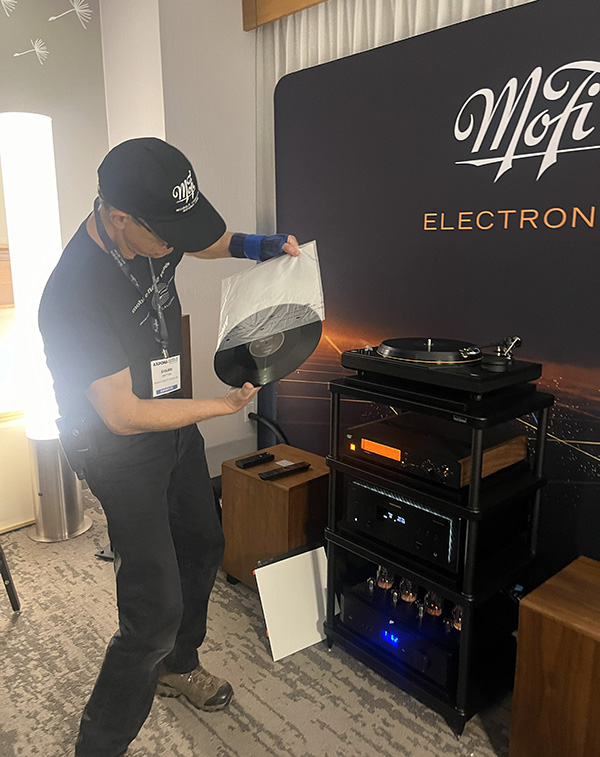
Britton: Right? Anyway, back to Van Halen I, and “Eruption.” When we were doing the transfers, you’d align the tape to the tones per the tones, and you’d align the reproducer amplifiers — the repros. The tones are only a beginning, especially if there are splices in the tape. Let’s say you were recording with Van Halen, and on Tuesday, you like that mix of this section of the song — but then on Wednesday, there’s a superior tail-out, so you splice the two together.
But what if the tape machine is not aligned exactly perfectly? We try to mirror the playback of our Studer [tape] deck to what the original recorder was. When you do that, you get proper phase response. You get exactly what was recorded on the tape — and that’s the beauty of doing these DSD transfers, because a) we’re not scrubbing the tape, and b) we can get it spot-on.
Rob mentioned Dolby. When we’re in the field, we’ll do transfers at other studios, just in case those tapes don’t get sent to us. We don’t decode with Dolby — we just do them raw, and we bring ’em home. That way, you can fiddle with the Dolby. And that’s a technical term, by the way — fiddling with it. Get your fiddly bits! (laughter all around)
Mettler: How many dB are we talking here?
Britton: Two-tenths of a dB. Sometimes, it’s just an incremental bit on the Dolby, and the reverb tails open up. Actually, Krieg is a master at Dolby decoding, so that allows us the luxury of time to get it right. And we want to get it exactly right.
LoVerde: I like the point that Shawn’s making, so I’m going to amplify it. There’s definitely a starting point — and the starting point is to play back the master tape as neutrally as possible. If you don’t start there, you really don’t know what you’re doing. You’re aligning your tape machine to that master tape, because that tells you at least what’s on the tape in an accurate way with your tape machine reproducer. You want to make sure that your level, high frequency, low frequency, and azimuth are all correctly calibrated when you start playing the tape.
End of Part 1. Needless to say, the MoFi UD1S OMR discussion will continue in future installments, so stay tuned!

Author bio: Mike Mettler is the editor of Analog Planet in addition to being the music editor of our sister site Sound & Vision, and he’s also a contributing music editor to one of our other sister sites, Stereophile, in addition to being the regular Vinyl Icons column scribe for Hi-Fi News. Plus, he’s quite partial to vintage 1967 Mustang fastbacks, but that’s yet another story for a different time and place.

















 |
Equipment Reviews | |
The Gruvy Awards | |
Blogs Analog Tips | Columns Music | |
Show Reports | |
News Resources |
 © 2026 AnalogPlanet
AVTech Media Americas Inc.
All rights reserved