


Steve Stevens on All Those Riveting Riffs He Provides for Billy Idol, and Why They Sound Best on Both New and Remastered Vinyl

Steve Stevens isn’t one for sitting still. As you probably know, Stevens is the longtime guitar foil for iconoclast British alt-punk rocker Billy Idol, who collectively, recently wrapped their perfectly named summer jaunt, “It’s a Nice Day to . . . Tour Again!” — and I bet seeing those three ellipses in the middle of that phrase before the final punch/kicker instantly triggered your singing a few key words of the song it fetes, “White Wedding,” in your head upon reading it. (Admit it — you also adopted Idol’s signature sneer while doing so, didn’tcha?)
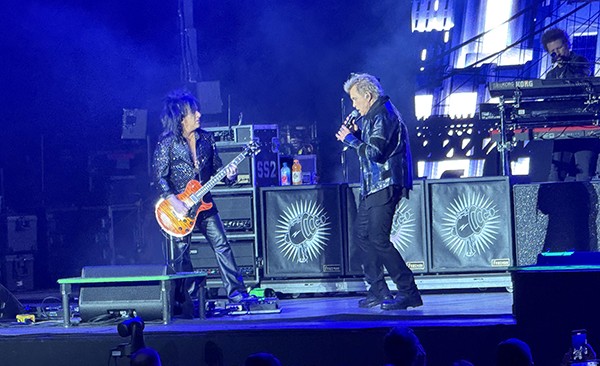
Me, I happened to see their show at Budweiser Stage in Toronto back on May 23, 2025, and it was a riveting display (pun intended, and you’ll soon see why) of exactly how the Idol/Stevens tandem captured the imaginations of the MTV-era/Generation X (pun also intended) members of the crowd and the much younger attendees who knew every word to sing along with and the exact times to fist pump as much as, if not more, than we do.
Not only that, but the ace axeman also had his new Steve Stevens Signature Ascender travel guitars on display and in hand all throughout the night, a line he developed with Ciari Guitars for maximum impact and ease of portability. If you’re also a music- equipment gearhead, you can learn more about them right here. (Stevens is surrounded by them in the photo by Bruno Talledo below.)

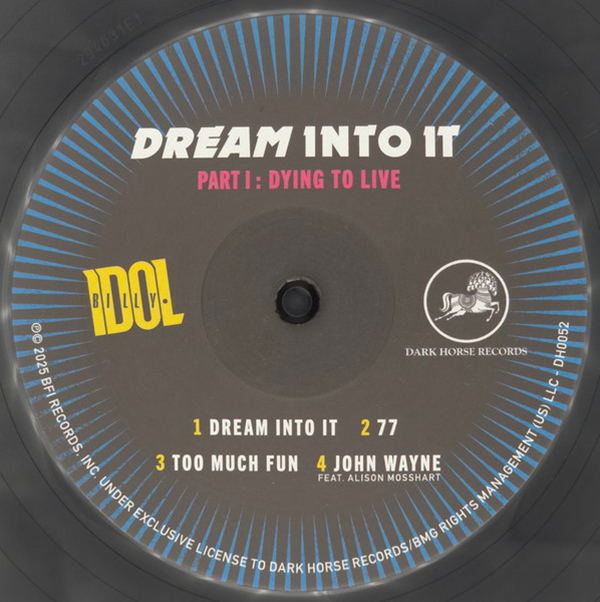
Besides classic Idol tunes galore, the tour’s setlist also featured five songs from Idol’s current LP, Dream Into It, which was released on 180g wax via Dark Horse/BMG back on April 25, 2025. My pristine copy of the It LP was deep black, perfectly centered, and flat — and another reminder of why Idol’s still got that certain “It Factor.” Given the patented snarl of “77” (Side 1, Track 2), the acoustified balladry of “I’m Your Hero” (Side 2, Track 4), and the unabashed staying power M.O. of “Still Dancing” (Side 2, Track 5), I give Dream Into It an 8 for the Music, and 8 for the Sound. The It LP sports a quite reasonable SRP of $27.99, and you can buy it from Music Direct here, or via the MD link graphic that appears at the end of this story, just ahead of the tracklisting section.
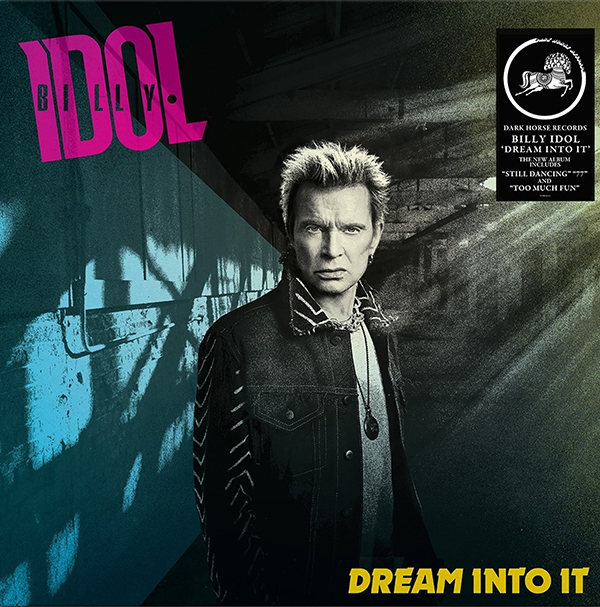
If MD happens to be sold out of the Dream Into It LP whenever you click on the link, you can ask to be notified when it’s restocked, or you can order It directly from Idol’s official webstore for $27 here. Note that there are also some limited-edition versions of It out there on color vinyl — purple, and yellow — as well as some LPs that Idol personally signed on the front cover, but you’ll have to scour Discogs and elsewhere to find those (and likely at somewhat higher prices too, at that).
As Stevens told me exclusively for AP, he and Idol sequenced It specifically for vinyl. “We went through a couple of different running orders, and landed on the one we felt told the story in a great way on vinyl,” Stevens confirmed. “And ‘Still Dancing’ seemed like a great message to end the record with [on Side 2]: We’re still here, and still dancing.” (Start agaaaaain, indeed.)
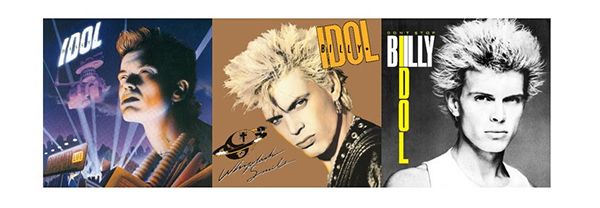
I should add that a trio of classic, vital Idol LPs were reissued over the summer via Chrysalis/Capitol/UMe — namely, a) his October 1981 debut EP Don’t Stop that features Idol’s perennial party-favorite cover of “Mony Mony,” appearing in standard black and lemon yellow options; b) October 1986’s Whiplash Smile, which is available in either standard black or opaque tangerine; and c) 1990’s Charmed Life, the latter of which comes in 2LP form on standard black or turquoise. All three of those color choices are limited editions, and I can duly report all three of them played back just fine on a pair of my turntables (my high-end go-to table and an entry-level model, respectively).
And, in case you’re wondering, Idol’s seminal November 1983 album Rebel Yell was also made available as an expanded 2LP set, in May 2024. All of the standard black editions of those four re-releases can be found either here or here, with the 1LP sets going for $27.98, and the 2LP sets for $32.99, respectively. (The limited editions are harder to find at present — unless you commence some Discogs sleuthing, that is.) Depending on your Idol allegiances, they’re all worth picking up either collectively or in order of your catalog preferences. The Sound ratings retain an 8 across the board, and I’d ratchet the Music rating for Rebel Yell up to a 9, as it is the epitome of ’80s dominance and production/performance prowess.
As much as Stevens is considered to be a guitar hero, he affirmed with me that he only wants to serve the needs of the song at hand, first and foremost. “I think the worst thing for a singer is having a guitar player with their own agenda, you know?” he said with a hearty laugh. “That’s why, after 43 years, we still work together. Billy knows that’s not something that interests me, because I’m there to serve the song.”
On a recent Zoom call during one of their summer tour breaks — and if you missed out on seeing them, not to worry, as I predict they’ll be back on the road in North America in 2026 (and beyond), plus they’re soon enough heading out to perform in South America this November — Stevens, 66, and I discussed why sequencing for vinyl is of utmost importance to both him and Idol, how he got that “bullet blast” during his solo on “Rebel Yell,” and why European progressive rock became one of his key influences. What set you free? / I need you here by me, because. . .
Mike Mettler: I’m glad that you guys made sure to see Dream Into It got onto vinyl proper. Was that something important to both you and Billy?
Steve Stevens: Yeah. We’ve been doing vinyl reissues of the back catalog for a while now, and — I mean, we’re old school. (chuckles)
And actually, with the new record, we were even thinking in terms of Side 1 and Side 2 while we were doing it, so it was definitely appropriate to have a vinyl issue of the record.
Mettler: Did you get to check any Dream Into It test pressings? How did you go about doing the QC on this one?
Stevens: Yep, I do test pressings. And I do test pressings of all of the reissues too, so I had to go out and buy a turntable — a purple one. I wanted a color turntable, and that’s the one I chose. I can’t remember the brand name of it offhand, though, sorry.
Mettler: That’s okay. Good choice on the color, by the way. I have a secondary, entry-level turntable I occasionally use in my playback system that has a red plinth, so I get where you’re coming from with that idea. In your earlier days growing up, do you remember what kind of turntable you had — what you listened to your records on back in the day?
Stevens: I had a Technics turntable back then. I was very jealous of my best friend who had an AR [Acoustic Research] turntable, which was really nice.
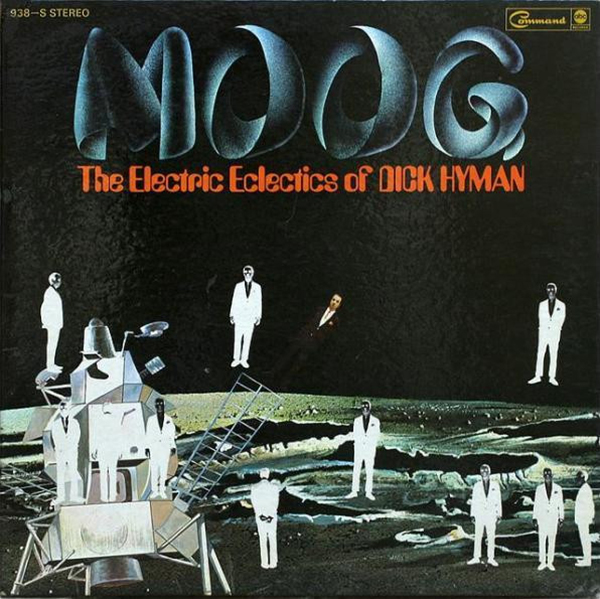
And my dad — he had a fantastic vinyl collection. He was a real audiophile, and he has some really, really good pressings. What was great is that my dad had the first Moog synthesizer record by Dick Hyman [Moog: The Electric Eclectics of Dick Hyman, released on Command in 1969]. I have a brother who’s five years older than me, and he brought home the first [self-titled] Emerson, Lake and Palmer record [released on Island in 1970 in the UK, and on Cotillion in 1971 in the U.S.], and we said, “Dad, here’s that crazy instrument you were playing for us.” And my dad dug it, you know? I mean, of course he couldn’t relate to what they were doing to his prized, classical composition. It was a little bit different, but he still liked hearing the Moog on those records.
Mettler: Did you have a record shop that you went to that was like “the place,” the one that was your place to go look at records and then buy them?
Stevens: It worked out really well, actually. I was born in Brooklyn and raised in Queens — Far Rockaway — and WNEW-FM was my radio station.
Mettler: Oh yeah — with Scott Muni, in the afternoon. I always listened to his show when I worked in New York City.
Stevens: Yeah! Scott Muni had a part of his show called “Things From England” [that would air on Fridays]. Our E.J. Korvette’s department store had a killer record department, and they had a great import section. I’d hear what Scott was playing, and I’d go in there and get it.
I was a Yes fan. They were a band that I really loved, so, early on, I discovered that the first two albums had different covers, right? I was able to get those albums as imports. (Footnote 1) This was the progressive rock era, and there were a lot of good Italian progressive rock bands. I remember I was able to get albums by PFM, and Le Orme. I was all about the European progressive imports.
Mettler: Ahh, now you’re speaking my language! (Stevens laughs) You must have also gotten into progressive bands like Eloy, Goblin, Camel, Caravan, Nektar — all that stuff.
Stevens: Oh my God, yeah! Yeah, I loved all of that. And, you know, it was all part of my — I mean, as a budding guitar player, those were the guys that were really pushing the envelope as far as styles, and I devoured those records.
When I started playing guitar, I was 7½ years old. That was the era of James Taylor, Joni Mitchell, all the folk-rock stuff — and I got a classical guitar teacher. I got an electric guitar when I was 13, and all of those prog-rock guitar players were the guys who were utilizing all these styles that I had learned before — as opposed to an Eric Clapton, who basically plugged in and played, I was able to go, “Oh wow! These guys are using this stuff that I already know in the context of a rock band.” Even Robert Fripp [of King Crimson]. That’s the kind of stuff I really gravitated towards.
Mettler: That’s a heavy load for you to figure out — not only the prog guys, but things like those Joni Mitchell tunings, and stuff like that. Were you trying to decipher that too?
Stevens: I could do the open tuning things, yeah. Things like “Big Yellow Taxi” [from Joni’s April 1970 LP on Reprise, Ladies of the Canyon]. She started to get really out there a little bit later on, and that stuff was a bit above my head.
Mettler: Do you still have any of those records from when you were growing up? Do you still have the originals?
Stevens: I wish I did! I do not, no. But I’ve started collecting vinyl again. Not so much the Yes stuff, although, there was a really good live Tomorrow record I got [possibly Live at the BBC, released in 2025 on 1960s Records]. It’s really good. (Footnote 2)
My most recent vinyl stuff has been the Scott Walker catalog. I’ve fallen in love with him and, well, I got all those reissues. Scott 3 is a fantastic record. [Initially released in 1969 on Philips/Smash, Scott 3 was reissued on vinyl by Mercury in the UK in 2014, and by 4 Men With Beards in the U.S. in 2008.]
Mettler: Okay, I’m officially putting Scott 3 down on my must-get list, because I don’t think I have that one on vinyl. Speaking of reissues, let’s talk about what you guys did with Rebel Yell last year — the one with the bonus disc that has some of your demos and other bonus tracks on it. I still have my original Yell LP that I played to no end during those formative years, but I much prefer putting the new vinyl on my turntable. Since you QC’ed that one, did you hear anything different in terms of some of the playing, or even the space between some of the notes? To my ears, some things just sound a lot fuller to me on the newer version. It made me feel like maybe I missed something back when I overplayed this album back in the day.
Stevens: Well, I have a home studio, and I would A/B the vinyl versus what’s available online. I’m not gonna name where people listen to their music (both laugh), but the thing that was really immediately noticeable was the stereo width. On the new vinyl, the soundstage is so much wider— and as a guitar player, that’s where I live in the mix. My guitars are left and right, and drums, bass, and vocals are in the center. So, on vinyl, my guitar sounds so much better — and fuller — because they’re occupying that far left and right field. With all of the newer reissues we’ve done, I’m really happy with the way my guitar sounds.
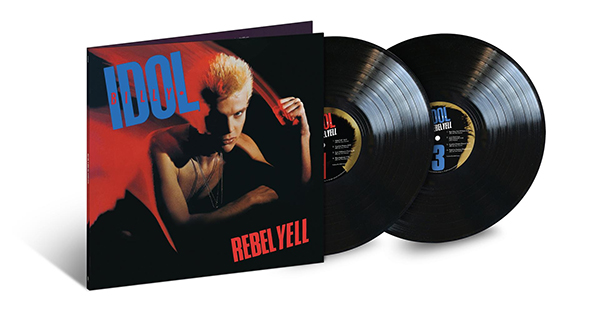
Stevens: I believe when we did the original Rebel Yell album, we mastered it four times before we were happy with it, because the needle would jump. We tried to push that envelope with the bass and we always wanted a fuller mix, but it took like four tries to master it the way we wanted it.
Mettler: I can see that. For one thing, there are those bass breaks on “Flesh for Fantasy” that are super-low, so I imagine that also had to do with sequencing where it goes at the very outset of Side 2. If it was in the “wrong” spot on that side, the needle would jump. Did you have to resequence tracks on Rebel Yell, or did you have the sequence figured out beforehand?
Stevens: We had the sequence figured out — but we always knew that, as you got closer to the center of the disc, you were gonna get less volume out of the tune. I think that’s why we ended Rebel Yell with “The Dead Next Door” [at the end of Side 2]. It’s very sparse, and we didn’t have to worry about that one.
Mettler: I do have to say I still love hearing that “bullet blast” part of your guitar attack on “Rebel Yell,” which is such a great sound. It’s really unique to you. How did you come up with that one, Steve? We don’t hear anybody else really doing that kind of thing before you did.
Stevens: When we were tracking it — well, there’s no surprise when you got a winner. I always tell people, “The record company might muck it up, but when you got a good record or a good song, you know it.” it’s not a mystery — and “Rebel Yell,” the title track, became apparent to us that we had a real winner. Like that backing track, with Thommy Price on drums. [Sadly, Price recently passed away at age 68, on October 10, 2025.]
Stevens: When it came time for the guitar solo, I said, “it’s gotta be more than just notes” — and just playing fast wouldn’t create that. So, I brought in, one of my favorite guitar solos on the Billy Cobham Spectrum album was on “Quadrant 4” (Side 1, Track 1), with Tommy Bolin. (Footnote 3) Tommy Bolin used to do this thing with the Echoplex, and I brought it in and I played it to our producer Keith [Forsey], and I said, “We need something like that — that sound effect that suddenly takes over the guitar —but I don’t wanna copy what he did.”
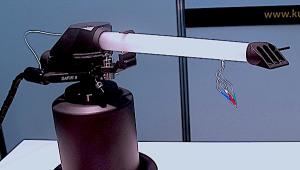
At the time, I was really into collecting Chinese and Japanese tin toys, toy robots, and rayguns and stuff. I happened to be playing my guitar at home, plugged into my little amp and playing with the raygun — and I realized it came through the pickups of the guitar. I thought, “Oh, wow. If I could do that . . .” So, I brought it into the studio and, basically, I recorded the solo, added some delay to it, and we punched me in on those parts and I just pulled the trigger on the raygun — and Bob’s your uncle! (laughs)
Mettler: And it totally holds up to this day, because I never get tired of hearing it. Now let’s talk about Dream Into It for a bit. I like the update of “John Wayne” (Side 1, Track 4), for example, because I also have the 2008 version that appeared on The Very Best of Billy Idol (LP2, Side D, Track 4). Before we got on Zoom today, I played both versions back-to-back, and it seems like you guys were able to capture another special moment that fits the present day — and it's the perfect end to Side 1 too. Another good example of sequencing, right there.
Stevens: Yes — and [The Kills’ lead vocalist] Alison Mosshart guests on that. We had done a show at Hoover Dam, and she was a guest. It was her request to do that song, and we were like (incredulously), “Really? ‘John Wayne’?” But it worked out really well — so well that we did it on the record.
Mettler: I’m glad you made that call with it. And I’m glad to see younger-gen listeners getting into the new album too.
Stevens: It was such a great experience getting a new album as a kid, wasn’t it? You’d get a new release, and three or four friends would get together to listen to it. You’d read the liner notes, you’d put the record on, and you shared that experience — and you played that thing a couple of times to devour it. We did that with all of those records, and I hope kids now are also sharing the music like that — whatever kind of album they play, regardless of whether it’s rock or something else. I hope they have that shared experience of experiencing music like it’s a mini-concert — just on your turntable.
Mettler: I’m with you on that too, Steve. Okay, I have one last thing I wanna wrap us up with now. What I like to do is, I’m gonna throw us 50 years into the future now, so it’s 2075. And, as I like to say, unless there’s some weird science going on, you and I may not physically be on the planet — though maybe you will be, I don’t know. You might be good. (Stevens laughs) Anyway, however people are listening to music then, and they type in “Billy Idol,” “Steve Stevens,” “Atomic Playboys,” or other things like “Flamenco a Go-Go” into their listening device, what do you want a future listener to get out of the music you’ve made?
Stevens: Oh wow. (slight pause) I would say, take an entire album and listen to the entire album, because our point of reference both for Billy Idol and myself is those Beatles records where every track is a little different. We’ve done that with every album. We’ve never subscribed to the idea that the songs should all sound the same, because The Beatles didn’t do that. And with Rebel Yell, “Eyes Without a Face” sounds nothing like “Blue Highway,” which sounds nothing like “Flesh for Fantasy.”
Stevens: So, I would hope that, any record of ours they stumble upon in their spaceship (both laugh), or in their flying car, I hope they listen to it in its entirety. And I hope it’s a record that maybe we haven’t even made yet, because I feel we are much better at our craft now than we were back then. We’re really fortunate, because Billy’s audience is very receptive to hearing new music — so we’re gonna keep on doing what we’re doing. We’re still learning, and we’re still perfecting what we do, hopefully.
Author bio: Mike Mettler is the editor of Analog Planet in addition to being the music editor of our sister site Sound & Vision, and he’s also a contributing music editor to one of our other sister sites, Stereophile, in addition to being the regular Vinyl Icons column scribe for Hi-Fi News. Plus, he’s quite partial to vintage 1967 Mustang fastbacks, but that’s yet another story for a different time and place.
Footnote 1: Yes’ self-titled debut LP was released by Atlantic in the UK in July 1969 with the band’s name in a large red-and-blue word balloon on a black background, while the U.S. version released in October 1969 sported a shot of the band hanging around together a British architectural center instead. Yes’ second album, Time and a Word, was released by Atlantic in the UK in July 1970 with a dada-esque black-and-white cover design, while the U.S. version released in November 1970 again showed the band on the cover — albeit a shot that included guitarist Steve Howe, who did not play on that album. (February 1971’s The Yes Album was his first with the band.)
Footnote 2: Speaking of Steve Howe, who was in Tomorrow with vocalist Keith West prior to joining the Yes fold, you can read my interview with him about shepherding an updated vinyl version of Tomorrow’s debut February 1968 LP now renamed Permanent Dream that posted here on AP back on May 4, 2023.
Footnote 3: Billy Cobham’s truly stellar Spectrum LP was released on Atlantic in October 1973 — but the absolute best version of it on vinyl is Acoustic Sounds’ Atlantic 75 Audiophile Series 180g 2LP 45rpm edition that was just released earlier in October 2025. Music is a 10.05, and the Sound is a 10.5.

BILLY IDOL
DREAM INTO IT
180g 1LP (Dark Horse/BMG)
Side 1 / Part I: Dying to Live
1. Dream Into It
2. 77
3. Too Much Fun
4. John Wayne (Feat. Alison Mosshart)
Side 2 / Part II: I’m Reborn
1. Wildside (Feat. Joan Jett)
2. People I Love
3. Gimme The Weight
4. I’m Your Hero
5. Still Dancing















 |
Equipment Reviews | |
The Gruvy Awards | |
Blogs Analog Tips | Columns Music | |
Show Reports | |
News Resources |
 © 2026 AnalogPlanet
AVTech Media Americas Inc.
All rights reserved