


Gem Dandy's PolyTable Signature And Sorane TA-1L Tonearm Part 2
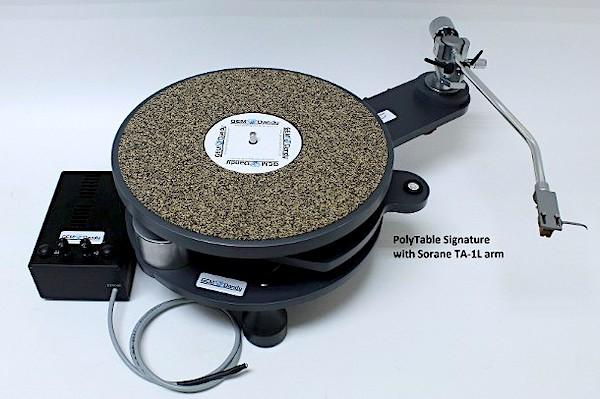
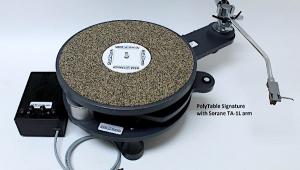
The ‘table comes mostly set-up but what’s not includes two unique tasks: inserting the thrust pad into the bearing well and adding to the motor 12 milliliters of special light weight damping oil. The instructions caution that some damping oil may eventually migrate from the motor housing onto your stand’s surface. That didn’t happen during the months the turntable was set up either directly on my Stillpoints SS rack or on the Isoacoustics ZaZen1 platform ($199) designed to isolate turntables or other components weighing up to 25 pounds (the ZaZen II is for up to 40 pound turntables or components).
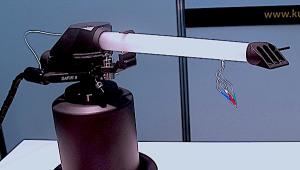
The arm set-up was straightforward and easily accomplished. While doing so I took note of the arm’s impressive “fit’n’finish”. The only glitch I encountered with the arm was the too loose counterweight. Once engaged on the shaft it should only be moveable by rotating its spiraled inner channel on the counterweight shaft but this counterweight could be easily slid fore and aft making difficult setting VTF especially when I tried using the circular gauge at the counterweight’s front.
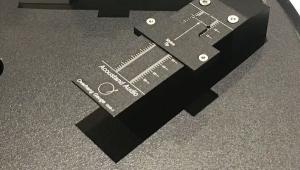
I used a supplied from the importer Löfgren A protractor to set overhang and zenith angle. Anti-skating is via a built in spring adjusted by a knob on the side of the arm that’s attached to a sliding pointer type gauge. VTF/SRA is the basic grub screw/post type. It’s not marked in millimeters so you’ll have to mark the post with your own reference point once you establish parallel to the record surface as a starting point (which is a good idea, even if using a digital microscope). I used a new Wallytool to do this, that I’ll soon write about. Once set up, the arm was a pleasure to use though I’m not at all a 12” arm fan. It’s like the stylus is in a different time zone than the pivot. Sorane makes a 9” version but the ‘table is built for the 12” one.
Polytable Signature and Sorane Performance
Job one is to turn at the correct and consistent speed. Here the ‘table’s performance pretty much backed up the designer’s claims for his motor controller. See for yourself:
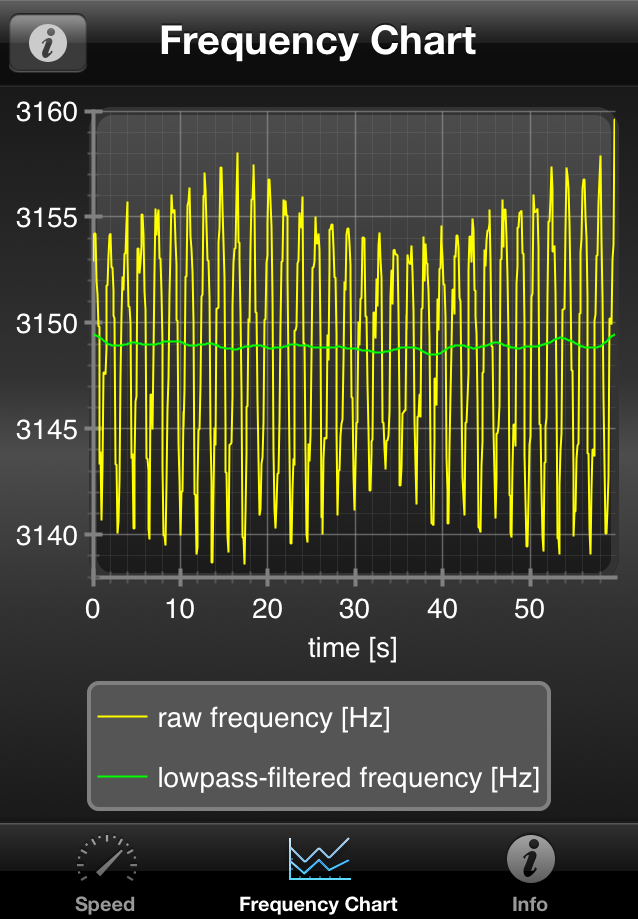
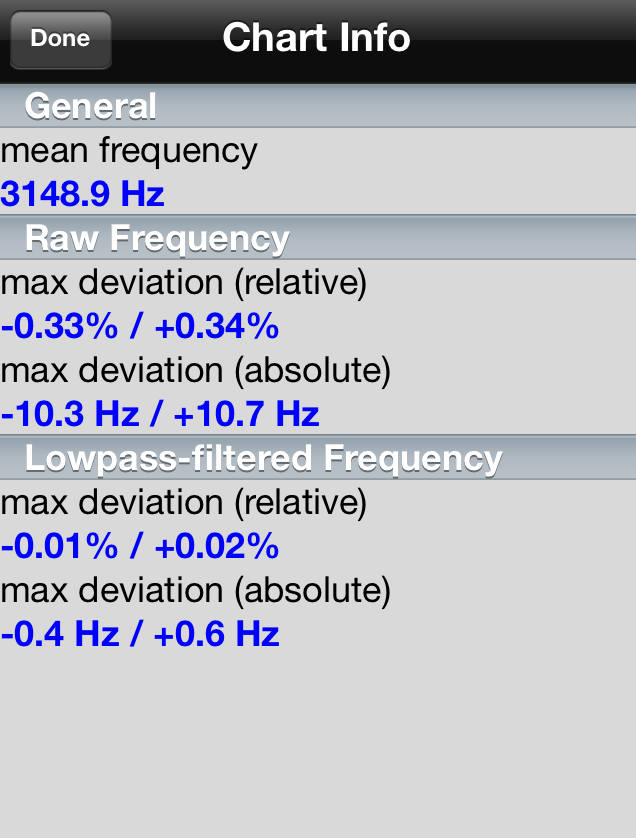
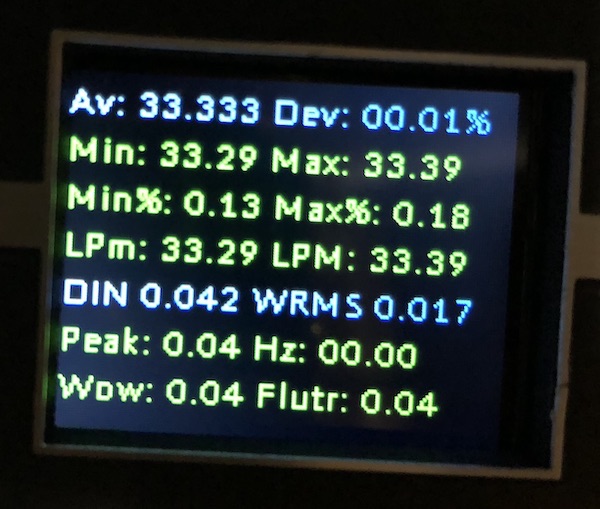
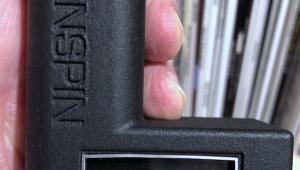
As you can see the low-pass filtered green line is smooth. The ‘table is running ever so slightly slow but of course that’s easily fixed and as the numbers show, it’s only 1.1Hz off as is. More importantly the relative maximum frequency deviations both relative and absolute are small. The third image is from a new device called a “shaknspin” that doesn’t require a record. This is a prototype so I won’t write further about it until the finished one arrives but the basic results match well with the platterspeed app. So the PolyTable Signature is a spinning champ.
I listened using two cartridges well-known to me: a Lyra Helikon SL and a Transfiguration Spirit Mk3 (both of which are no longer manufactured and probably on the high end of what buyers of this turntable/arm combo are likely to use with it).
For Phono preamps I used the CiAudio PEQ MKII, the Zen Phono, a new budget unit ($149.99) from iFi and the Hagerman Trumpet MC a $1099 hybrid design featuring a JFET front end for MC and an all-tube MM phono preamp following. Both will soon be reviewed.
Of course, it might seem absurd that these modestly priced components were plugged into (mostly) my reference system, with the only substitution being Wilson Audio Specialties’ XVX speakers ($329,000) currently being reviewed instead of the Alexx that I own, but as it turned out it wasn’t.
When I auditioned The Glory of Venice (Columbia M30937) with the Transfiguration Spirit plugged into the Hagerman Trumpet, it was a near religious experience (the music of Gabrieli recorded in Basilica San Marco, Venice with E. Power Biggs on a ferried in Rieger organ hauled up piece by piece to the gallery where the organ once stood in Gabrieli’s time, plud The Gregg Smith Singers, the Texas Boys Choir and The Edward Tarr Brass Ensemble didn’t hurt making it a religious experience !).
Joking aside, this combo costing $2995+ $1875+ $1099 produced an enticing combination of timbral generosity—warm but not too warm—vocal verisimilitude, three-dimensional imagery, spatial focus, stability and natural attack, sustain and especially spatial decay that backed up the super-stable measured performance.
Here: listen for yourself! (and no, the Trumpet is not the quietest phono preamp ever [blacker backgrounds are available from the solid state units] but what it offers in terms of musical pleasure for a grand is special).
Magnificat—Counter tenor, Baritone and Chorus
(BTW: Columbia M30937 is about an $8 record on Discogs. High Fidelity magazine called it “The Greatest Marriage of music and acoustics in history” and though it’s a 1971 Columbia pressing, my copy at least is dead quiet pressing perfection).
I was thumbing through some “abandoned” records and came upon Dub Colossus’s Dub Me Tender Vol. 1 (Real World YSC001). It’s not UB40, nor is it the heaviest dub you’ll hear but it was a fun, lightweight listen (with song titles like “Dub Me Tender” and “Stop! In the Name of Dub”, you’re not exactly expecting “heavy”) and it demonstrated the ‘table and arm’s solid bass performance: good extension, effective low frequency energy control and “tunefulness”.
Herbie Hancock’s second Blue Note album (as group leader) My Point of View (Blue Note BST 84126/B0031882-01) recently reissued in the Tone Poet series has an outstanding lineup that includes Donald Byrd, Hank Mobley, Grant Green, a very young (17) Tony Williams, Grachan Moncur III and Chuck Israels. Yes, “Blind Man, Blind Man” reprises the funkiness of “Watermelon Man” with less funk, but the album is worth getting just for the stunning ballad “A Tribute to Someone”, which Herbie wrote as a teenager while a student at Berklee. Aside from its musical suavity, the sound of Byrd’s “in your room” trumpet and the clarity and expressiveness of Williams’ drum kit made for mighty satisfying listening. Mobley was “in the room” too, especially via the Hagerman Trumpet. This moderately priced turntable/arm combo system delivers the full glory goods in all the ways that no digital edition can come close to providing.
Quibbles
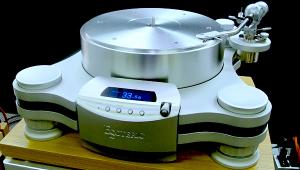
You’ll know almost immediately upon set-up that Livio Cucuzza (Audio Research’s genius industrial designer) did not produce this ‘table! The feet are fastened down with 3 domed Philips head screws, one of which is front and center and stares you down every time you play a record, giving the turntable a not exactly elegant look. Adding to the “inelegant” looks is the tacky blue and white “Gem Dandy” badge next to said screw that for some reason says to me “I belong on an electric toothbrush”, as is the center platter’s white stick-on “badge”. It too is “appliance-like”.
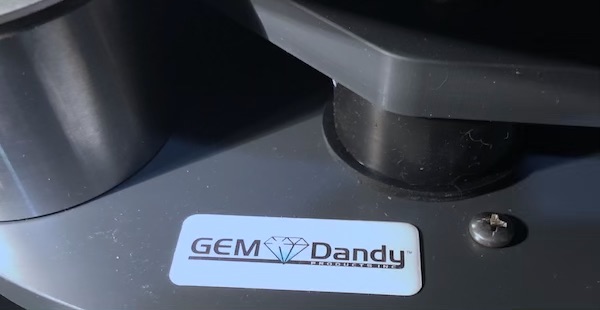
Add the “hanging strobe umbilical” (and a few other design aspects I won’t bother to mention because I don’t want to appear to be “piling on”) and you have a turntable best seen in a “bachelor pad” and not one to bring home to wifey’s living room (unless she’s super tolerant).
The only other issue with the ‘table I’ll mention is the lateral instability caused by the multiple Sorbothane pucks, both separating the two bases and used as feet. The slightest lateral “bump” will produce major “stylus jump”. Not a problem if you’re careful and actually the ‘table’s sonic stability is a testament to the excellent machining execution and build quality.
The Sorane TA-1L 12” Arm
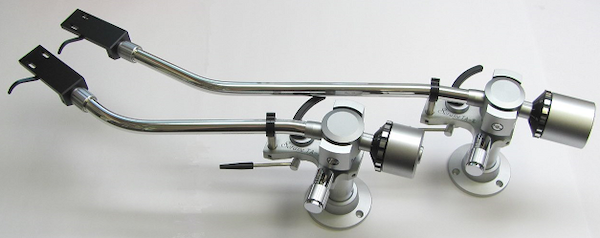
If you’re wondering if this arm is a suitable Jelco replacement, the answer is “yes”. The construction quality, “fit’n’finish” and complete set of user adjustable features plus what feel and sound like high quality bearings (low frequency excellence) make it so. The only issue I had was the ‘slippery’ counterweight. The spirals appear to be machined into the counterweight but it too easily slide fore and aft making turning it all but impossible to turn to make small VTF adjustments—and don’t even attempt to turn the front gauge piece because the entire counterweight will slide. I’m not sure if this is a sample or design issue. However, with an MSRP of $1875 dollars it’s best to put aside this quibble. This is a seriously fine arm at a seriously reasonable price.
Conclusion
I reviewed the basic GemDandy PolyTable in Stereophile (Vol. 39 No.8) and gave it an enthusiastic write-up. The bottom end shortfall there (not a problem really, unless you have full range speakers) was not an issue here (within reason: I’m not here to tell you the PolyTable Signature has the brute force bottom end produced by the “mega-tables”) but it’s definitely got “testicular bass” as my mentor Harry Pearson liked to refer to it.
The PolyTable Signature’s speed accuracy and consistency are definitely competitive with the best turntables regardless of price as you can see for yourself and its freedom from obvious timbral colorations and effective rejection of unwanted energy input per Mr. Merrill’s design goals were clear with every record played.
There’s serious competition at the circa $5000 price-point (for ‘table and arm) so you have many choices. If you are shopping in that range (and the utilitarian looks don’t bother you) make sure Gem Dandy’s smartly designed, well-constructed, fine sounding PolyTable Signature turntable (and Sorane arm) is on your short list.
 | |||||||||||

|
|
| |||||||||


















|
Equipment Reviews | |
The Gruvy Awards | |
Blogs Analog Tips | Columns Music | |
Show Reports | |
News Resources |
 © 2026 AnalogPlanet
AVTech Media Americas Inc.
All rights reserved