


Allnic Audio H-5500 Phono Preamp

I’m always on the prowl for finding high-achieving, great sounding, value-added phono preamps. They play such a huge role in our vinyl listening experience, and there are just so many phono-stage varieties available out there. From tiny solid-state progenitors that solely serve moving magnet (MM) signals, transimpedance units that promise to change the very physics of cartridge loading, pragmatic mid-priced units that bridge the worlds of moving magnet and moving coil (MC), to the luxurious, glow-in-the-dark devices that boast tubes and their promise of bloom, romance, and warmth — I’ve had them all!
Truth is, I love my sadly discontinued, totally tube-flavored Tavish Audio Design Adagio phono preamp, but I also lean towards the Manley Chinook, the latter of which is, hands down, the best tube phono preamp at its price point of $3,199.
All this phono-pre love and reminiscing of mine now bring us to the unit that I have in hand for this review — namely, the Allnic Audio H-5500 phono preamp ($6,600), which replaces the company’s previous, stalwart H-1202 model. Let’s see how it fares.
Features & Specs
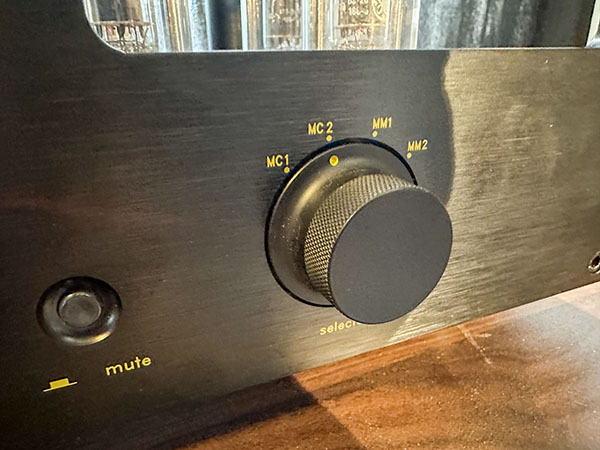
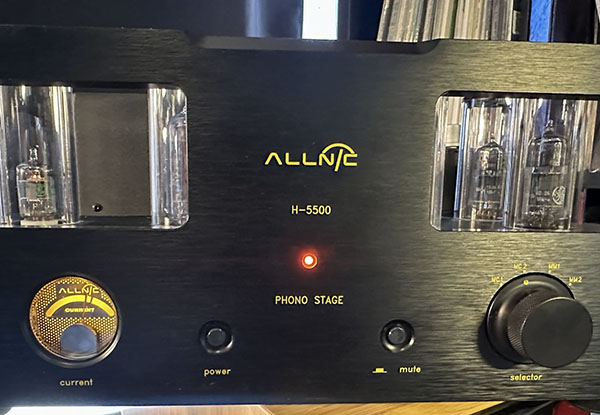
The Allnic Audio H-5500 phono preamp offers dual MM and MC inputs, Mu-metal shielding to increase S/N (signal-to-noise ratio), power-supply capacity double that of the above-noted H-1202, and a current meter for monitoring tube status.
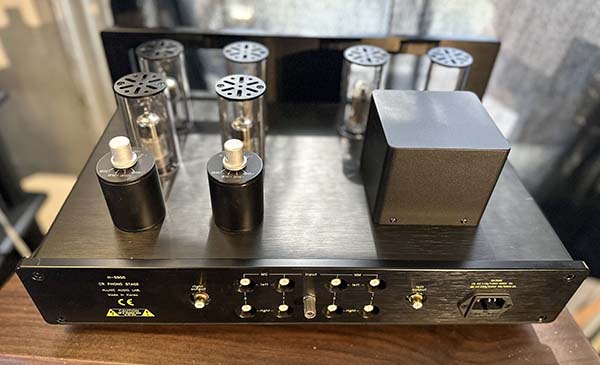
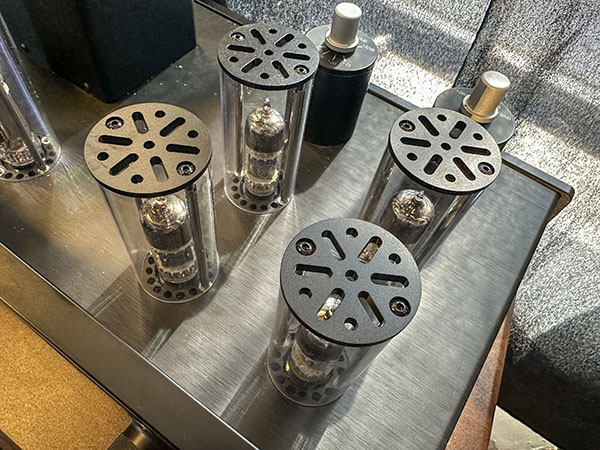
The H-5500 employs an aluminum chassis. Like all Allnic Audio products, the H-5500 uses Permalloy (iron and nickel alloy) for its transformer cores. It arrives stock with four NOS E180CC twin triode tubes. For this new phono pre, Allnic calls them “Analogues,” and they also use a 7233 voltage regulator tube and a 5654 for voltage correction. The H-5500 power transformer has been upgraded, and the unit also includes the same step-up transformers from Allnic’s H-7000 and flagship H-8000 preamps.
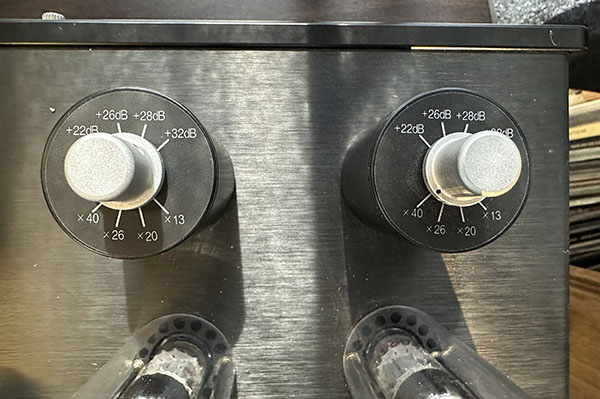
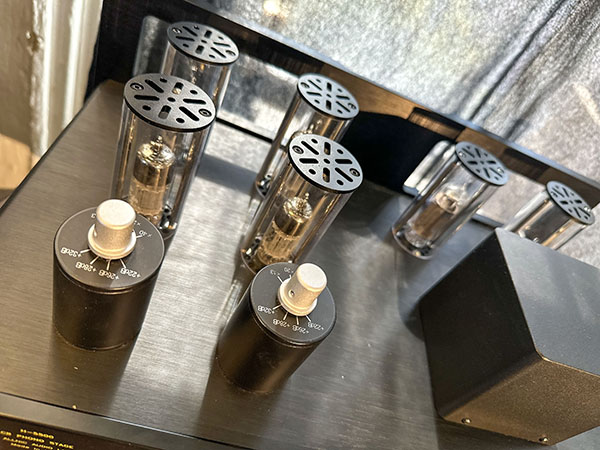
The H-5500 is a Class A design with zero negative feedback, and it offers 278ohm, 117ohm, 69ohm, and 29ohm loading settings. Loading is chosen from two chassis-mounted rotational pots, each of which is tied to a specific gain factor: +22dB, +26dB, +28dB, and +32dB. Loading was on the fly, and instantly audible. Soft start function, mute switch, and dual single-ended input and outputs complete the specs.
The boldly black H-5500 has an almost gothic appeal, its tubes protected by round metal and glass shields that look a bit spooky like round torture devices, with air holes for breathing. They recall those fetus-enclosing pods in Ridley Scott’s 1979 horror/sci-fi classic, Alien. Equally odd — and almost Brutalist — its front plate, thin but strong, looks like that monumental mute slab in Stanley Kubrick’s 1968 forever classic 2001: A Space Odyssey, or the faceless cabinet of a baffle-free speaker design.
The H-5500’s control panel resembles that of a Soviet-designed submarine — blunt and no-nonsense; all switches and gauges; no frills, all business. As you will soon enough learn, however, this machine is anything but alien, cold, or foreign in the way it sounds.
Setup
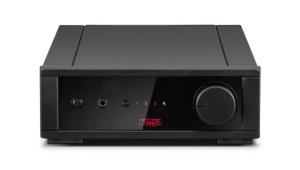
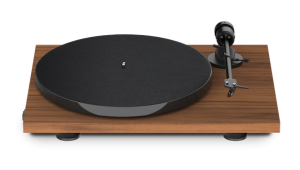
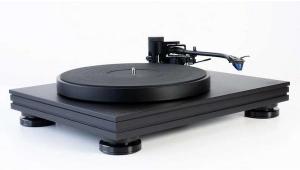
My system for this review included a Rega P8 turntable fitted with a Rega Ania Pro MC cartridge (which, spoiler alert, I’ll be reviewing here on AP in just a few days from now!), a Sugden LA-4 preamp, Elekit TU-8888 monoblock amps, and DeVore Fidelity Super Nine gibbon loudspeakers. Cables from Auditorium 23, AudioQuest, and Darwin completed the connection setup, as allied to IsoTek and AudioQuest power conditioners.
Four albums acted as my judge and jury: a) 1974’s bossa nova classic Elis & Tom (Philips IPN 6349 112), for its vocal beauty; b) The Great Jazz Trio’s 1978 offering Love for Sale (East Wind EW 8046), for its thunder quaking drums; c) Gene Bertoncini and Michael Moore’s 1986 LP O Grande Amor: A Bossa Nova Collection (Stash ST258), for its mushroom-cloud bass; and d) McCoy Tyner’s 1967 masterpiece The Real McCoy (Blue Note BLP 4264), for its dynamics, fire, and mono soundstage.
Listening Sessions
Before deploying the Allnic Audio H-5500 into the signal chain, I first listened to the Rega P8 table with my Manley Chinook, and found the sound didn’t gel. It was too fussy, and a little bit forward. Without inserting my Tavish Adagio in the chain, I assumed it would sound too much like cherubim on fluffy clouds, as its totally tube-saturated mien can be overkill in the wrong rig. So, the H-5500 seemed primed to enter the race, and soon revealed that it melded better with the Sugden LA-4 preamp, providing more over-tube roundness than the Manley to the Sugden’s straightforward approach.
Antonio Carlos Jobim and Elis Regina’s “Águas de Março” (Side 1, Track 1), from the aforementioned landmark 1974 LP Elis & Tom, took on new life through the Allnic, infused with a richness that only deepened its magic. While it may not match the Manley’s razor-sharp precision or microscopic detail, the H-5500 delivered something equally compelling — warmth, a touch more lushness, and a palpably human quality.
The soundstage was expansive, with vocals and instruments occupying distinct breathing space. The music flowed with a natural, almost physical momentum, extending well beyond the confines of the speakers. As with everything played through the Allnic, the bass was extended, physical, and weighty — if not the absolute last word in clarity. But where it truly excelled was in capturing the rhythmic sway and pulse of this Brazilian masterpiece, rendering it with a vitality that rivaled any playback I’ve experienced.
The Bertoncini/Moore record — an album of playful guitar and bass duets, anchored by the innovative Brazilian drummer Edison Machado — revealed similar strengths through the Allnic. The soundstage was vast and deep, with the record’s prodigious bass both reasonably well-defined and immersive. Machado’s samba bass-drum patterns snapped with clarity, while the low end remained fat and rich. The mids and treble were resonant, almost fragrant in their clarity, wrapping melodies in an atmospheric glow.
Once again, the Allnic H-5500 asserted itself as a preamp of regal tonality, delivering not just soundstage depth but a rich, inviting personality that made every note effortless to absorb.
The Allnic handled The Real McCoy LP with precision and poise, revealing Tyner’s music in sharp relief — rich, clear, and full of life. It cast a wide mono image, where Elvin Jones’ explosive drumming cut through with strong definition. The piano’s right hand sat just slightly back, likely due to Rudy Van Gelder’s idiosyncratic recording, but the performance remained electrifying — dynamic, punchy, and brimming with energy. The H-5500 captured every high point of this classic session, delivering a vivid and compelling listen.
The Allnic’s take on The Great Jazz Trio felt slightly held back — though some of that restraint likely stems from the Sugden LA-4’s linear, if not entirely transparent, approach. Still, the H-5500 brought Ron Carter’s bass into sharp focus, gave Hank Jones’ piano a satisfying heft, and let Tony Williams’ drums surge with full projection and rhythmic drive. Transparency may not have been absolute, but the musicality was undeniable.

Conclusions
The Allnic Audio H-5500 is a phono preamp that wins you over instantly. Its on-the-fly loading and gain adjustments were very convenient and impactful, making their boldness heard the moment you tweak them. The H-5500 wraps every record in warmth and humanity — yet, as The Real McCoy LP demonstrated, it never smothers or sweetens what should stay dry.
The Allnic Audio H-5500 phono preamp’s signature lies in its midrange — capable of absolute transparency or sumptuous lushness, depending on the music. This versatility carries through to its bass, which is as resonant as it is full-bodied. The Allnic is neither overly romantic nor clinically analytical, but it strikes a balance of melodic grace, tonal richness, and rhythmic drive. In short, the H-5500 is the kind of phono preamp that doesn’t just play music — it enchants — and it certainly cast its spell on me and my system. It’s another phono-pre winner in my book, so do give the H-5500 a try.
For more about Allnic Audio, go here.
To find an authorized Allnic Audio distributor, go here.
Author bio: Former musician, former artist, and former legal wastrel Ken Micallef has written numerous hi-fi equipment reviews for Stereophile and Analog Planet, and his byline has also appeared within Mojo, Electronic Musician, and The Grammys. You can also find him at YouTube (Ken Micallef Jazz Vinyl Audiophile).





















 |
Equipment Reviews | |
The Gruvy Awards | |
Blogs Analog Tips | Columns Music | |
Show Reports | |
News Resources |
 © 2026 AnalogPlanet
AVTech Media Americas Inc.
All rights reserved