


Fluance’s RT85 Turntable Is a High Value Proposition Page 2
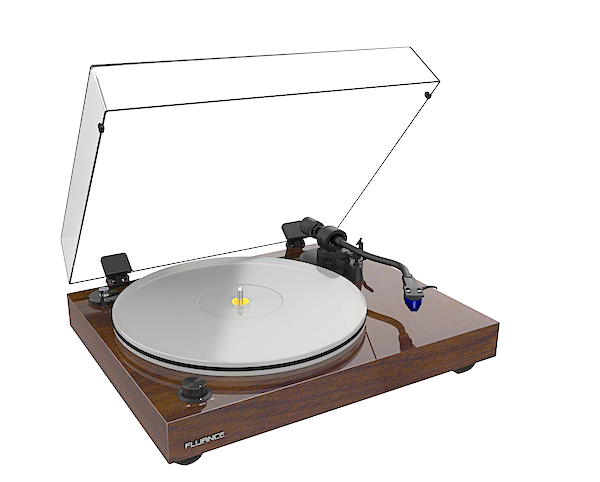
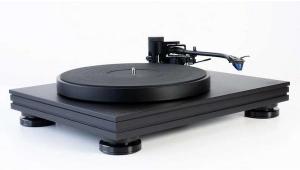
Thanks to the outstanding instruction manual even a novice can take the RT85 out of the box and within a few minutes start spinning records. I repeated the same “tap test” that turned the Thorens ‘table into a big low frequency drum and unfortunately, this ‘table responded the same way. The plinth is lively to say the least, while tapping on the platform upon which the ‘table set indicated that the elastomer feet were quite effective at isolating the system from footfalls and the like.
While this sort of impulse test does not mean the ‘table will perform like a drum it does mean that in a system with speakers that go low, the low frequencies traveling by air through the room will have a mild sonic effect but more significantly, so will vibrations produced at the stylus/groove interface.
Not surprisingly then, the turntable’s overall sound was on the somewhat warm but very pleasing side—something noted in the customer reviews on the Fluance website.
I started with the ORG double 45rpm reissue of Ella Fitzgerald sings the Rodgers and Hart Song Book (ORG 055) recorded in stereo in 1956—don’t let the date fool you: the sound is quite well-extended top to bottom and dynamics beat most of the compressed stuff released now. The track “You Took Advantage of Me” has a massive and deep kick drum that enters following Ella’s intro. The RT85 reproduced it with reasonably effective control and very good extension, resulting in a pleasing kick drum sound. Ella’s voice floated nicely and stably between the speakers, sibilants were cleanly reproduced, and the strings were mellifluous and had plenty of sheen. Anyone replacing a plastic turntable with this one and first playing this track would be pleased with his or her purchase.
Band of Horses’ Acoustic at the Ryman (BRWN003) recorded live to DSD in 2013 at the famed Nashville venue and mastered by Bob Ludwig with lacquers cut by the late Doug Sax provided a good test of the RT85s. The music’s robust bottom end excites the cavernous hall. On the best analog front ends the bass remains firm and separated from the hall’s warmth. On the worst it turns into running mud. Here Bill Reynolds’ stand up bass attack is pretty well controlled and the hall contours, including the room’s reverberant field, stands behind in convincing relief. Warm, but not too warm!
I tried a Milt Jackson track featuring Ray Brown on bass, Monty Alexander on piano, Teddy Edwards on tenor “saxaphone”(sic) and Dick Berk on drums recorded live at Shelly’s Manne-hole in Hollywood August 1st and 2nd 1969. It’s on a 1972 Impulse compilation (Impulse-1972) aimed at attracting to jazz the boomer generation. The black and white jacket combines a psychedelic illustration on back and R.Crumb style writing on front. Artists include Pharoah Sanders, John and Alice Coltrane, and Archie Shepp.
The Jackson track convinced me that this turntable, despite the lively plinth, which I hope Fluance addresses in future designs, provides good performance for the money. Jackson’s vibes were reproduced with pleasing attack, and a generous sustain that made it sound convincingly metallic and not at all soft, Alexander’s piano was equally well presented and Brown’s bass was well-extended with clean, controlled attack—all of which produced attractive “rhythm’n’pacing” as they like to write in Stereophile, plus the small club’s acoustics were convincingly portrayed in the space around the instruments.
Conclusion
A $200 cartridge included in a $500 turntable package isn’t necessarily a good value, especially if the ‘table has serious mechanical and/or performance deficits. Here you get a servo-controlled motor that produces outstanding speed consistency and accuracy, a nicely machined 3 pound acrylic platter riding on a well-designed and quiet bearing system and an arm that gets the job done and will treat your records kindly.
With the exception of a layer of smooth, evenly dispersed warmth added most likely by the lively undamped plinth, the RT85’s well-balanced minor sins are those of omission—for instance expect modest not explosive dynamics.
The RT85 is an especially attractive purchase for the casual listener who wants a good looking sweet sounding, easy to set up and use turntable. Is it worth twice the cost of the RT81, which comes with a built in phono preamp and an Audio Technica AT95E? I’d say “yes” not just because of the better Ortofon 2M cartridge (though the 95E is better than its $50 price indicates), but especially because of the servo-controlled motor that produces far better pitch stability and control.
The competition would include the Pro-Ject Debut Carbon DC Esprit SB, which for $100 more gives you a fully adjustable (SRA and azimuth) carbon fiber arm, and a better damped plinth but comes with a less costly Ortofon 2M Red. You’d have to spend around $200 to upgrade the stylus to the Blue and by then you’d be into it for $300, which for some would be a budget-buster, plus the RT85 looks better, if that matters to you.
All-in-all then, the Fluance RT85 represents very good value for the money, and with the Ortofon 2M Blue pre-installed will produce very good out of the box sound.
 | |||||||||||

|
|
| |||||||||















|
Equipment Reviews | |
The Gruvy Awards | |
Blogs Analog Tips | Columns Music | |
Show Reports | |
News Resources |
 © 2026 AnalogPlanet
AVTech Media Americas Inc.
All rights reserved