


JBL Spinner BT Turntable
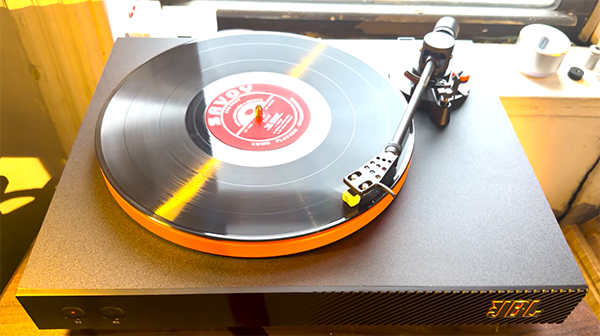
Every budding vinyl devotee faces the same question: do you sink your cash into a serious turntable and cartridge combo, then cobble together the rest of your system on the cheap, hoping to upgrade down the road? Or do you spread the budget equally across turntable, amplifier, and speakers? I’ve always preached the latter. Dropping serious coin on a source component only to shackle it to bargain-basement separates is no way to achieve system synergy — i.e., that rare, almost alchemical moment when everything clicks and your system sings beyond what any single component could accomplish alone.
And that leads us to the JBL Spinner BT turntable, which may very well be among the least expensive tables ever to land a review on Analog Planet at, yes, an SRP of $440 (as of this posting, that is, per the company’s site; we also saw it going for $349 at one point, but you know how SRPs can fluctuate these days).
The Spinner BT turntable is designed and marketed by JBL, a subsidiary of Harman International, which is in turn owned by Samsung. In a statement to AP, Harman confirmed that, quote, “for this project, the overall product concept, performance targets, and industrial design direction were led by JBL. JBL defined the sound, performance, aesthetic, and price-point goals from the outset, and worked with experienced manufacturing partners to execute against those requirements.”
Getting a review sample in hand was proving, er, somewhat elusive, so, after firing off multiple emails into the void and jousting with nonresponsive customer service bots, I finally did what any self-respecting New Yorker would do: I hoofed it down to the JBL storefront on Houston and Broadway — formerly a locale for a vegetable stand! — where I met the ever gracious Jamie Feuss. There, Feuss set me up with a Spinner BT faster than I could say, “James B. Lansing.” The box weighed 18lb all-in, so no Uber was required for getting it back to my place.
The Spinner BT table is JBL’s little brother to the company’s pricier TT350 Classic ($1,100) — and only the brand’s second crack at the turntable game. Founded by the legendary, above-noted James Bullough Lansing and now backed by Harman’s deep pockets, JBL can throw serious money and serious engineering muscle at quality, affordable analog gear. Whether they’ve accomplished the “quality” portion of that equation here is the question, so let’s find out.
Features & Specs
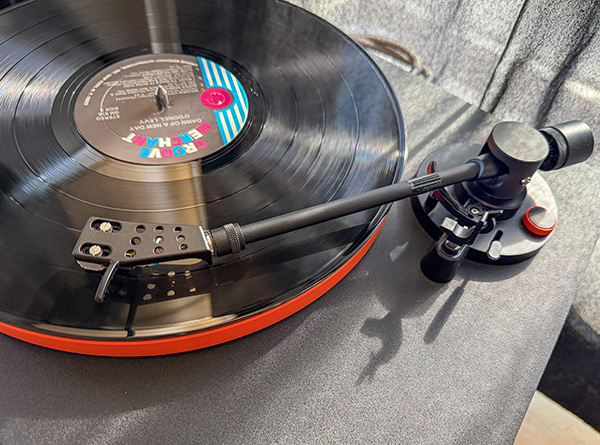
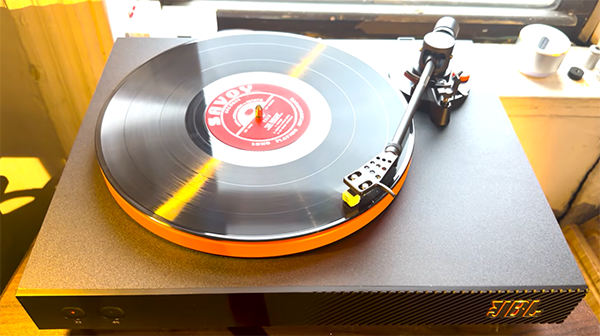
Belt-driven and built around a black MDF plinth, the JBL Spinner BT turntable sports a die-cast aluminum tonearm with removable headshell, adjustable counterweight, and adjustable anti-skating — features you don’t always find at this budgetary price point. The supplied Audio-Technica AT3600L moving magnet (MM) cartridge handled playback duties with a conical stylus — a good choice for a warm, round sound on the cheap. Wireless output via Bluetooth 5.2 with Qualcomm aptX HD keeps the cord-cutters happy. A stereo RCA pair covers the traditionalists.
There’s also an onboard phono preamp that can be bypassed in favor of an outboard unit — a smart, flexible touch — and the table also has a defeatable button for auto-stop. (Who’d stop that?) Dimensions of the Spinner BT turntable, with the dust cover in place, are 17.1 x 6.1 x 14.5in (w/h/d), and the unit itself weighs in at a very manageable 11.7lb.
If you caught my Spinner BT unboxing video over on our YouTube channel, you already know that this table required exactly one hand to lift into place on my excellent $139 Fitueyes Design 4-tier A/V media stand. (If you didn’t catch that video or just want to see it again, you can check it out above.)
Both the supplied Audio-Technica cart and counterweight installed without drama. And even at sub-$500, the Spinner BT table felt mechanically solid, not like something that would rattle apart after a dozen album sides. The cosmetic design shows that R&D dollars were spent both inside and out.
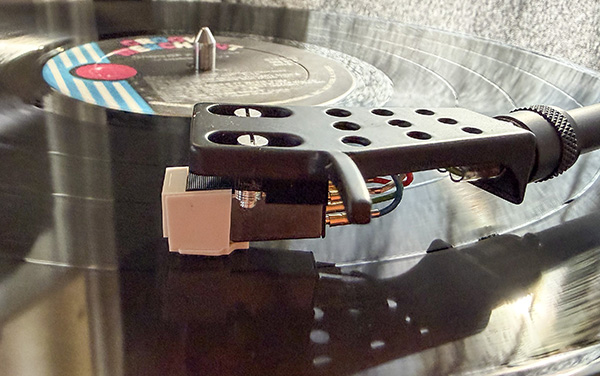
That said, the Spinner BT isn’t without its compromises. No VTA or azimuth adjustment — not shocking at this price, but worth noting. The feet are adjustable, which helps with leveling. And the removable headshell? At this price point, that’s a gift.
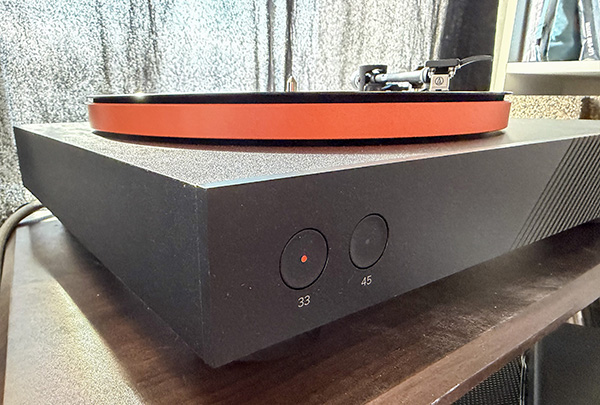
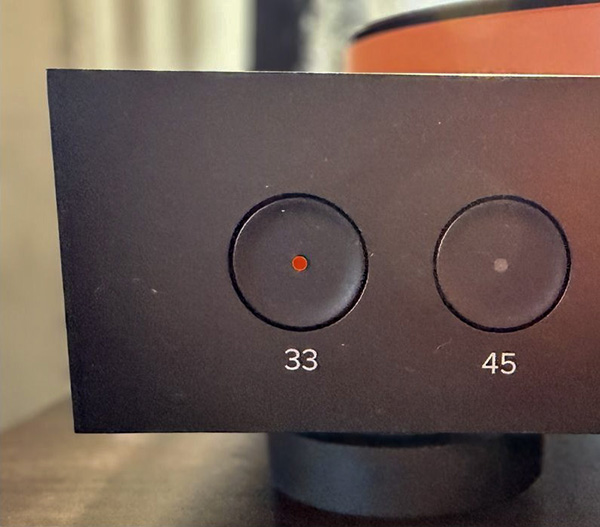
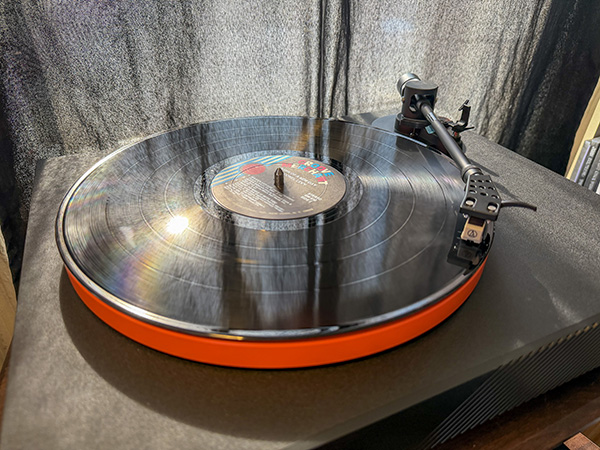
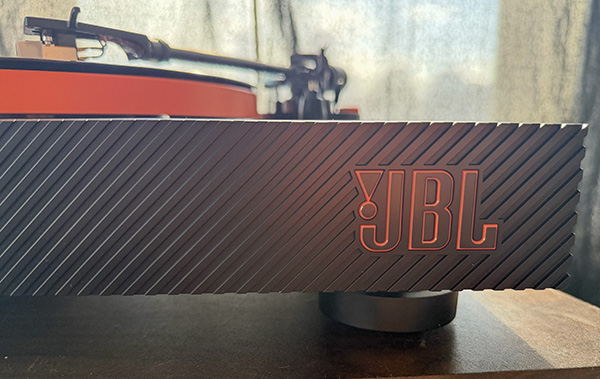
The Spinner BT cuts a sharp figure — its eye-catching orange aluminum platter boasting a spongey mat, color-matching blood red orange anti-skate dial, muted black surface, and a chamfered fascia with raised JBL lettering and inset control buttons. Handsome analog kit, this table.
Setup
One quirk stopped me cold out of the box: no ground screw, no ground cable. Thus, I did what folks do these days when they’re confused — I asked AI. Turns out JBL integrates the ground directly into the cable when used with the onboard phono preamp. And, to the company’s credit, that solution held up just as well with both the outboard solid-state and tubed phono preamps I used during this review. (More on those pairings shortly.)
The cueing lever felt like a frugal step, akin to a thin ladder creaking in an elevator shaft (it was silent). I skipped deploying the dustcover — an echo chamber has no place in serious listening — and dove straight in with the Spinner BT’s internal phono preamp before graduating to more ambitious outboard company: a Fosi Audio Box X5 Phono preamp joined to an Ampsandsound Yosemite preamp, Air Tight ATM-1 2024 Edition power amp, and DeVore Fidelity Gibbon Super Nine loudspeakers. Cabling was courtesy AudioQuest and Triode Wire Labs, and conditioning was by AudioQuest and IsoTek.
Yes, I know — pairing a budget-level turntable with such a higher-end system is somewhat absurd. But if the Spinner BT had something to say, this rig would tell me exactly what it was.
Listening Sessions
A telling sign: the motors in some budget belt-drive turntables are often so feeble that brushing a record with something like a Hunt EDA will visibly bog the platter down. The JBL Spinner BT table had no such weakness — its motor held speed without complaint, letting me clean records quickly and without resistance.
For this eval, I pulled out a clutch of jazz funk favorites to appraise the Spinner BT, including Ramon Morris’ Sweet Sister Funk (1973; Groove Merchant GM 516), George Benson’s Good King Bad (1976; CTI Records CTI 6062), Lonnie Liston Smith & The Cosmic Echoes’ Cosmic Funk (1974; Flying Dutchman BDL1-0591), and O’Donel Levy’s Dawn of a New Day (1973; Groove Merchant GM 518).
Assaulting the Spinner BT for what it doesn’t do would be too easy — and frankly, too boring. Better to celebrate what this table gets right — which turns out to be a lot. Paired with its included $40 Audio-Technica ATN3600LC MM cartridge, the Spinner BT scores more hits than misses, conjuring the essential magic of analog playback with the enthusiasm of a turntable that wrings every last drop from its modest means.
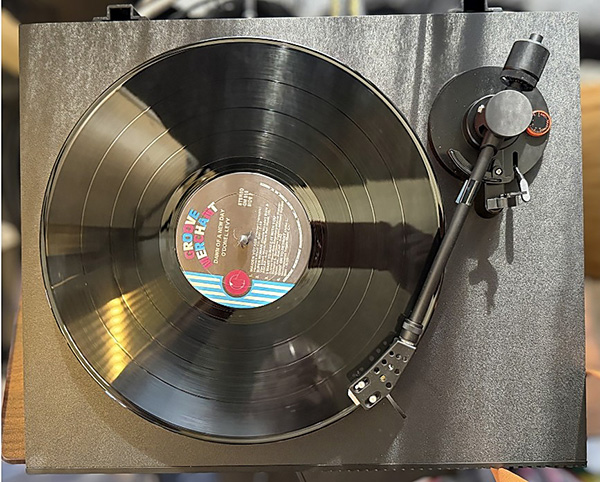
The simmering funk of guitarist O’Donel Levy’s take on Herbie Hancock’s “Maiden Voyage” (Side 2, Track 1) had me hooked from the needle drop. Sure, cymbals ran a touch hard, images glommed together at the edges, the midrange turned a little gummy, and the treble, while revealing, skewed glossy. But the stage opened wide, and dynamics arrived with authority, Levy’s guitar flowed like a juicy waterfall, and the groove — the all-important groove — was simply off the charts. Nothing mechanical, dull, staid, wooly, or plastic haunted the Spinner BT’s sound. For $440 (or less), that’s a flat-out win. Riding Levy’s charming funk fusillades, I marveled at the Spinner BT’s earthy tone, room-filling sonics, and relentlessly engaging mien.
George Benson may be getting on in years, but in the 1970s, he was a strapping pop star, and his 1976 hit single “Breezin’” (the title track to that No.1 album!) barely disguising the talent that John Scofield once described to me, unprompted, as “freakishly great.” Good King Bad is a lost CTI classic from earlier that same year — a monster funk workout anchored by bassist Gary King and drummer Andy Newmark. The music courts popular tastes rather than clandestine club action, but don’t mistake accessibility for a deficit of funk. This record has got it in spades.
The Spinner BT sorted out the Good King album’s heavy ’70s overdubbing like a seasoned magician. Benson’s hollowbody electric guitar solos leapt from the speakers with the kind of bloom I normally associate with a SET amplifier. The stage spread wide, instruments layered cleanly from strings to drums, and the music pulsed with groove, propulsion, and ample energy. The Spinner BT’s strong motor drive paid real dividends in drive and punch. The top end glistened perhaps a shade too brightly, but I didn’t care — I turned it up, and got lost in the groove. Mission accomplished.
Switching gears, I pulled out Esther Phillips w/Beck’s What a Diff’rence a Day Makes (1975; KUDU 23) and its righteous disco-flagging opener “One Night Affair” (Side 1, Track 1). From the jump, bassist Will Lee and drummer Chris Parker set the joint ablaze, the Spinner BT relaying the groove as a manic, out-of-control party anthem. The top end ran bright, the mids clear-eyed, the bass driving and insistent. But beyond the particulars, this track moved like a freight train. Phillips’ voice came through thin — as if a pair of battered BIC Venturi monitors were blaring overhead in some sticky-floored disco — yet the mojo, the communication, and the raw energy never let up. The Spinner BT wasn’t tidy nor refined, and made no apologies for either. Its groove was mountainous.
Swapping in the $109 Fosi Audio Box X5 phono preamp brought greater transparency, a smidgen more refinement, and a cleaner overall picture. But some of the magic evaporated. Mojo gave way to control, and juice surrendered to manners. I’ll take drive and abandon over restraint and decorum every time.
Conclusions
For all its rough edges, the JBL Spinner BT turntable reminded me why I fell for vinyl in the first place. In the end, the Spinner BT knocked me sideways with its savage groove potential, unrestrained dynamics, generous soundstage, and decent imaging. If there’s a better $440 turntable out there, I haven’t heard it. Another similarly priced turntable has just landed at Chez Micallef, and if it can match the thump and groove-grind of the mighty Spinner BT, you’ll be the first to know. But as it stands, the Spinner BT is an outright winner.
For more about JBL, go here.
To find an authorized JBL dealer, go here.
Author bio: Former musician, former artist, and former legal wastrel Ken Micallef has written numerous hi-fi equipment reviews for Stereophile and Analog Planet, and his byline has also appeared within Mojo, Electronic Musician, and The Grammys. You can also find him at YouTube (Ken Micallef Jazz Vinyl Audiophile).



















 |
Equipment Reviews | |
The Gruvy Awards | |
Blogs Analog Tips | Columns Music | |
Show Reports | |
News Resources |
 © 2026 AnalogPlanet
AVTech Media Americas Inc.
All rights reserved