


Pear Audio Blue Captain John Handy Turntable
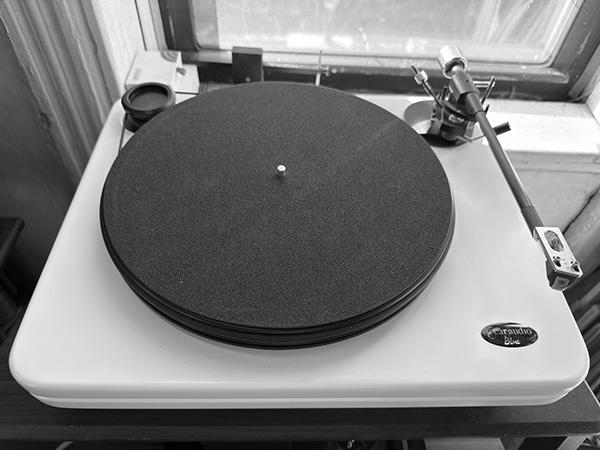
In the world of high-end audio, turntable design is defined by strict minimalists, creative maximalists, and those who refuse the confines of traditional geometry altogether. For these daring few, the critical variables of playback and construction — material resonance, energy dissipation, and rotational precision — are not just technical hurdles, but raw materials to be manipulated in favor of a unique sonic architecture. To them, a turntable is an instrument of kinetic physics, where every engineering choice serves a singular vision.
The late Tom Fletcher was one such man. His designs debuted in the 1970s at Nottingham Analogue, and, eventually, at his own company, Fletcher Audio — and his design wisdom is very much in evidence in the way Pear Audio Analogue constructed their all-new Pear Audio Blue Captain John Handy turntable ($4,000).
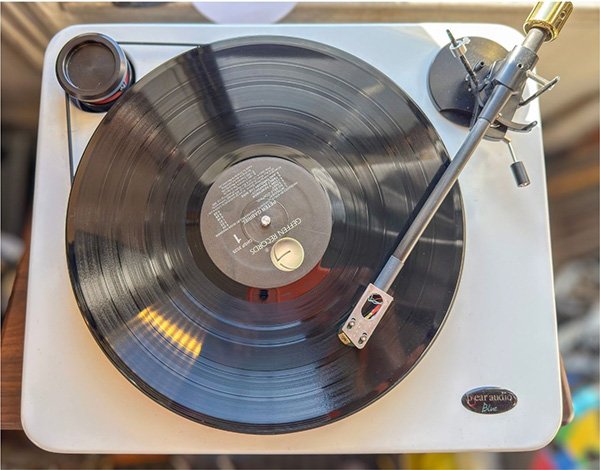
“Pear Audio Blue introduces a range of turntables and tonearms based on Tom Fletcher’s last ideas on turntable construction,” notes the official Pear Audio Analogue (a.k.a. PAA) site. “Unrestricted from past designs, Tom Fletcher designed a new range of turntables and tonearms for his good friend Peter Mezek, called Pear Audio Blue.” (To get a fuller understanding of Fletcher’s truly amazing turntable design achievements over the years, scroll down to Footnote 1, which follows the balance of this review, to get the full background.)
The PAA site further elaborates that, like Nottingham Analogue models, Pear Audio Blue tables “use the same motor principle, and the motor is [still initially] spun by hand. This motor principle drastically reduces the resonance going from the motor to the platter and ensures speed accuracy.” The site further notes that PAA, quote, “matches materials able to control resonance naturally and that are sonically in phase,” and “special attention has been placed on new bearing development, improved motor arrangement, and a different platter which results in astonishing realism, tonal quality and balance.”

And no, the turntable at hand’s handle, Captain John Handy, doesn’t imply that you’ve fallen into a black hole of Jimmy Buffett tribute bands. Fletcher and Mezek often listened to New Orleans jazz together, so each Pear Audio Blue turntable — the Little John, Kid Howard, Kid Thomas, Kid Punch, Odar, and Captain John Handy — is named after famous New Orleans jazz musicians.
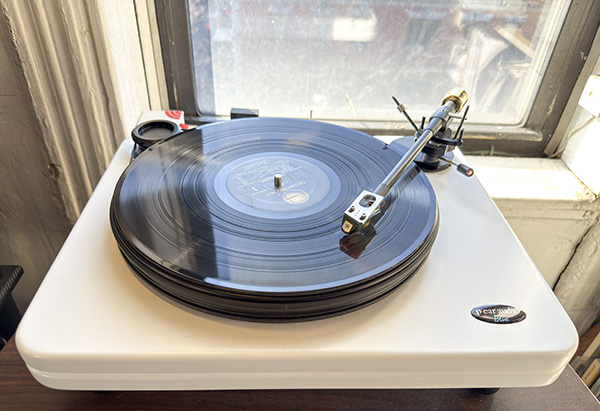
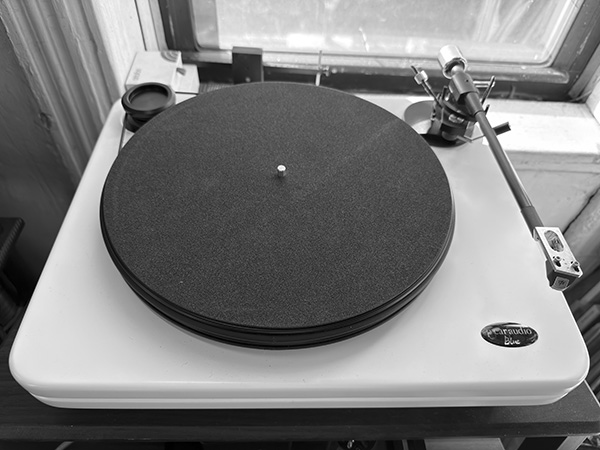
Pear Audio Analogue’s Blue turntable line presents a dense offering of Fletcher-derived designs that can easily baffle the uninitiated. This brand-wide verbosity turned into some personal confusion during my evaluation of the Captain John Handy table. For example, the unit in my listening/evaluation room flatly contradicted the company’s own digital storefront. While their site depicts a front-mounted motor, my review sample arrived with the motor positioned at the rear, an important visual discrepancy that should be tightened up on the site.
Navigating the brand’s digital presence requires precision. A casual search for “Pear Audio” will misdirect users to a UK-based distributor rather than the manufacturer. To find the authentic source, one must specify the full name, “Pear Audio Analogue,” which leads to the company’s Slovenian headquarters. For those in the U.S., the logistical trail ends at Audio Skies in Los Angeles, the sole gatekeeper for U.S. distribution.
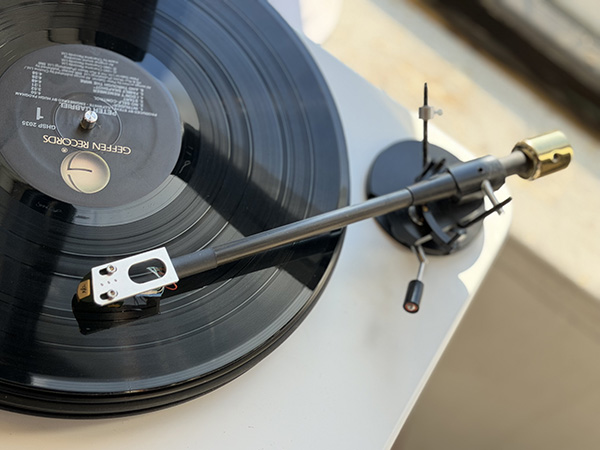
Pear Audio Analogue also makes tonearms based on Fletcher’s designs. “Cornet 1 and Cornet 2 tonearms are the culmination of Tom Fletcher’s continuing development of the Space Arm,” confirms the PAA site. “Unipivot arms are usually designed with the pivot sitting in a silicone bath. The problem with this design is that the silicone bath takes quite a while to settle down, so the sound of the arm changes as it plays. Many unipivots use eccentric counterweights to insure proper azimuth. Cornet [arms’] unipivot design uses a new approach: to maintain azimuth, along with a special material, developed with viscosity properties that do not flow and do not require ‘settling time.’”

Specs & Features
Via email, PAA’s Peter Mezek brought me up to speed on the ins and outs of the Captain John Handy model, which is “based on the concept of creating a turntable that is in-phase, meaning all the materials used to create the turntable are chosen to create the perfect marriage of materials. So, it’s not only what each part of the turntable is made of, but even more so, how each material interacts perfectly with each other to create a turntable where all the materials are in phase with each other. We do this in order to achieve the full dynamic range and the full potential of the analog reproduction of music.”
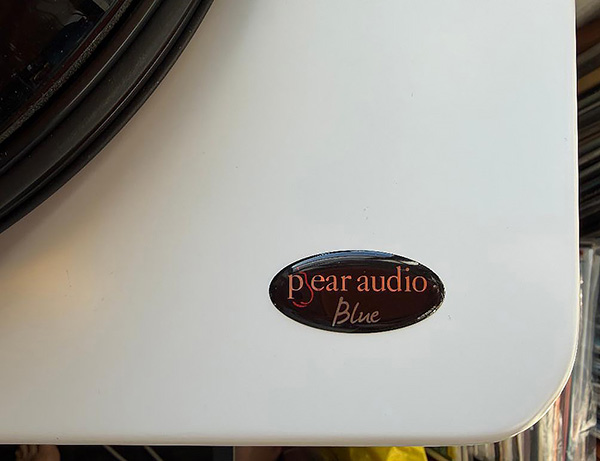
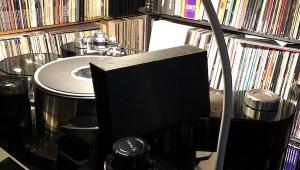
The Captain John Handy (a.k.a. CJH) table uses ultra low-torque motors, which reduce motor-to-platter transfers and vibrations “by over 90%, and is extremely speed consistent.” Once powered up, the motor stays on 24/7, quietly vibrating like a happy kitten. Meanwhile, the table’s composite wooden plinth greatly resembles those on Nottingham Analogue decks. Mezek again: “It has exceptional sonic properties, to achieve the above sonic goals and was carefully chosen after going through dozens and dozens of other materials, that were eliminated one-by-one.” The plinths for Pear Audio Blue tables are handcrafted and lacquered in multiple layers, and are available in white, burgundy, vintage Porsche, and other finishes.
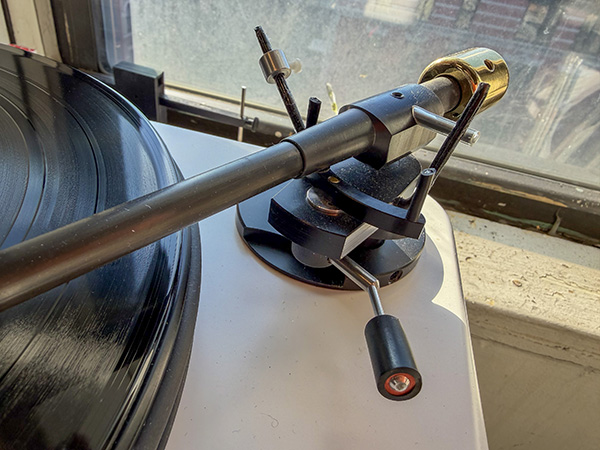
Not scrimping when only the best will do, the company’s aforementioned Cornet tonearms use Wireworld cables and Cardas cartridge pins. “Cornet’s design uses a new approach to maintain azimuth,” Mezek wrote, “with two parallel bars on either side of the bearing, limiting side-to-side motion, but allowing enough movement for the cartridge to be able to follow any groove in the vinyl. This limitation eliminates issues of typical unipivot tonearms. Along with a special material developed for the tonearm bearing, with viscosity properties that don’t require ‘settling time.’”
A state-of-the-art carbon-fiber arm wand is used in the Cornet 1 tonearm, “with fibers orientated lengthwise of the tonearm and not wrapped around it. This greatly increases the strength, resonance control, and the rigidity of the arm,” wrote Mezek. (The Cornet 1 is the arm that was fitted on my CJH review table.)
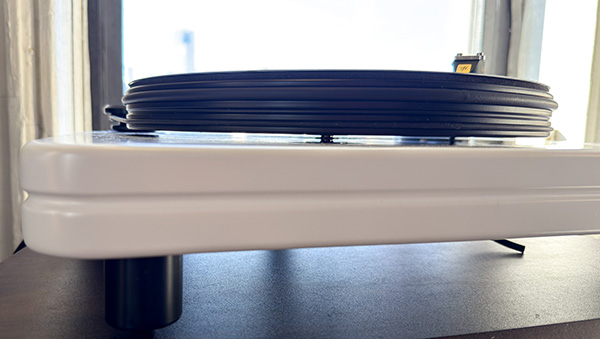
The Captain John Handy platter is made of aluminum alloy; the thin mat is silicone-based felt. Mezek calls the turntable bearing, “sacrificial — hard material into soft materials, so as not to create unwanted out-of-phase resonances. The spindle is hard materials on the outside or outer shell/edge, and, soft inside, going into a soft metal material bearing. Again, all materials touching each other that are all in phase.” The table’s belt is silicone and rubber-based, the machine’s feet are comprised of Delrin and silicone. “The design is based on form follows functions,” Mezek concluded. “So, there are no added gadgets to make it look more impressive, only exactly what is needed for optimal performance.”
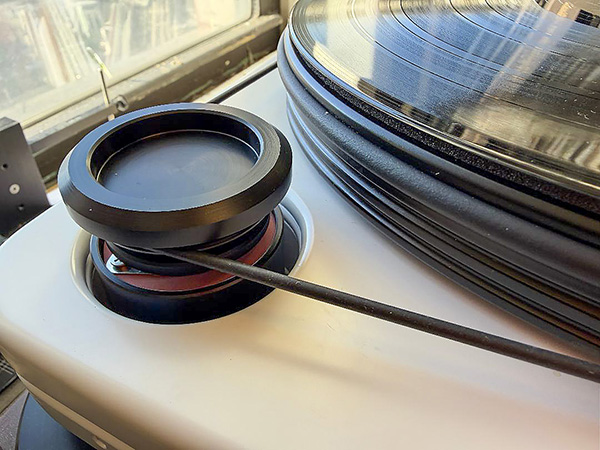
A small rubber tube extends from the surface of the 43lb CJH table, invisible unless you’re looking for it. “The rubber on the underside ever so lightly touches the underside of the platter and creates a tiny amount of drag on the platter,” wrote Michael Vamos of PAA’s U.S. distributor, Audio Skies, via email. “It’s like trying to pull a rope at a steady even pace that is not attached to anything. That’s very hard. But if it is running through something so that there is a tiny tug, it is much easier to pull at a steady pace. This tiny amount of drag makes the motor pull even more steadily, creating better flow and timing. It’s a very simple but ingenious idea, and without any negative side effects.”
Setup
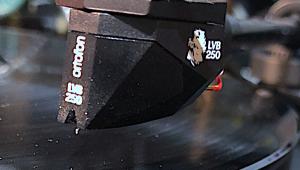
Duly armed with all of that heavy PAA design knowledge, it was time for testing. For this review, I used my personal high-end arsenal: VPI Goldy MC cartridge, Allnic Audio H-5500 phono preamp, and an AVM Evolution A5.2 integrated amp driving Wharfedale Super Linton loudspeakers. AudioQuest and Triode Wire Lab cables locked it all together — no weak links; just pure connectivity.
You may have seen my unboxing video of the Captain John Handy table that we posted on our YouTube channel back on December 2, 2025 — but if you haven’t yet or want/need a refresher, you can check it out a few grafs above this one. I was surprised that each element of the table was wrapped as if your favorite grandma thought it was her finest China. For example, the plinth was wrapped in seemingly endless layers of plastic wrap. Similarly, the Cornet 1 tonearm and dedicated Wireworld cables were cocooned in thick bubble wrap. These items were then shoehorned into a box replete with layers of foam rubber.
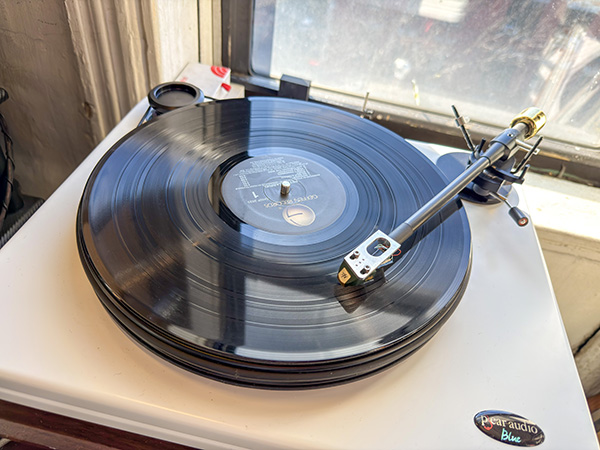
When I inquired about the table’s packing purposes, I was assured by Vamos of Audio Skies that whenever someone purchases a Pear Audio Blue turntable, they are also purchasing their own setup technician. As if on cue, Dr. Vinyl, a.k.a. Jose Ramirez, was duly dispatched to my building. Promptly climbing the stairs up to my listening lair, he then set up the Captain John Handy table in no time flat while calmly answering all my admittedly annoying questions. Thanks, Doc!
Listening Sessions
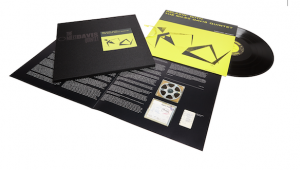
Still caught up in the holiday spirit, I cued up “Chim Chim Cheree” (Side 1, Track 1) from the stereo pressing of 1965’s The John Coltrane Quartet Plays (Impulse! AS-85), and was instantly transfixed. The music delivered extraordinary resolution from the first notes, with Elvin Jones’ drums and cymbals rendered in precise, powerful strokes across a vast soundstage that made critical listening nearly impossible — because I was too absorbed in simply experiencing it. Coltrane’s tenor sax soared overhead, sinewy and coarse and spellbinding, while Jimmy Garrison’s bass and McCoy Tyner’s piano sat lighter in the mix, reflecting Rudy Van Gelder’s 1965 engineering approach on the original tracking. Yet the overall presentation was thrillingly spatial, riveting, and lightning-fast, conjuring a paradoxical mood that felt simultaneously like meditative prayer and tidal-wave force.
When I let the CJH table/VPI cart combination roll into “Brazilia” (Side 1, Track 2) — which opens as a Jones/Coltrane duet — the magic intensified. Jones’ searing buzz roll arrived first: deep, dark, and penetrating, with such resolution that I could detect his shifting stick pressure on the snare as Coltrane entered hard in the left channel and ascended with ferocious intent. I was transported yet again, entirely caught up in sound so flowing and natural it seemed to cauterize my senses — the duo’s performance powerful, visceral, and clean as a whistle. The CJH’s ability to vanish as a component and instead drive the music over me with charm, amplitude, and velocity felt like pure sorcery.
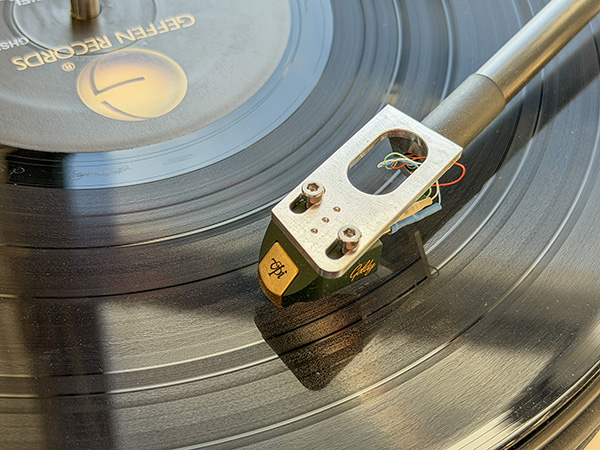
Kruder & Dorfmeister’s 1998 The K&D Sessions 4LP set (!K7 Records !K7073LP) — a blast of freaky, synth-heavy dance grooves — revealed the CJH/VPI combination’s consistent sonic signature: extremely open, shimmering treble, crystalline mids, and reasonably deep bass. What captivated me again was the dimensional spaciousness, with sweetly layered drums and percussion creating a vast bed for rollicking synths. The presentation ran dry rather than wet, with bass that felt rich and deep but not especially extended, yet the layered, resonant images populating the midrange-to-treble zone proved intoxicating. Most striking was the jump factor — the high-energy, beat-to-beat groove locomotion that emerged as another defining characteristic of this turntable pairing.
Still curious about bass performance, I turned to Kraftwerk’s 2015 2LP repress of Tour de France Soundtracks (Kling Klang 50999 9 66109 1 6), which delivered morphing electronic bass drums sunken in a deep sonic well better than nearly any dance record. Here, the CJH/VPI combo stepped up decisively, rendering the album’s round, deep, extended bass — including that crucial bass drum — with solid imaging and excellent tone that drove big, round, and propulsive. My entire body felt pulled into Kraftwerk’s synth hall of mirrors, with LP1, Side A’s succession of “Tour De France Étape 1,” “Tour De France Étape 2,” and “Tour De France Étape 3” (Tracks 2-4) becoming a glowing journey through an insular, hermetic world, as if flying high above earth cocooned in gossamer. The CJH/VPI pairing captured the essence of this music as well as I’ve ever heard it.
Finally, spinning Hank Mobley’s 1962 Blue Note classic Workout album via its 2010 2LP incarnation (Analogue Productions AP-84080), I encountered immediacy, air, space, and propulsion in equal measure. Drummer Philly Joe Jones’ ride cymbal emerged with acute detail — from stick tip striking bronze to its ambient roar spreading through the room. The music jumped hard, popping and driving a storm of jazz profundity straight into my head like a narcotic.
For comparison, I also played the 2LP Workout set on a J.Sikora Aspire turntable, where the soundstage expanded in size and weight, bass shifted from slightly smudged to upfront and supremely defined, and tonality was rich and generous, transforming Mobley’s tenor sax from a comfortable swoon into a soulful cry. The Aspire table sells for $10K, and the CJH table goes for $4K — yet the latter table held its ground, especially in terms of nimbleness and speed, its sense PRaT clearly defined.
Conclusions
The Pear Audio Blue Captain John Handy is a turntable that follows no leader, and it defies conventional design wisdom. Yet it could also be considered a Tom Fletcher triumph, as channeled through Mezek and PAA’s modern interpretation. Fletcher’s unusual choices — from tonearm geometry to platter rotation to anti-skate implementation and platter drag considerations — are novel in my experience, and they work brilliantly here.
The Captain John Handy is one helluva fine turntable, easily matching far more expensive decks in drive, flow, sensuousness, soundstage, and ambience retrieval. It played music with such life force and dynamic power that I was consistently, totally captivated. While the table’s lack of finger-lift, always-on motor, and other peculiarities may not suit everyone’s tastes, I can’t imagine anyone resisting its outstanding sound. In short, the Pear Audio Blue Captain John Handy turntable more than deserves your utmost rapt attention.
For more about Pear Audio Analogue, go here.
To find an authorized Pear Audio Analogue distributor, go here, and scroll down to the “Worldwide Distributors” section.
Author bio: Former musician, former artist, and former legal wastrel Ken Micallef has written numerous hi-fi equipment reviews for Stereophile and Analog Planet, and his byline has also appeared within Mojo, Electronic Musician, and The Grammys. You can also find him at YouTube (Ken Micallef Jazz Vinyl Audiophile).
Footnote 1: As promised, here is some deep background on Tom Fletcher. At the Nottingham Analogue Studio site, Fletcher’s design approach is on full display. Next to some unusual-looking turntables — including one built into what appears to be a polished log used as a plinth — descriptions include such phraseology as, “The basic design idea, incorporated into nine models, is to liberate the platter, arm, and motor from the resonance-laden, box-like base which housed most turntables in the past, [u]sing low-torque motors and materials that work wonderfully well together.”
Examining the iconic Nottingham Spacedeck and Hyperspace tables reveals the fingerprints of Fletcher’s engineering: every detail serves a calculated purpose. From the finger-lift-free headshell that eliminates parasitic resonance to the belt-drive system recessed into deep platter grooves for superior torque stability, nothing is decorative. Even the dampened rubber surrounding the heavy cueing lever isn’t for comfort — it’s a deliberate tactile intervention designed to isolate mechanical vibration from the delicate stylus path.
A similar design aesthetic can be seen at Fletcheraudio.co.uk, the dormant site that documents Fletcher’s final creations. Made in Denmark, Fletcher’s turntables and tonearms were one of a kind. “The tonearm is made almost without the use of bearings that can affect playback,” the Fletcher site states. “The materials are based on the desire to eliminate mechanical energy and resonances. If you look at many other tonearms in the price range, they will have a lot of ‘bells and whistles’ and bearings that are tightened up around the structure.”






















 |
Equipment Reviews | |
The Gruvy Awards | |
Blogs Analog Tips | Columns Music | |
Show Reports | |
News Resources |
 © 2026 AnalogPlanet
AVTech Media Americas Inc.
All rights reserved