


Ramar Record Brush Joni
The world of record cleaning brushes spans decades and price points, from minimalist designs to maximalist engineering. The Discwasher, a ’70s holdover, still has its devotees, despite a wide surface and sparse bristles that often redistribute as much dust as they remove. The Hunt EDA (which has often been rebranded over the years) strikes an ideal balance — dual bristle rows flanking a felt center deliver consistent, impressive results at a reasonable price.
Then there are the newbies: flimsy dual-row models with bristles too soft to dislodge a gnat, brushes resembling horse grooming tools or a grandfather’s shaving brush, and even a tonearm-mounted contraption that whispers across each groove. At the summit of them all sits Ramar, whose line of record brushes command between €360-€582 ($430-$700). Before you choke on your coffee, hear me out.
I discovered Ramar brushes at High End Munich 2025 in the Thrax Room, where founder Rangel Vasev and his team were also showcasing the German company’s new Ramar Record Stand (Footnote 1) and weight/resonance controller dubbed the Jewel. I was intrigued by one of their beautifully constructed brushes — the one called Record Brush Joni, which is described on Ramar’s site as follows: “Joni is stardust. Her golden appearance is imposing, lively, enchanting.” (Do those lines remind you of a certain legendary Canadian singer/songwriter? They should.) Other brushes in the line (all of them handcrafted in Berlin) include Tina, Noir, Yakisugi, Christo, Red, Tara, and Amy.
Features & Specs
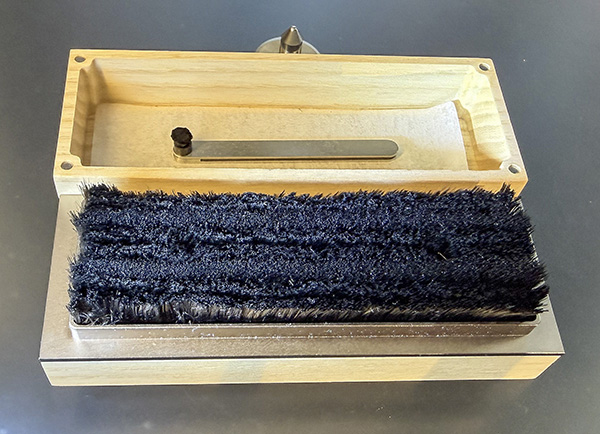
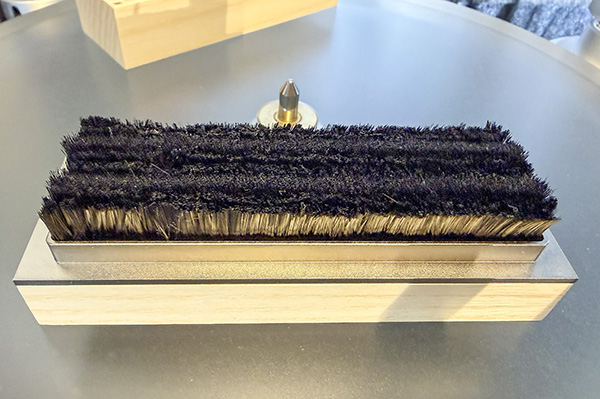
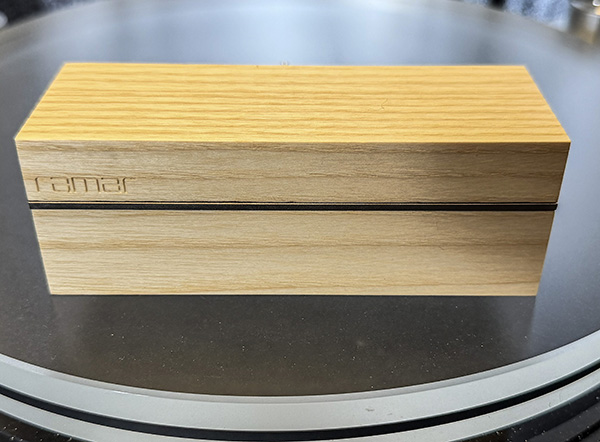
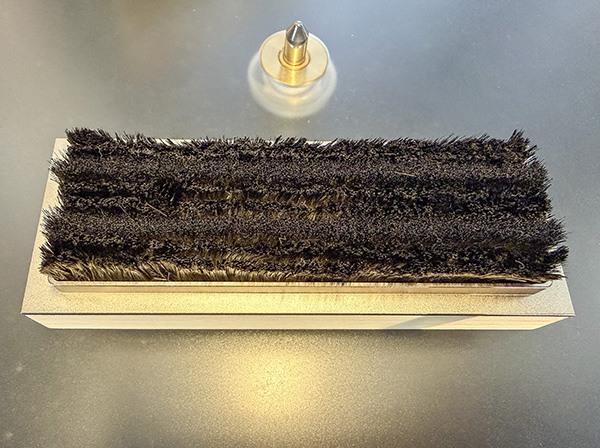
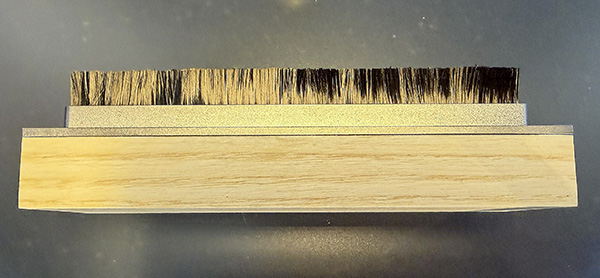
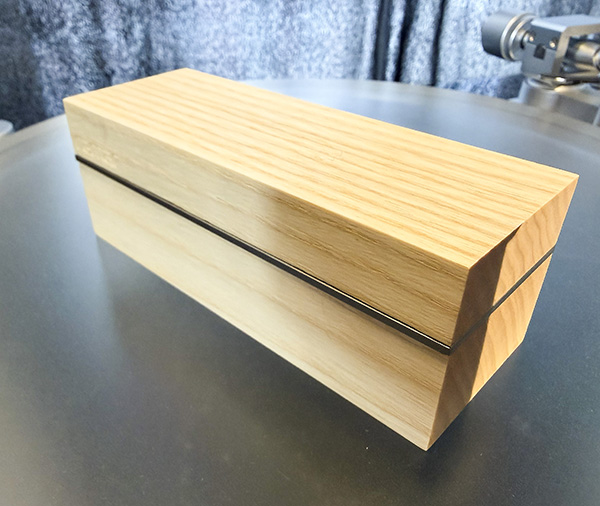
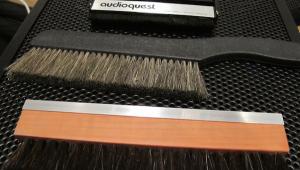
Within weeks of my return from Munich, Record Brush Joni, which is described as being “characterized by a strikingly light grain with different colours,” arrived, complete with a small stylus brush magnetically housed in its flip-top handle. Its wooden case measures 5 x 2 x 2in (w/h/d). The brush itself embeds in the top handle, which lifts to reveal seven rows of dense bristles — soft yet firm.
“Basically, all nine of our differently finished brushes have identical bristles,” Vasev told me over email. “Six double rows of carbon fiber and two rows of goat hair. The [handle] of the brush is milled from a single wooden blank. I wanted to build the brush so that it doesn’t look like a brush. I wanted to create an object that makes you wonder what it might be, and what’s inside. Every brush has 27 single parts. All of them are made specially for us in Germany and various EU countries. The bulk of the parts — magnets, etc. — are hidden, so from the outside everything looks very simple. The assembling of a single brush takes up to 4-5 hours.”
Ramar use only standard woods — walnut, ash, and cherry — with an eye towards sustainability. Ramar also replaces and repairs the brushes and bristles as needed. All of their wooden finishes are oiled to maintain the natural wood color, which is said to make the surface abrasion-proof and dirt resistant.
I asked Vasev how he compares his brush to the very similar looking Ursa Major brush, which is unavailable in the U.S. “I really don’t like to compare our brushes with them,” he responded. “Everything there is made by machines, so they can offer the brushes at low price.”
I wanted to get more history about the man and the company, and Vasev was more than happy to share. “It took me almost two years (parallel to my employment at the German Bundestag) from the idea to the first small production batch of brushes,” he continued. “I conducted many tests to find out what works best. Back then, I had more than 10 years [of] woodworking experience, but no clue about brushes. As I started developing the brushes, I started researching what brushes were available, their pros and cons.
“I soon realized that the vinyl community is very divided when it comes to the type of fibers used for the brushes: carbon fiber or goat hair,” Vasev continued. “Some say that brushes with carbon are the best, others swear by brushes with natural fibers — especially goat hair. I wanted to combine the best properties to achieve the best cleaning effect. I began experimenting with the positioning and number of the different rows of bristles. I decided that six rows of carbon fiber and two rows of goat hair in this current position works best. Every single part of the brushes, the record weight, and stand are developed by me.”
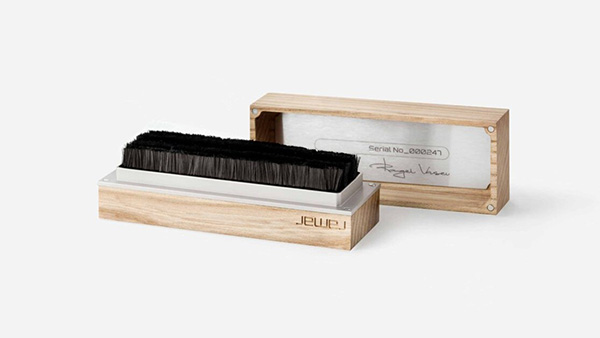
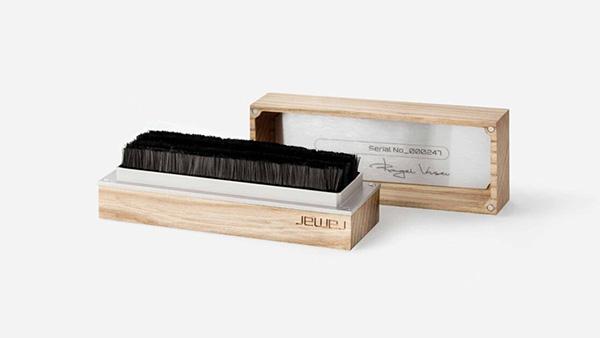
Each Ramar brush includes a stylus brush and serial number (as seen in the stock shot above). The flip-off handle is magnetically attached to its case. From the provided specs, we learn: “Body — 3D printed PETG filament — Polyethylene terephthalate glycol-modified is a durable and long-lasting material for interior applications. PETG has favorable product qualities, is food-safe, resistant to chemicals.”
Brush It, Brush It Good
The Ramar Record Brush Joni is a joy to use. Despite its substantial build, the flip-top handle with the embedded brush felt weightless in my hand. In fact, the bristles are the softest and densest I’ve encountered in any brush. The handle’s weight distribution seems calibrated for its exact function. Using the Joni reinforced record cleaning as an important ritual — like lowering the stylus into the grooves, or sliding a disc into its sleeve and jacket. The Ramar Joni became part of the process, a meditative instant of focus before the joy of playback.
The Joni works like any record brush — bristles turning left to right as the LP spins — but with precision and refinement. Holding the brush at its midsection, case in the other hand, I brought it to the spinning record on my turntable and watched — and practically felt — it capture every dust particle. Once you learn to leverage its weight, cleaning becomes an elegant dance. The magnetically attached stylus brush performs equally well.
Conclusions
Does the Ramar Record Brush Joni work better than that cheaper EDA, or a shaving-style brush? Absolutely. Although I do like those lightweight, cheaper record brushes with bulbous handles and fan-shaped bristles, the Ramar Record Brush Joni operates in another league entirely — superior in build quality, function, and execution.
The Joni’s weighted handle and dense, soft, yielding bristles remove dust better than anything I’ve tested. The brush feels exceptionally well-made — like a fine hairbrush, or a first-pressing Blue Note LP jacket from the 1960s. The craftsmanship and build quality surpass every other record brush on the market. It’s expensive, yes, at — but if you demand the best in quality and execution, then the Ramar Record Brush Joni stands alone.
For more about Ramar, go here.
To find an authorized Ramar dealer, go here.
Author bio: Former musician, former artist, and former legal wastrel Ken Micallef has written numerous hi-fi equipment reviews for Stereophile and Analog Planet, and his byline has also appeared within Mojo, Electronic Musician, and The Grammys. You can also find him at YouTube (Ken Micallef Jazz Vinyl Audiophile).
Footnote 1: The Ramar Record Stand (€89) consists of ten stubby tubes in various lengths, with a circular metal grid at its center. The stand is sturdier than it appears, and can easily hold up to six albums. “The stand was born as part of the packaging of the record weight to ensure safe delivery,” Vasev recalled. “But I wanted to make it more sustainable, and came up with the idea to use it as a record stand. It works well also as a phone or tablet stand.”























 |
Equipment Reviews | |
The Gruvy Awards | |
Blogs Analog Tips | Columns Music | |
Show Reports | |
News Resources |
 © 2026 AnalogPlanet
AVTech Media Americas Inc.
All rights reserved