


Soulines tt23 Turntable
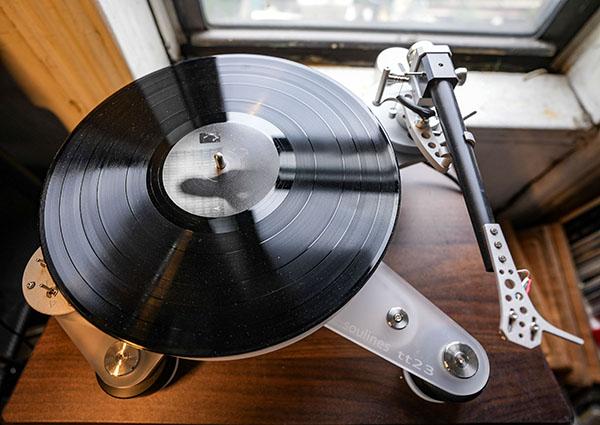
Serbian manufacturer Soulines name and market their turntables by using what are known as numeronyms, a number/word combination that holds deeper meaning. These table names include the tt42, tt9, the Kubrick DCX, and their latest offering, the tt23 turntable. For those who might think the number 23 is a curious choice, it bears further investigation before we get into the testing.
23 Skidoo
The number 23 is part of what is known as the “23 enigma,” which is built around the belief that 23 has a deeply cosmic secret significance that has shaped the course of world events. Here are but a few examples. In 1960, novelist William S. Burroughs (Naked Lunch) met a sea captain by the name of Clark who bragged that he had sailed for 23 years without an accident; later that day, Clark’s ship crashed, and the captain and his entire crew perished. In the 2007 film The Number 23, starring Jim Carrey, his character is obsessed with a book that mirrors his life, citing the number 23 as an omen of death. Human cells contain exactly 23 pairs of chromosomes. The Earth’s axis is tilted at approximately 23.5 degrees, which creates our planet’s changing seasons. It takes an average of 23 seconds for blood to circulate through the entire human body. (Footnote 1)
Soulines further elaborates on their application of the enigma of 23 on their official site: “Besides personal importance for us, the number 23 holds significance in various contexts, including mathematics (unique properties of the number 23), human biology (23 pairs of chromosomes), religion (Psalm 23), and numerology and astrology (angel number and the number of creativity). All mentioned properties of the number 23 almost perfectly match the tt23 turntable design principles and performance abilities.”
Now that we know the reasoning why, let’s find out what the tt23 turntable is actually all about.
Specs & Features
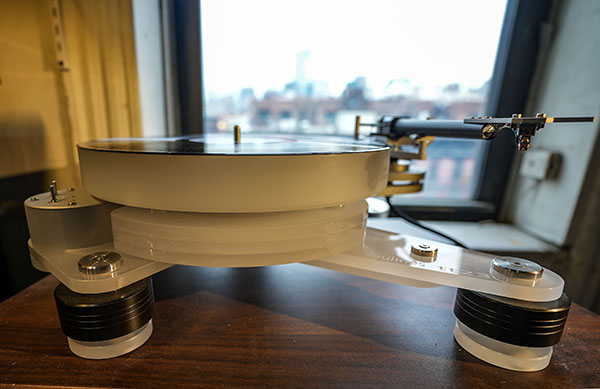
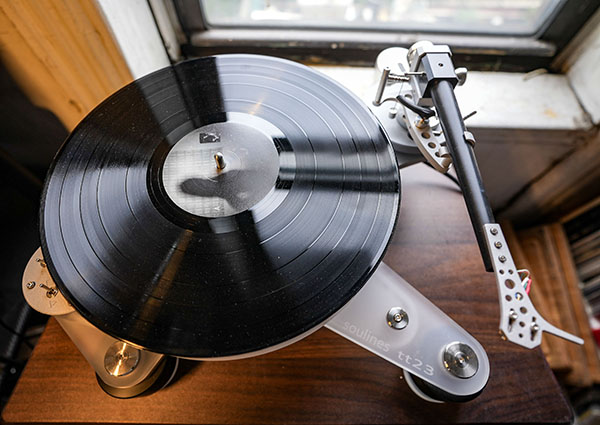
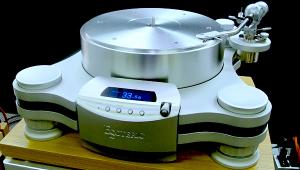
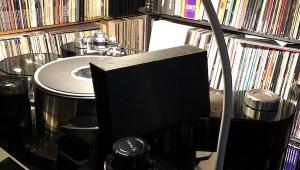
The Soulines tt23 turntable ($6,006) means business. The entire thing is machined from triple-layered cast acrylic, Delrin (POM engineering plastic), and aluminum. The tt23 is light but rigid — a combination that works in theory, but is harder to pull off. The logic is to keep mass to a minimum so resonances can’t build up, can’t store, can’t ingest, corrupt or foul your music like some malevolent invading force. (Forces begone!) In theory, this design philosophy should produce a quiet turntable that reveals potent dynamics, impressive resolution and detail, and an unerring sense of tone and wholeness.
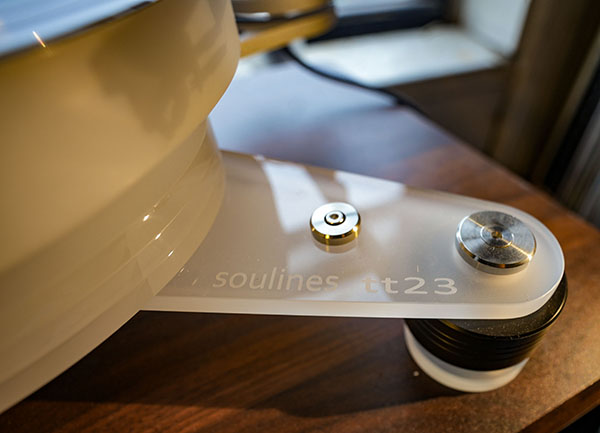
Soulines didn’t leave the tt23’s plinth geometry to chance. The dimensions and odd, low-slung, tripod-rambling-across-Mars shape of the main plinth and sub-plinth were reportedly dialed-in using the Golden Ratio and Fibonacci sequence, two closely intertwined mathematical concepts. The hope is uniform vibration damping and reduced inertia across all three axes, referenced to the center of mass, and, again, with lower noise being the goal. Gödel, Escher, Bach, anyone? (Footnote 2)
The tt23’s 40mm-thick, 3.5kg cast acrylic platter is not as heavy as it looks. It easily lifted out of its foam lined shipping box. (See my official tt23 unboxing video on our YouTube channel above.) Paired with an “advanced main bearing” (their words), the tt23’s platter spun easily by finger power, a sure sign of smooth bearing quality and proper machining and alignment. A 1.0mm recess on the platter surface is intended to cradle an LP’s paper label, and (hopefully) ensures dead-flat record seating. The included Soulines tt clamp assists in the task.
That main, inverted-type bearing features a stainless-steel outer cup, brass spindle sleeve, stainless-steel spindle, and Delrin thrust plate, to which the Delrin subplatter is rigidly secured. The solid aluminum armboard and main bearing mount directly to the aluminum sub-plinth, which is then 3-point-coupled to the main plinth via rubber-cork washers of varying thickness and diameter). The Delrin motor assembly bolts rigidly to the main plinth, topped off with toggle control switches.
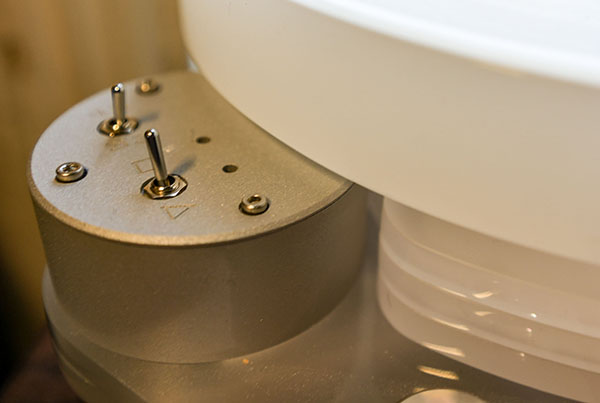
Power comes from the same DC motor found in Soulines’ top-tier tables, but it still terminates in an average wall wart. The tt23 is electronically controlled for speed adjustment, as 33rpm and 45rpm and power switching is handled by dead-simple, well-illustrated toggle switches. Meanwhile, the supplied rubber belt slipped securely over platter and motor pulley stub.
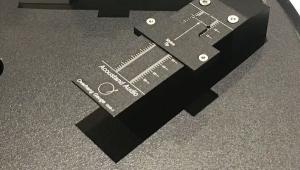
The tt23 ships ready to play, and it is pre-mounted with a Soulines KiVi M3 tonearm and aforementioned tt clamp. It also comes with an architecturally handsome acrylic dust cover and a decent cartridge alignment protractor made of 300g paper stock, with Baerwald, Loefgren, and Stevenson options all present. The tt23 stands 17 x 7 x 14in (or 440 x 180 x 355mm; w/h/d), and it weighs 30.86lb.
Setup
I gotta say, Soulines’ turntable and tonearm manuals were among the finest I’ve ever seen, regardless of price. It’s beautifully illustrated from multiple angles, with clear, painstakingly concise step-by-step instructions, the manuals were a thing of beauty.
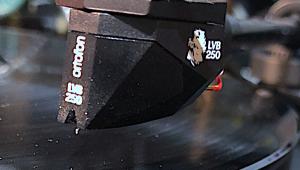
Setup was reasonably straightforward. The massive platter slid easily and securely over the spindle. The tonearm on my test tt23 table was outfitted with the excellent Dynavector Te Kaitora Rua MC cartridge ($3,650), which had come direct from a show. I checked and adjusted alignment with the Feickert Universal Protractor.
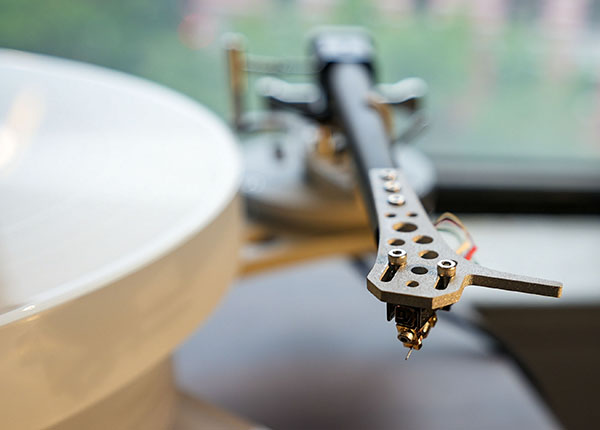
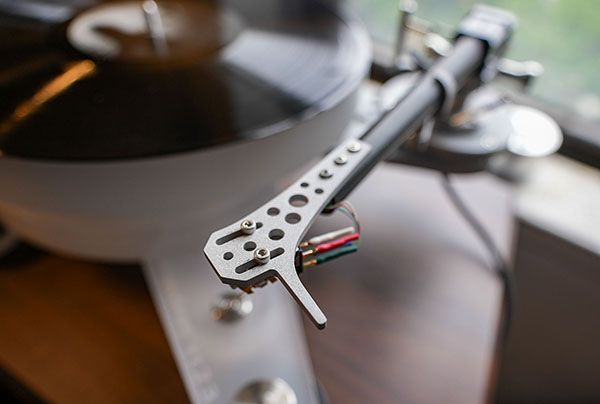
I particularly like the supplied and attached tonearm counterweights for dialing in VTF. As smooth as silk and beautifully machined, the two weights — one larger, one smaller — allowed me to correctly and easily set the Dynavector cart’s suggested 2g tracking force. And, like magic, after rotating the weights, they stayed put and stayed in place, with no interior screw tightening required.
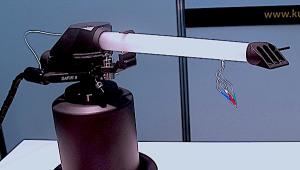
The tonearm is a thing of beauty too — its tapered wand and blocky, Brutalist, all-aluminum collar housing the transit screws and anti-skate rods make for a strong visual statement.
A few odd ergonomic choices to note, however: 1) the adjustment for the cueing lever support platform is tucked around back, and 2) using a DIN connector rather than the standard (in the U.S., that is) dual RCA jacks for the turntable-to-phono-stage connection — particularly notable over here, since neither the DIN connector nor interconnects were included. Many potential Stateside consumers won’t have a spare DIN cable lying around, so, at its palindromic $6,006 price point, Soulines should include them with the tt23. Full stop!
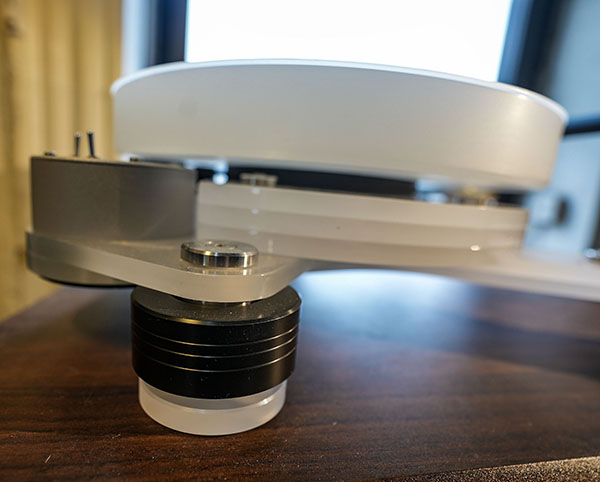
Three acrylic pads are supplied to fit under the three massive footers. Adjustable and easy to rotate, leveling was easy as pie — blueberry pie, to be exact.
I didn’t use the squarish acrylic dust cover, which looks like a knockoff of the one supplied for the Rega Research P8, but it sure looks cool, if that’s your thing.
Listening Sessions
For my tt23 review, I employed Tavish Design Adagio, Manley Chinook, and Allnic Audio H-5500 phono stages; a Luxman L100 Centennial integrated amplifier; and DeVore Fidelity Gibbon Super Nine loudspeakers. Cabling came courtesy Auditorium 23, AudioQuest, and Triode Wire Labs.
Since AP editor Mike Mettler and I are working on a joint review of the recently released UHQR 45rpm 2LP edition of ZZ Top’s seminal 1973 LP Tres Hombres, I decided to compare it to its also recently released Warner Records version (via Rhino). I also cued up Boards of Canada’s Inferno (2026; Warp WARPLP496X), Blaxploitation composer Willie Hutch’s The Mark of the Beast (1974; Motown M6-815S1), and Belgian songstress and smoky atmospheric conjurer Melanie de Biasio’s A Stomach Is Burning (2019; Igloo IGL193LP), along with Steamin’ With the Miles Davis Quintet (1961; Prestige PRLP 7200) and assorted other Blue Note and Prestige titles.
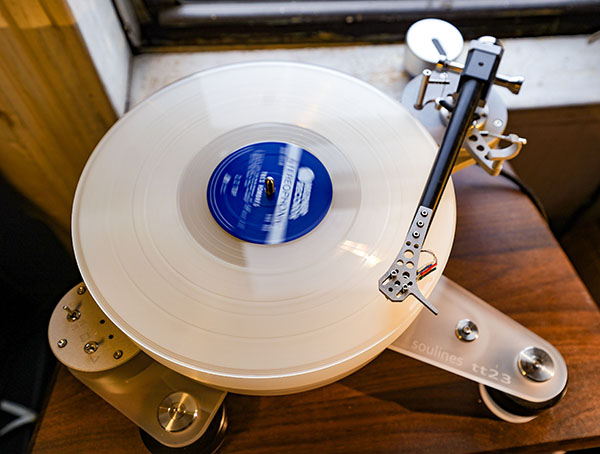
The Soulines/Dynavector combo wasted no time sorting out the two ZZ Top reissues. The UHQR edition hit hard, with tremendous bass, clear mids, and a surging treble that worked the DeVore Super Nine’s tweeter like a speed bag. The Warner Records edition pulled back a little but was better focused, with cleaner bass and treble and sensuous tone, though with less raw energy overall. The tt23/Te Kaitora Rua team acquitted itself cleanly — lifelike pacing, tonal liquidity that breathed and flowed, and enough boogie factor to ride ZZ Top’s turbulent Texas rock & roll without breaking a sweat.
Boards of Canada’s long-awaited 2026 return hits every mark the Scottish duo set in their early catalog. Inferno abounds with gooey, stalker beats colliding with nauseous, eerie samples and melodies, with their trademark unsettling artwork also still present. Packed with horror grooves, dizzying rhythms, alien voices, and creeping obsessions, Inferno thrills and chills.
The Soulines/Dynavector pairing wrung out every ounce of weirdness the record could muster, framing it all in a large, vividly rendered soundstage — as tall as it was deep. I zoned out completely, lost in the spell. Big beats assailed my skin. The 2 and 4 accent pressure landed like a crack to the neck. The tt23 played it all with tonal wholeness, gripping resolution, good scale, and an atmospherics sense of production and staging.
Spinning The Police’s 1978 A&M debut LP Outlandos d’Amour and its first single, “Roxanne” (Side 1, Track 3), landed physical and punchy, with Sting’s bass warm and rolling — especially on “So Lonely” (Side 1, Track 2), where, near the end, someone at the board literally cranked the low end. A 2009 12in 45rpm reissue of Radiohead’s 1997 “Karma Police” single delivered a fat bass-drum thud, clean enunciation from vocalist Thom Yorke, and a production that throbbed from the first downbeat.
At $6,006, the Soulines tt23 turntable impresses: natural pacing, genuine flow, and a solid sense of drive across every genre I threw at it. Pairing it with the $3,600 Dynavector Te Kaitora Rua felt right — tonally rich, dimensionally full, and as detail-oriented as I could ask for. The soundstage could turn diffuse at times with imaging less locked-in than laser-precise, but music bloomed and expanded, strode like a galloping horse, and never played it cool.
More atmospheric than concrete, more diffuse than missile-clear — that’s the tt23’s character. But that same quality feeds its weight and scale, so I’ll take the trade.
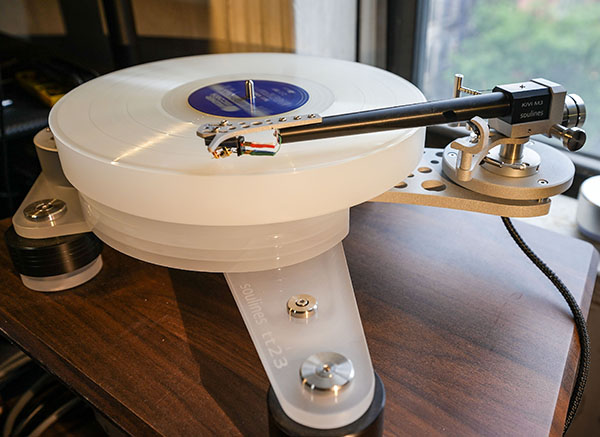
Swapping the Tavish Design Adagio for the Manley Chinook phono stage tightened things considerably: better focus, more gleam, and greater incisiveness. The tt23/Te Kaitora Rua tandem turned more exacting through the Manley, if slightly less emotional than through the Tavish. Boards of Canada hit with tremendous thwack, and a genuine sense of doom. A Kenny Barron jazz-trio record, however, felt meatier and more fleshed-out through the Tavish, with the Manley trading some warmth for precision.
For additional perspective, I pulled in my rebuilt 1957 Thorens TD 124 turntable fitted with a new Ortofon MC X30 cartridge. The shift was immediate, from atmospheric and diffuse to deeply layered, singular, and demonstrative. The Thorens table played like a surgical instrument: insane detail retrieval, increased separation, a more determined rhythmic sense and raw force. The Soulines, by contrast, sounded lusher, less acute, less rigorous — ear-candy-friendly in the best sense.
It’s a legitimate face-off. A refurbished Thorens TD 124 (roughly $3,000–$7,500) with my Korf TA-SF9R tonearm ($2,800) and the Ortofon MC X30 ($799), versus the Soulines tt23 ($6,006) with the Dynavector Te Kaitora Rua cart ($3,650) are two very different machines with very different personalities. The Soulines table brings vast soundstage, romantic color, and tonal beauty. The Thorens brings rhythmic muscle, energy, and relentless detail — though occasional treble peakiness could be a liability in brighter systems. (Choose your fighter.)
Conclusions
The Soulines tt23 turntable as fitted with the Dynavector Te Kaitora Rua cartridge sang with color, weight, and a soundstage that breathed. Smooth without being sleepy and unfussy without losing personality, this table handled hip-hop, jazz, and electronic music with equal aplomb. It offered a big stage, an easy groove, and zero drama.
At $6,006, it faces serious heat from the comparably priced Technics SL-1210GME, VPI Prime 21, MoFi MasterDeck, Clearaudio Performance DC, and Rega Planar 10 — but it more than holds its own. Having spent time with all of those tables, I’d call the Soulines tt23 the most atmospheric of the bunch. It’s gentler, equally colorful, and possessed of its own quiet authority. Match the Soulines tt23 with a strong cartridge and a sympathetic phono stage, and you’ll find that this thing flies. I give it a high recommendation in a crowded field.
For more about Soulines, go here.
To find an authorized Soulines distributor, go here.
Author bio: Former musician, former artist, and former legal wastrel Ken Micallef has written numerous hi-fi equipment reviews for Stereophile and Analog Planet, and his byline has also appeared within Mojo, Electronic Musician, and The Grammys. You can also find him at YouTube (Ken Micallef Jazz Vinyl Audiophile).
Footnote 1: Through Headhunters drummer Mike Clark and a friend, Frank Katz, I learned that jazz legend Herbie Hancock holds a deep reverence for the number 23, and he even used it as a chant and meditation focal point in pre-concert rituals the pioneering fusion band shared together. (Clark’s iconic groove on Hancock’s “Actual Proof” [Side 1, Track 2] — from his September 1974 Thrust LP, on Columbia — earned him wide acclaim as a master of funk and fusion drumming.)
Footnote 2: For more on this interconnected point, go here.




















 |
Equipment Reviews | |
The Gruvy Awards | |
Blogs Analog Tips | Columns Music | |
Show Reports | |
News Resources |
 © 2026 AnalogPlanet
AVTech Media Americas Inc.
All rights reserved