


Musical Fidelity Nu-Vista Vinyl S Phono Preamp

I get nervous when I hear that an audio company I like is suddenly under new ownership. Are the new owners planning to carry forward the legacy of the company’s founders, or will they try to move things in a different direction? Worst of all is when just the brand name is sold off to some marginally connected manufacturer so that they can slap a prestigious name on some cheap garbage, such as the $15 Nakamichi-branded kids’ headphones I recently saw for sale at Walmart. Then there are companies that are either gone altogether, like Thiel, or seemingly dormant, like Wadia and Infinity. These companies were once cornerstones of the high-end audio world and are now either dead or surviving as a website with promises of upcoming activity that rarely happens.
On the brighter side, there are plenty of cases where a new owner seems to understand what they have bought and builds on the strengths of the brand while moving it forward. Klipsch and McIntosh are good examples. Now I can confidently add Musical Fidelity to that list: The original owner passed the reins to Austria’s Audio Tuning in 2018.
Founded in 1982 by Englishman Antony Michaelson, Musical Fidelity always wore its Britishness proudly. So when they ran into a trademark dispute just as they were starting out, which prevented them from using the brand name Musical Fidelity in the U.S., the obvious choice was to name it British Fidelity for a couple of years until the dispute was resolved.
Michaelson himself is the quintessential Englishman. A few years back, he asked if we could meet up in New York to discuss Musical Fidelity’s plans. Naturally, he insisted we do it while enjoying high tea at the Plaza Hotel. One thing I learned then is that it’s always Antony, never Tony, and don’t even think about sticking a misplaced h into his first name.
In its early days, Musical Fidelity gained a reputation as one of the first British hi-fi manufacturers to take on the big heavyweight amplifier guys from across the pond such as Krell and Mark Levinson. The first real shot across the bows came in 1986 with a massive bruiser of an amp called the A370, which could deliver 185 mostly class-A watts per channel. It weighed more than 100lb. Apparently feeling that wasn’t enough, Michaelson followed it up two years later with the SA470, which weighed a shelf-busting 190lb: definitely a four-man lift, minimum. These were big, room-heating beasts.
Giant power-sucking amps weren’t an ideal choice for most British consumers, so Musical Fidelity also made a wide range of smaller, more affordable amps, better scaled to typical British systems and rooms. One highlight was the luscious-sounding A1 integrated, which packed a bite-sized 25Wpc taste of class-A goodness into a compact amplifier that ran hot enough to fry your eggs on, sunny side up. The demo A1 we had running at Sound by Singer in the late 1980s ran so hot that it managed to melt the plastic banana plugs on the ends of the speaker cables attached to it.
Musical Fidelity has never been thought of as a tube-amp company, but in the late 1990s, Michaelson started exploring the qualities of a type of tube called the nuvistor. Developed toward the end of the 1950s, just as tubes were starting to be replaced by early transistors, nuvistors came in a tiny metal-and-ceramic envelope, about the size of a large peanut. They didn’t look like tubes and ran much cooler than the typical glass equivalent. The military used them because of their ruggedness and relative immunity to electromagnetic interference. In 1976, when Soviet fighter pilot Viktor Belenko defected to the West by landing his MiG-25 interceptor jet at a civilian airport in Japan, the US authorities were astonished to discover that most of the plane’s avionics circuitry used nuvistor vacuum tubes. One theory was that this design choice was intended to make the plane less susceptible to electromagnetic-pulse weapons, which could knock out a plane’s electronics.
The first “Nu-Vista” (get it?) product from Musical Fidelity was a preamp launched in 1997; it was followed by a limited series of amplifiers, preamps, and a CD player. I owned a Nu-Vista M3 integrated for a while in the early 2000s. As fine as it sounded, it wasn’t a great match for the speakers I was using at the time, so I moved it along. Nu-Vista products were strictly limited editions because, word had it, nuvistors were in short supply. After a few years, Michaelson moved to using another rare subminiature tube called the 5703WB, dubbing it the Tri-Vista. This too was short-lived.
Musical Fidelity’s new owner is Audio Tuning, the growing hi-fi empire owned and operated by Austrian Heinz Lichtenegger (Footnote 1). He started out by creating the Pro-Ject turntable company in 1991, and over the last 35 years has built steadily from that humble foundation to become a serious player in the global audiophile market. 1991 was around the time the Iron Curtain, which had divided Europe, fell. Lichtenegger was a pioneer in leveraging Eastern-bloc manufacturing expertise to make audio components in Europe without incurring prohibitive labor costs.
Since taking over Musical Fidelity, Lichtenegger has moved to strengthen the brand, making the product lineup more logical and reintroducing products that had fallen by the wayside, such as the rare M1 turntable, now revised to become the M8xTT; a new, cooler running version of the little A1 integrated; and a revived Nu-Vista series, their current flagship product line. They must have found a hidden warehouse full of nuvistor tubes. The relaunched Nu-Vista series now comprises nine products including integrated amps, preamps, power amps, a DAC, and two phono preamps.
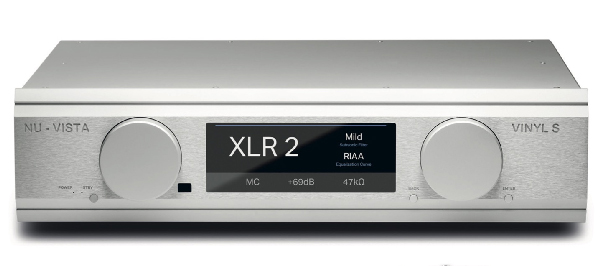
The latest to be launched is the Nu-Vista Vinyl S phono ($6,999), a slightly simplified version of the top $12,999 Nu-Vista Vinyl 2. To be clear, “slightly simplified” doesn’t mean “stripped down.” The Vinyl S is bristling with useful features.
One thing that has changed with Musical Fidelity’s new owners is where the products are designed and built. The shipping box for the Nu-Vista Vinyl S says “Made In EC” (whatever that means), while the unit says “Designed in EU and Built in EU.” Word is that the Vinyl S is built in Slovakia, while the design work is shared between Audio Tuning’s operations in Slovakia and their Vienna, Austria, headquarters.
Interestingly, the Nu-Vista 600.2 amplifier Martin Colloms reviewed last year for Stereophile was made in Taiwan. I have seen Nu-Vista EU and Asian products sitting side by side. I found it impossible to tell that they were made in different factories on opposite sides of the planet.
When you compare the features and specifications of the Vinyl S to the bigger Vinyl 2, you start to wonder why anyone would pay an extra $6,000 for the big guy. The Vinyl 2’s chassis is taller and deeper, and it weighs about 18lb more, but the two phono preamps offer an identical feature set and very similar circuit designs. One key difference appears to be the size of the power supply — and the Vinyl 2 allows you to add an outboard power supply called the Nu-Vista Uni PSU. As I tried to learn more about the Vinyl S, I saw a few press articles that described it as “compact” — but that’s a lie. At nearly 40lb, the Vinyl S is a beast. It’s heavier than many power amps I have owned, and it fills every inch of a shelf on most standard audio racks.
With four cartridge inputs — two balanced using XLR input connectors and two single-ended with RCAs — the Vinyl S is well-prepped for systems with multiple turntables and tonearms. One of my regular setup customers in New Jersey has three turntables connected to his system, one of which has two tonearms. He could run the whole schmear into the Vinyl S and get rid of his four separate phono preamps.
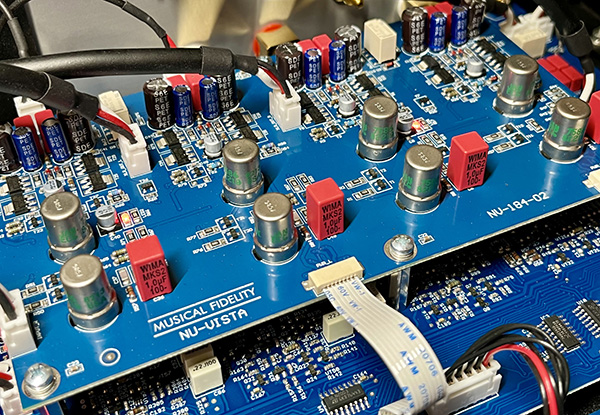
Over the last few years, Heinz Lichtenegger has become a big proponent of leveraging the naturally balanced output signal delivered by most cartridges, to lower noise, and the Vinyl S’s two balanced XLR inputs reflect that. The balancing act doesn’t end there however, because the internal circuitry is entirely differential from input to output. That means each channel uses a mirror-imaged pair of circuits, one for each phase of the balanced signal, canceling out noise common to both. The circuit uses three discrete gain stages with a split passive RIAA EQ curve tucked between gain stages. The eight nuvistor tubes — four per channel — are used to buffer the output section while endowing the circuit with some thermionic color and richness.
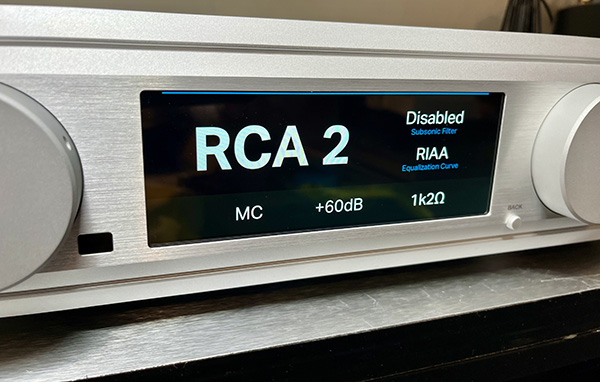
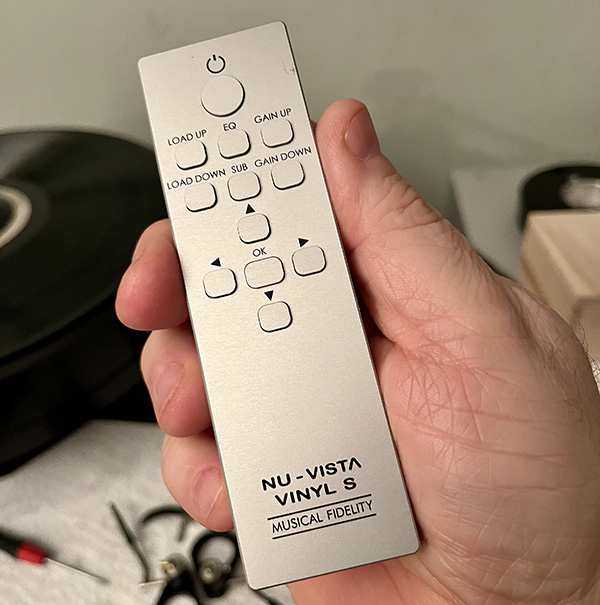
A clear OLED display big enough for boomers like me to read from across the room allows you to set up each input using either the slim aluminum remote or front-panel buttons. In the moving magnet setting, you get four gain options between 40 and 49dB, and capacitive load adjustable in eight steps from 50 to 400pF. The MC setting boosts the gain another 20dB, to between 60 and 69dB, with nine resistive load options from 5 ohms to 47k ohms. Having a 47k ohm load option on the high-gain MC input means the Vinyl S should be a good match for low-output moving iron (variable reluctance) cartridges such as those available from Grado and SoundSmith.
In addition to the standard RIAA EQ curve, you can select either the Decca or Columbia curves for early pressings. Two bass-rolloff (rumble) filters are available: either a gentle IEC curve starting at around 100Hz, or a steeper subsonic cutoff below 20Hz. I would have loved to see a mono switch, but there isn’t one. A mono switch can be a real help for curbing surface noise when playing mono pressings with a stereo cartridge.
I have never heard the Vinyl 2 in my system, but looking at the manufacturer’s specifications, the only significant difference I see (other than size and weight) is a small uptick in noise in the smaller preamp. For most of my time with the Vinyl S, I used my Lyra Atlas λ Lambda cartridge, but I also tried it with the lower-output Sumiko Oriole discussed below and the even-lower-output Ortofon MC 90X. Noise wasn’t noticeable with any of them. With my ear next to my speaker’s tweeter at a loud volume setting, I heard a low-level hiss, but from even a foot away I no longer heard it.
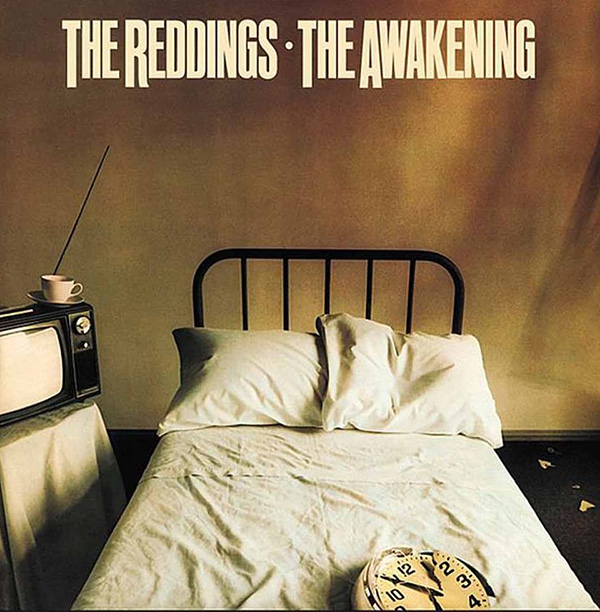
Right out of the gate, the Vinyl S gave me the kind of bold and powerful sound that made me want to crank up the volume. The Reddings were a soul-funk group formed by Otis Redding’s sons Dexter and Otis III and Mark Lockett in the late 1970s. While they never got much traction, their debut album The Awakening (Believe In A Dream JZ 36875) includes some impressive slap-bass playing by Dexter. “The Awakening (Part 1)” has been covered by slap-bass legend Les Claypool, but I prefer the Reddings’ original, which was released in 1980. With the Vinyl S, bass was tight and powerful but with enough detail to let you hear Dexter’s fingers slide across each winding on his bass strings. The record starts off with Dexter double tracked, with bass lines panned to the left and right and the drums smack in the center. It’s not a natural soundstage, but it feels like he’s having a conversation with himself. This is exciting stuff, and the Vinyl S kept it all organized and focused.

To chill out a bit, I put on the title track from Shelby Lynne’s Just a Little Lovin’ (Analog Productions APP 041). Lynne recorded the album to analog tape at Capitol Studios in LA in 2007 with industry veterans Phil Ramone and Al Schmitt at the controls. The album was mastered by another legend, Doug Sax. Sadly, all three are now gone, but this album stands as a throwback to an earlier era, with its intimate, stripped-down sound and classy arrangements.
Using the Ortofon MC 90X into the Vinyl S, Lynne’s voice, recorded with a vintage RCA ribbon microphone, was luscious and warm, and while the bass is a little fat, as is common with most modern mixes, the detail and color are exquisite. If this record played through this front end doesn’t convince you about the capabilities of an all-analog source, I don’t know what will.
The Musical Fidelity Nu-Vista Vinyl S promises a huge chunk of what you get with their top Vinyl 2 model, at just over half the cost. Its flexibility makes it perfect for people who run several turntables, arms, and cartridges — but even if you’re analog-monogamous, the Vinyl S will extract the best from your chosen cartridge with verve, color, and vividness.
Editor’s note: This review first appeared in our sister site Stereophile’s May 2026 print edition, and it is shared here on AP with their kind permission. For more of Michael Trei’s Spin Doctor columns (this review is the first part of installment #36) — go here.
Footnote 1: Musical Fidelity, A Division of Audio Tuning Vertriebs GmbH, Margaretenstrasse 98, A-1050 Vienna, Austria. Tel: +43 50443. Email: info@musicalfidelity.com. Web: Musicalfidelity.com. US distribution: Harmonia Distribution 1712 Corrigan Ct., La Verne, CA 91750. Tel: (909) 931-0219. Email: Info@harmoniadistribution.com. Web: harmoniadistribution.com






















 |
Equipment Reviews | |
The Gruvy Awards | |
Blogs Analog Tips | Columns Music | |
Show Reports | |
News Resources |
 © 2026 AnalogPlanet
AVTech Media Americas Inc.
All rights reserved