


Parks Audio Waxwing Phono Preamp
In 1936, the great blues pioneer Robert Johnson recorded his song “Cross Road Blues,” which many interpret as his telling the story of how he went to a crossroads and fell to his knees to make a deal with the devil, selling his soul in exchange for musical genius. This interpretation is pure speculation; Johnson never mentions Satan in the lyrics.
But people who study Johnson’s brief career have noted how his guitar-playing skills took a giant leap forward after he wrote the song in the early 1930s.
This type of Faustian contract came to mind as I was digging into the mind-boggling capabilities of the Parks Audio Waxwing phono preamp. Most of us who get deeply involved in the process of buying, collecting, caring for, and ultimately enjoying vinyl records do so due to a committed belief that music sounds best when it is stored and reproduced from an analog source. The Waxwing rejects that thinking, converting the analog signal coming from your turntable to PCM digital, at 24 bits, presumably at 96kHz, since that’s what the DSP works at. Once you’ve made that leap and digitized the signal, everything becomes easier to implement, including the RIAA equalization curve, before it gets converted back to analog and sent on its way to the rest of your system.
The obvious question, then, is whether digitizing the source makes vinyl pointless, taking away the main reason we embraced analog in the first place. Or is it a brilliant, pragmatic move that opens up new ways to extract more music from a record? I feel it’s a bit of both.
Shannon Parks started Parks Audio in 2013 (Footnote 1). He wanted to make a conventional, affordable tube phono stage called the Budgie. He had already developed a number of tube amp kits and upgrades for classic amplifiers like the Dynaco ST-35, which he promoted on the DIY Audio forum. A one-man operation, Parks concentrates on one project at a time. After building Budgies for a few years, he discontinued that model and introduced the Puffin, a solid state, DSP-enabled phono preamp.
Breaking many of the hallowed rules of vinyl playback, the Puffin digitized the signal, motivated by Parks’ belief that by processing the signal using DSP, you can get better results and a nearly limitless ability to add features. In a conventional, all-analog phono preamp, a lot of the cost is in the filters needed to equalize the signal in a transparent way. In the digital realm, it’s an easy number-crunching problem, so there’s no need for the expensive, high-end filter capacitors and inductors used in a top-shelf analog phono stage.
The Puffin used a two-line display with a scroll wheel to adjust these features, but as Parks’ fertile mind expanded the list of adjustments through firmware updates, the Puffin’s user interface became cumbersome and awkward to navigate. The Waxwing solves that problem by moving all the controls to an app — iOS and Android are available — that communicates with the Waxwing using Bluetooth.
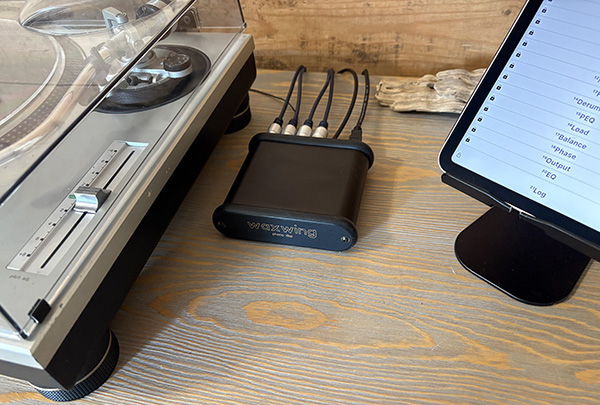
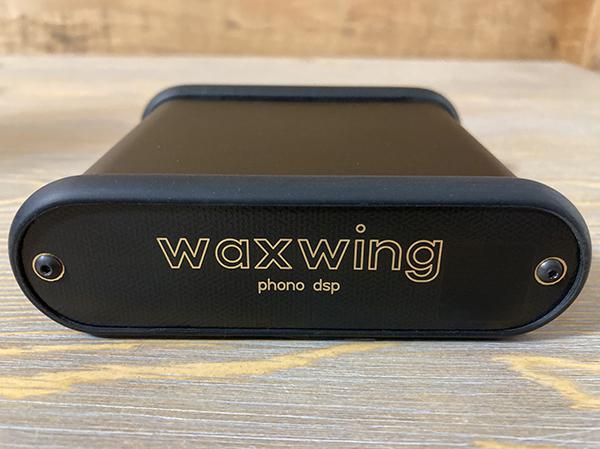
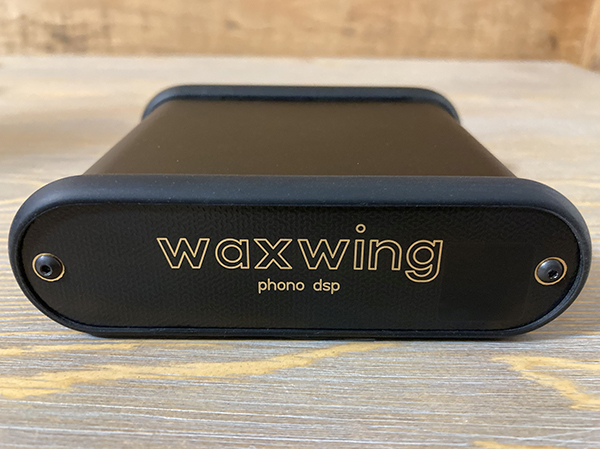
The Waxwing is a cute little thing, about the size of a Leica M6 lying on its back but weighing substantially less. You could easily tuck it away on the back of a shelf, where it would remain controllable via the app. There are no lights to indicate that it’s powered up, although you can see the telltale red glow of the TosLink optical output when it's on. Power comes from a tiny switch-mode wall wart, which connects to the Waxwing with a USB cable.
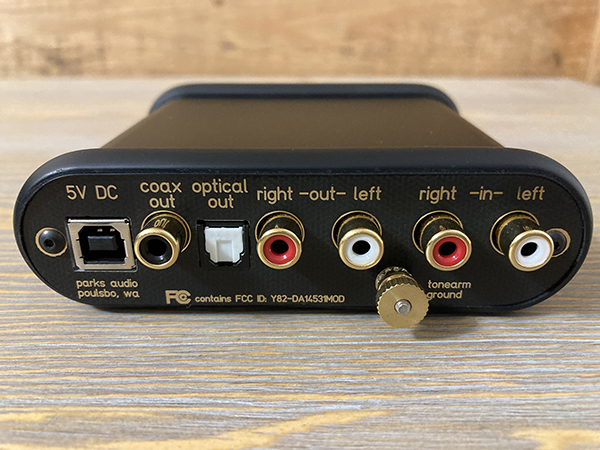
On the small back panel are left and right analog inputs and outputs along with coaxial S/PDIF and TosLink digital outputs. These allow you to play the Waxwing through an outboard DAC or connect the output to a computer audio editor like Audacity to digitize a record. The ADC and DAC in the Waxwing are, respectively, the Texas Instruments PCM1808 and PCM5102A, and as mentioned previously, DSP processing is performed at 24/96. Natively, the output is 96kHz, but this can be downsampled to 48kHz if you’re using an outboard DAC that isn’t capable of handling 96kHz. I mostly used the internal DAC, but I also connected it to my Denafrips Terminator DAC using an optical connection.
The level of control offered by the Parks Audio Waxwing is mind-boggling. All the expected stuff is there. The gain is adjustable from –4dB, for line-level sources, up to 72dB for very low-output moving coil cartridges. RIAA equalization is standard, but you also get a flat setting for line-level sources, and 10 presets for early LPs and 78s. You can custom-tune the EQ using turnover and bass-shelving controls.
Resistive and capacitive cartridge loading is one area where the Waxwing is limited. The Waxwing has just two resistive load settings, 47k ohms and 200 ohms, and a fixed capacitive load of 60pF. These are good compromises, but they are limiting. The DSP EQ, called Air, can simulate the top-end frequency response you get by adjusting the capacitive loading with a moving magnet cartridge.
The Waxwing boasts a wide range of other ways to tweak the frequency response. The Treble and Bass controls are self-explanatory, while Bass Boost acts only below 100Hz. Hi and Lo are much sharper bandwidth limiters, while PEQ is a single-band parametric EQ that’s useful for notching out a particular problem frequency.
The Warmth control reminds me of the tilt control found on older preamps made by Quad (Footnote 2), allowing you to tilt the frequency response over the full bandwidth. Each adjustment has a drop-down description box that tells you what it does and a frequency-response graph that lets you see the changes visually as you make them. But wait, there’s more.
Magic mode removes ticking and scratching from less-than-perfect records. The Phase control lets you invert absolute polarity for both channels or just one channel to help track down speaker-wiring problems. You can also listen to the L–R difference signal, which is useful for tweaking the channel balance.
I assumed that the De-rumble setting would be a traditional high-pass rumble filter at around 25Hz, but it’s cleverer and more sophisticated than that. It progressively collapses the lowest frequencies to mono, starting at around 120Hz, similar to how many records are mastered. But because you’re doing it at the playback end, it can also help to minimize problems with tonearm and cartridge resonance matching.
One of my pet peeves is phono stages that don’t include a mono switch for playing mono records with a stereo cartridge. Of course the Waxwing has one. Super Mono is also for playing mono records with a stereo cartridge. In Super Mono, the Waxwing monitors both channels and determines which one has the cleanest and quietest signal. It then selects left only, right only, or the combined signal, switching hundreds of times each second to give you the clearest signal possible.
The Waxwing can play either the left or the right channel through both speakers. Those of us with memories of equipment from 50 years ago will remember preamps that had a knob labeled stereo, mono, left, right, and reverse. One thing the Waxwing lacks is the reverse setting, which is useful if you hook something up backwards and suddenly the New York Philharmonic’s violin section is coming out of the right speaker.
What else? There’s a Tube setting that adds second-order harmonic distortion to mimic the sound of a 300B tube amplifier. The Tape feature adds third-harmonic distortion that’s supposedly similar to an Ampex tape recorder.
Finally, there are a number of useful setup tools including a pink-noise generator, a sinewave generator with adjustable frequencies, a crosstalk-measuring feature you can use to adjust your cartridge’s azimuth, and a clever speed checker that listens to the once-per-rotation click from the stylus playing in the leadout groove of a record and uses that to determine the platter speed.
There’s even a function called Grade, which “listens” to a record and assigns a letter grade for its condition. Finally, the Log setting will start a timer every time you are playing a record, allowing you to keep track of how many hours your stylus has played.
All these bells and whistles would be wasted if the Waxwing didn’t sound good, but sonically it punches way above its weight. To test some of the Waxwing’s party tricks, I pulled out the first record I ever bought, my plum-label UK pressing of 1969’s Led Zeppelin II on Atlantic. Back when I was nine, I thought I was babying this precious LP, but when I look at it today, and when I listen to it, it seems like something a record store would put in the $1 bin. Using the Magic setting didn’t make it sound new, but it did allow the music to come through much more clearly than it would with a regular preamp with no processing. I ran the Grade function on the LZII, and it earned a D+. That’s better than I expected, to be honest.
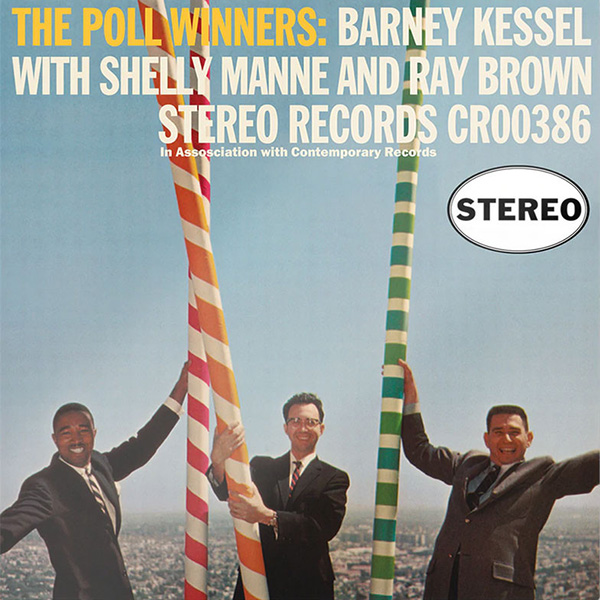
To check out something less compromised but still all-analog, I put on an original 1976 pressing of Straight Ahead by the Poll Winners (Contemporary S 78635) and played the song “Caravan.” This swinging West Coast jazz session was recorded by the great Roy DuNann, coaxed out of retirement to capture this reunion of three jazz legends. Guitarist Barney Kessel is the lead here, and the Waxwing delivered the warm, clean tone of his hollow body Gibson ES-350P guitar beautifully. Ray Brown’s acoustic bass sounded lean and clean, with no sign of the muddling that you can get from an acoustic bass that’s a bit overblown. Shelly Manne’s drums sounded as they should.
I don't have a bunch of $500 phono preamps available to make comparisons with the Waxwing, but I was able to put it head to head with my treasured, vintage, long-out-of-production Vendetta SCP-2B. Despite its age, this John Curl–designed preamp demonstrated why it’s so revered. It offered a slightly richer tonal palette and an even quieter background than the Waxwing. I had to constantly remind myself that the Waxwing costs just $500. I can’t name anything near that price that can do what it can do.
Much of today’s vinyl has gone through a digital step at some point between recording and pressing. All but a select few recordings made in the last 35 years were recorded digitally, and even reissues of older recordings from the analog era are frequently cut from digital files. Yet we still enjoy listening to those records — well, most of us do — and the best can sound incredible. Readers will recall the recent Mobile Fidelity debacle. The label was cutting vinyl from DSD files without telling us — yet the sound quality was excellent, proving that having a digital step isn’t a death sentence for musical enjoyment. For me, the Waxwing solidifies that impression. It also demonstrates what a fertile mind can create when let loose with DSP.
The question I'm asking — and I’m sure many others are asking — is does the Waxwing sound “digital”? For me the answer is no, not in a way I can point to and say "there, that’s digital." I find the sins of digital to be mostly of omission, and those are harder to recognize. Analog delivers just a little more body, color, depth, and vividness, although I’m pretty sure naysayers will say these qualities are no more than enjoyable colorations, and not accurate to the source. Assuming that’s true, I’m fine with it. To me, the Waxwing sounds like a good analog source, and you don’t have to sell your soul to the Devil to enjoy it.
Editor’s note: This review first appeared in our sister site Stereophile’s July 2026 print edition, and it is shared here on AP with their kind permission. For more of Michael Trei’s Spin Doctor columns (this review is the first part of installment #38) — go here.
Footnote 1: Parks Audio, Email: parksaudio@outlook.com. Web: Parksaudiollc.com.
Footnote 2: Current products from Bel Canto and Zesto also have a tilt feature.


















 |
Equipment Reviews | |
The Gruvy Awards | |
Blogs Analog Tips | Columns Music | |
Show Reports | |
News Resources |
 © 2026 AnalogPlanet
AVTech Media Americas Inc.
All rights reserved