


Hands On With the Cometa M2 Mixing Preamp
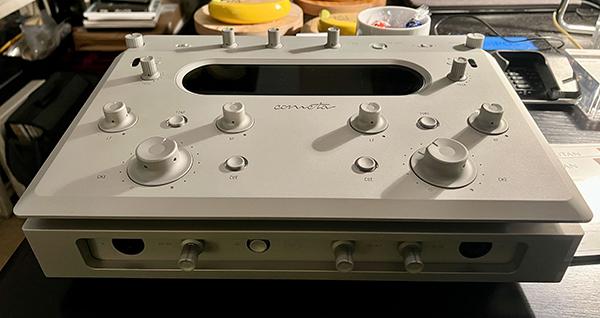
Not all audiophiles prefer to listen alone. We know that listening to music with others leads to a sense of community — and, ultimately, to more people becoming aware of the hi-fi universe and the gear that permeates it. The perfect example of this tenet is how hi-fi gear, DJ and club culture, and the pro-audio worlds all came together at a couple of recent events in Los Angeles on August 19-20, 2025 — events that were held not only to celebrate a new piece of analog gear, but some common heritage as well.
More specifically, August 19, 2025, marked the official launch date of a relatively new audio design company’s inaugural product — the Cometa M2 mixing preamp. (Cometa was founded in 2020.) This new analog component with some old-school attributes lent itself quite well to communal music listening, especially during its demo sessions at Common Wave Hi-Fi, an L.A.-area hi-fi dealership.
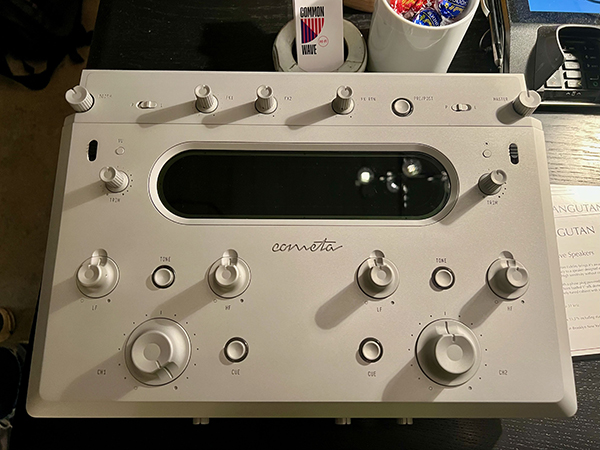
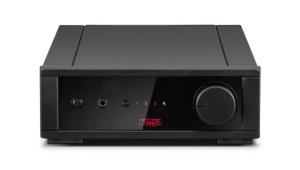
Fundamentally, the Cometa M2 is a rotary mixer, an all-analog device with two discrete channels incorporating two phono preamps — for MM, though an outboard step-up transformer can be used — and a headphone amp. (The same connection can be switched alternatively to plug in a microphone.)
At first glance, the Cometa M2 might seem an unexpected bit of kit to appear here on AP, as it’s essentially a “prosumer” component. It turns out, however, that the M2 is not only for DJs, as it was also conceived to fill a perceived gap in our audio arena. This is according to Common Wave Hi-Fi’s founder/owner Wesley Katzir, whose store hosted one of the aforementioned Cometa launch events. “When I opened up this business, a lot of my clients were incorporating mixers into their hi-fi systems as the keystone of their system,” Katzir told me. “And it wasn’t a price thing — they had incredible equipment behind it.”
Katzir’s clients include a wide range of audiophiles and pro-audio customers. “We have a restaurateur who has a system like this. Some music producers have systems like this,” he continued. “Every major ‘food group’ essentially has been covered by this type of build. It feels at home for a lot of us.”
Indeed, a team of professional DJs and other pro-audio experts are behind the M2’s origins, design, and creation, including Grammy-winning engineer/producer Ian MacGregor. Tobias Brunner, whom the company notes is “a Swiss-born artist and ÉCAL-trained industrial designer,” collaborated with the Cometa team to create the M2’s industrial design.
Katzir, who’s also done some DJing himself and enjoys using mixers, took a personal interest in the project, and he also provided some advice throughout its lengthy development. Katzir also believes in building community for music and hi-fi (just as we do). Common Wave recently began hosting another series of their Night School events, which are held between 7-9pm on select Thursdays. Presented by various audio and music industry folks, Night School refers specifically to their hi-fi listening and learning sessions. These sessions are open to the public — with an RSVP and advance donation required — and the admission fees benefit the local L.A. Unified Schools and Music Programs.

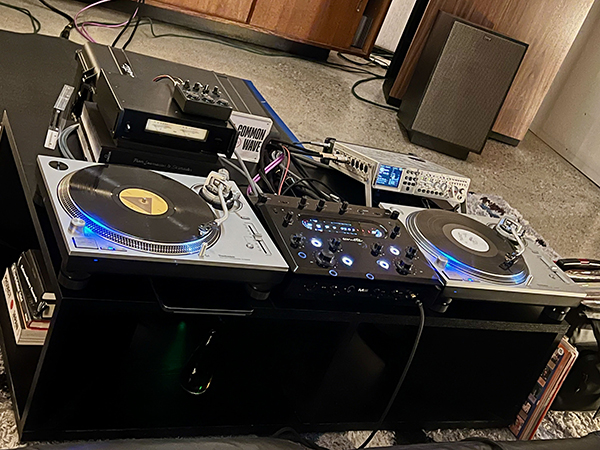
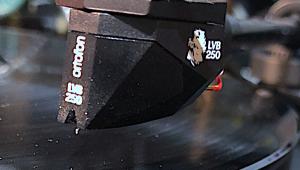
A week ago this past Thursday — i.e., August 14, 2025 — that particular Night School session coincided with the release of the Cometa M2 mixer, where it was incorporated into a special playback system. I was honored to have the opportunity to attend that event (and, full disclosure, my travel expenses were covered for said event). This Night School session brought pioneering DJ and Beat Junkies founder J. Rocc into the house. DJ J. Rocc — seen above left in the hat, alongside fellow DJ, Goddollars — was on the decks spinning vinyl on a pair of Technics SL-1200GR2 turntables, each with a Soundsmith Irox Ultimate moving iron cartridge (purported to be “unbreakable”) affixed to the end of its S-shaped tonearm. Those signals were fed into the Cometa M2, ahead of an Accuphase E-4000 integrated amp and a pair of Accuphase A-300 monoblock amps driving a pair of Klipsch Heritage Klipschorn AK7 speakers in use with active outboard crossovers (separate feeds for low, mids, and highs) with (fixed) DSP.
In both the musical selections and the hi-fi system in use, that Night School session paid homage to David Mancuso’s legendary Loft parties that were held in his New York City loft starting in 1970 — happenings that would influence nightclub culture for the next 50 years. By all accounts, Mancuso didn’t like the term “DJ” — he preferred the term “musical host.” Also, his Loft system included a dance floor with six Klipschorns. Mancuso, who passed away in 2016, was also an audiophile, just like us.
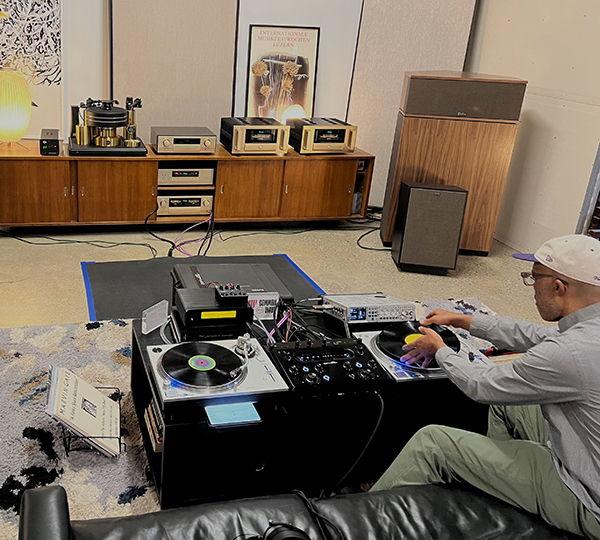
J. Rocc spun selected tracks that were played at Mancuso’s Loft parties. After he selected a new album from which to play a track and had fixed it in the mix, J. Rocc would then extend his arm, lifting that album’s cover up high for all to see — a gesture one might have done (or not) in the pre-Shazam era. [AP editor Mike Mettler adds: Some of us are still doing it!]
Common Wave’s Night School event demonstrated one important way to use the M2, as the centerpiece in a system — and, in this case, connected to those two cool Technics GR2 turntables — to enable seamless mixing and blending of vinyl tracks in a social setting without having to get up to change records.
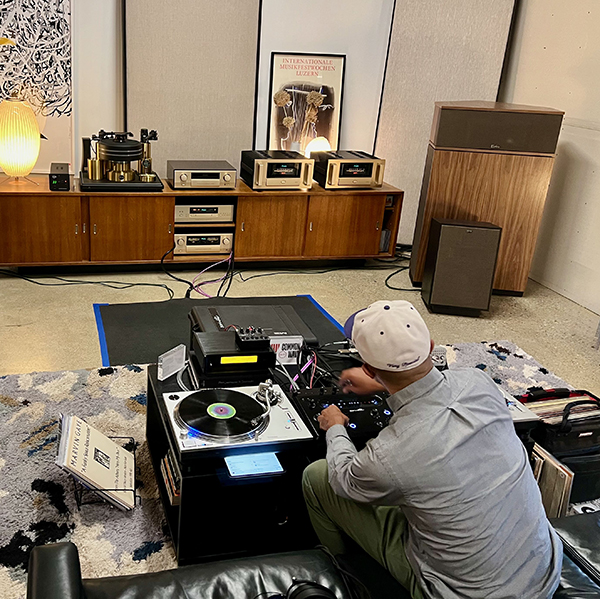
The M2 could also be used for easy switching between sources for A/B comparisons. For example, two turntables with different tonearms and/or cartridges can be affixed to them. Once both are connected, you can alternate between turning the two volume knobs up and down.
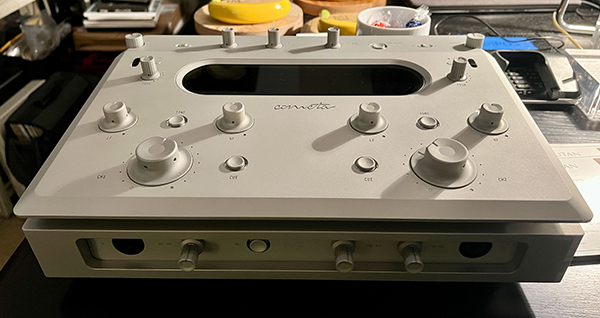
What’s under the M2’s hood? You can actually “lift the hood” — seeing how the top panel is on angled hinges, akin to the hood of a car — to view and access the circuitry and components inside. As noted, the M2 is an all-analog component. Its pure Class A topology for phono and line-level preamplification deploys discrete circuitry. The unit is made to be ultra-low-noise and offer plenty of headroom. Its proprietary signal path incorporates audiophile-grade parts, including Cinemag transformers — handmade in Canoga Park, California — on both outputs, and WIMA film capacitors. And the op-amps deployed inside derive from a discrete implementation designed by Barry Bialos, an engineer who designed custom monoblock amps for Mancuso’s Loft.
The M2’s custom VU meters, tricked out with 390 (!) LEDs, seemed rapid-fire responsive to help users keep an eye on input and output levels in real time. The display is also, of course, dimmable.
Another M2 key feature is its rotary knobs. Made from machined, anodized aluminum with a sculptural quality both for tactile joy and durability, they’re also suited for “eyes-free” usability in low-light situations (nightclub conditions, for instance).
In addition to gain and volume controls, the M2 has classic tone controls with passive high and low tonestack-style shelving EQ (inspired by the classic studio Pultec EQ design), plus cueing capability. It’s also equipped with inputs for connecting outboard effects units.
Essentially, the M2’s makers — audio pros who love music and great sound — wanted a mixer they themselves would want to use at home or at work. Cometa founder and CEO Spencer Velasquez summed up the unit’s raison d’être: “With the M2, we set out to build the kind of mixer we always wished existed.” And, I would add, to do so at the highest level — technically, sonically, and aesthetically. It would need to play well across various settings, from home hi-fi listening rooms or studios, to bars and nightclubs to, well, a dealership event like Night School.
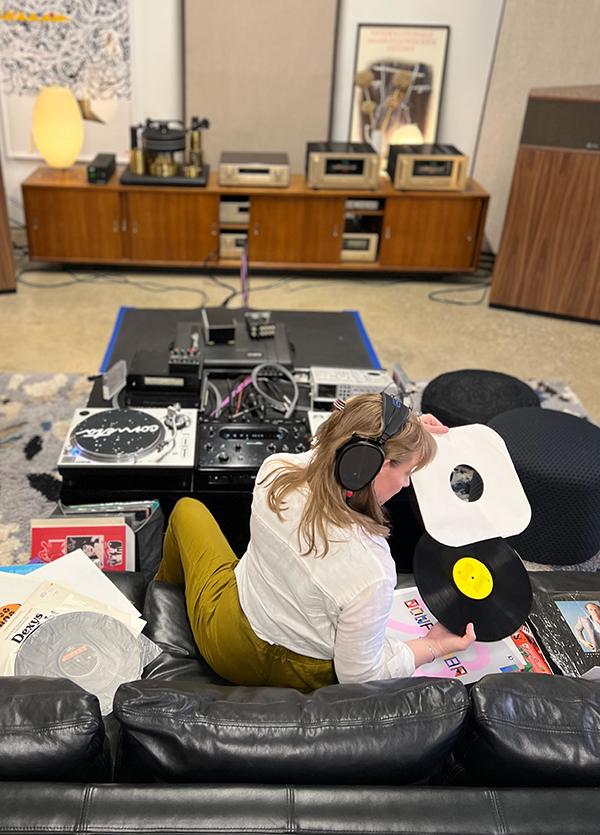
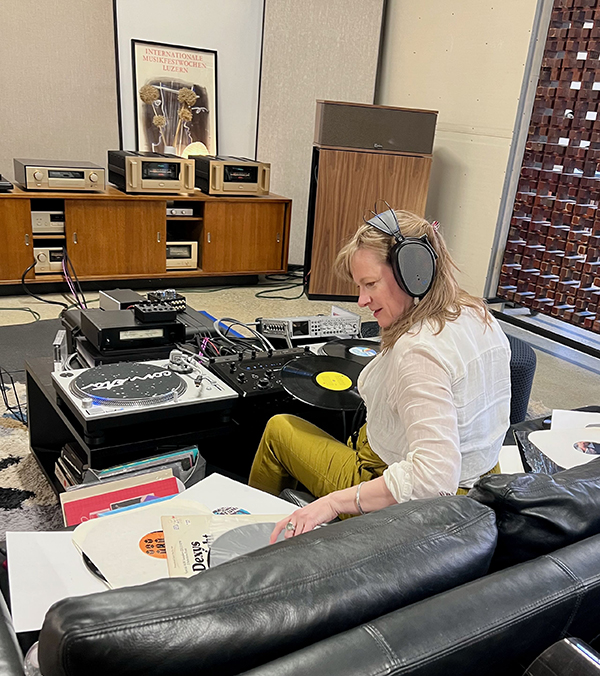
Best of all, I jumped at the chance to return to Common Wave the day after that Night School event to play around with the M2 for an hour or so myself. The rotary knobs were pleasant to handle — though it required some adjustment time on my end to adapt to using the knobs after being used to vertical faders. Steady and smooth in equal measure, I found that I didn’t need to be afraid to turn them further “up” than I would have imagined — perhaps the most notable difference between this and a more typical hi-fi component. The controls seemed quite intuitive, too.
Time flew as I spun several of the albums I’d schlepped along to the event, exploring the mixer’s feel and controls and possibilities for playback fun on a great hi-fi system.
As for the price and availability of this unit, Common Wave will be the exclusive dealer — along with Cometa, via their own site — for the initial limited-edition Founder’s Series run of Cometa M2 mixers. Each will have a numbered nameplate and will sport an SRP of $9,999. Upcoming editions will go for $12,999. Finishes (so far) include glossy black, silver, or brushed aluminum.
For more on Cometa, go here.
To preorder a Cometa M2, go to Cometa here, or go to Common Wave here.
Author bio: Julie Mullins, a lifelong music lover and record collector since age 10 who takes after her audiophile father, is also a contributing editor and reviewer on our sister site, Stereophile, for whom she also writes the monthly Re-Tales column. A former fulltime staffer at Cincinnati’s long-running alt-weekly CityBeat, she programs and hosts a weekly radio show on WAIF called On the Pulse.
If you want to read more about the DJing-related adventures of other AP writers, check out Ken Micallef’s account of his semi-regular gig as a jazz DJ at Tokyo Record Bar in New York City, which posted here on March 24, 2025.

























 |
Equipment Reviews | |
The Gruvy Awards | |
Blogs Analog Tips | Columns Music | |
Show Reports | |
News Resources |
 © 2026 AnalogPlanet
AVTech Media Americas Inc.
All rights reserved