


Origin Live Ground Anchor Grounding Box
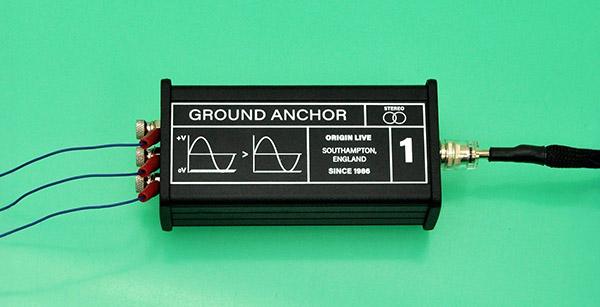
If there’s one thing that kills the unbridled joy of enjoying clean vinyl playback, it’s gotta be noise. British manufacturer Origin Live know this, which is why they’ve just announced the launch of their new Ground Anchor, a grounding box that connects between a tonearm’s grounds and a phono preamp. The Ground Anchor is said to reduce noise from airborne noise as well as mains noise, system noise, and microphonic component noise — music to our ears, in other words. The Ground Anchor also marks Origin Live’s first collaboration with fellow UK manufacturer Puritan Audio Laboratories. (More on the reasons why for that collab in just a bit.)
The Ground Anchor sports three grounding posts on the box’s cartridge signal side. This is intended for Origin Live premium tonearm cables, which use multiple grounding wires: one for the tonearm structure, two for the cable shielding, and one optional ground for the signal (though the company points out that the latter option is generally not needed). Why so many grounds? According to Origin Live CCO David Baker, it’s to reduce hum by accommodating the different ways phono preamp designs reference ground (0V).
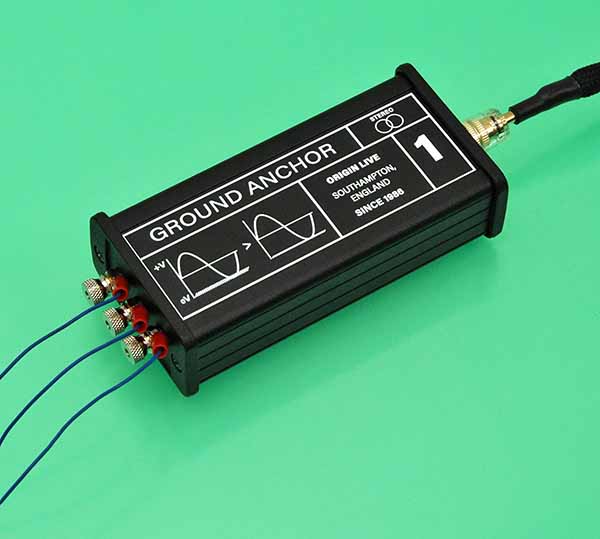
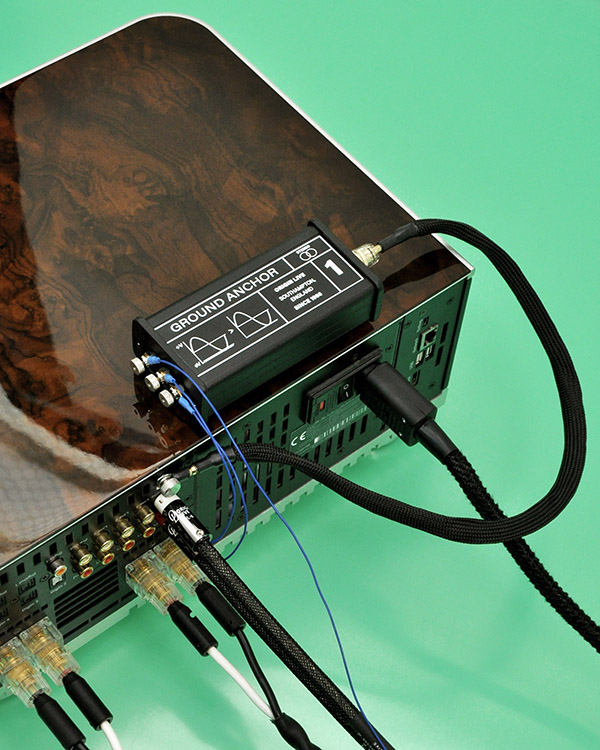
Another benefit Baker points out is that the Ground Anchor can also serve as a grounding box for up to three tonearms. The box is said to be universally compatible with all tonearms and all phono preamps, and can, in turn, accept the grounds from up to three tonearms.
Why the collaboration between Origin Live and Puritan Audio Labs? The Baker (OL) and Lester (PAL) families have often been found “in cahoots” (their words) at audio shows, with Mike Lester frequently dropping a Puritan product off with Baker and the OL team that, according to Baker, “always had a positive impact on our room’s sound.” Lester, in turn, uses an Origin Live Agile tonearm in his own reference system. “Puritan have a fantastic reputation in minimizing electrical noise,” Baker continued. “It seemed about time to work on something together, and when Mike suggested a grounding box, we jumped at the chance. One of the key principles we share with Puritan is the conviction that products must be developed by ear. This has proved to separate Mike’s work from many others.”
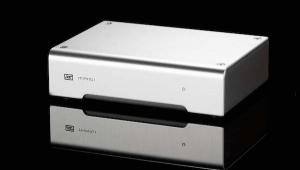
Included with the Origin Live Ground Anchor are 50cm copper ground cable, one side banana, one side with adaptable attachments for banana (gold-plated), spade, and spring clip terminations. The unit’s dimensions are 160 x 65 x 40mm (w/h/d).

In a press statement, Baker went into depth in order to explain the philosophy behind the origin of the Ground Anchor. “The beauty of vinyl playback is that it creates brand new electricity every time your cartridge stylus touches the groove,” he observed. “In contrast, the rest of the audio chain takes electricity from the mains, which is inherently noisy. Resolving this noise is a primary focus for every audio electronics engineer in every component in the audio chain.
“Yet the cartridge signal is an exception to this rule,” Baker continued. “The cartridge transducer converts mechanical energy to an electrical signal by induction between magnets and coils, meaning the power comes not from the wall, but from the little generator that sits on the end of your tonearm. The problems of interference for vinyl are, on the whole, mechanical, hence why we will endlessly be looking for solutions to vibration, resonance, and the transmission of mechanical energy.
“Despite the vinyl signal coming from a cleaner source and generally having a floating earth, it is still susceptible to picking up noise, since the tonearm’s tube and cable shielding acts as an antenna for RF and EMI. This audibly affects the signal within. Standard grounding reduces this considerably, but it is far from a perfect solution, leaving significant noise behind. This is where the Ground Anchor comes in.”
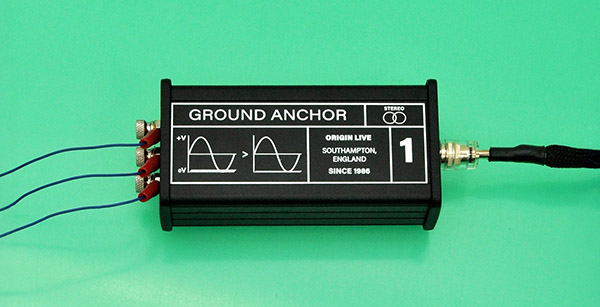
Noted Baker, “For an electrical waveform such as the cartridge signal to exist, it must reference the ground, or a 0V reference. The ground, which is connected to your mains, and the casework of your hi-fi separates is affected by airborne noise from radio frequencies, electromagnetic interference, as well as AC noise in the mains which enters your system circuits. There is also microphonic and electrical noise generated within the system electronics.
“As audio signals go, the vinyl signal is potentially the most vulnerable to airborne interference. The signal from an average MM [moving magnet] cartridge is 5mV, but for MC [moving coil] users, it can drop to as low as 0.1mV. To move that signal effectively through a tonearm tube without disturbing the mechanics of the arm, you are generally using thin unshielded wires, and asking the armtube to cover shielding duties. Where the armtube stands in as shielding, it needs to be grounded in order to transmit RF noise out of the system to ground.”
Baker concluded his observations by noting that the entire process should result in “more signal clarity in all aspects, from detail and texture to blacker backgrounds, a little more separation between musical elements and more clearly defined aural forms. I was especially interested in how it performed with my step-up transformer [SUT]. What you tend to gain in space and richness with an SUT, you often sacrifice in detail and attack. Connecting the Ground Anchor alongside my SUT lowered the noise floor, but also helped to retain resolution previously lost without [it].”
Finally, the SRP for the Ground Anchor is £545, and it will be available via authorized Origin Live dealers starting on February 20, 2026 (i.e. this upcoming Friday).
For more about Origin Live, go here.
To find an authorized Origin Live dealer, go here.





























 |
Equipment Reviews | |
The Gruvy Awards | |
Blogs Analog Tips | Columns Music | |
Show Reports | |
News Resources |
 © 2026 AnalogPlanet
AVTech Media Americas Inc.
All rights reserved