


Sweet Vinyl Sugar Cube SC-1 (Continued)
Naturally the first record I pulled from the shelf was that Beatles album. I put on side two, opened the app and got busy listening. First I listened to the “minty” opener “Martha My Dear” through the balanced connection (as I normally would). Then as it played and with the SC-1 set to “bypass” (analog output) I switched to the preamp input that outputted SC-1’s output, lowering the level to match (the balanced output is greater). So set I wouldn’t want to be subjected to a blind test to identify which was which. In other words, the SweetVinyl folks have designed an essentially transparent relay-based pass-through.
More importantly when “Blackbird” began I switched off the “bypass” so the signal passed through the SC-1’s pop and click removal circuitry. As soon as the “pop” started I hit the “click remover” button and with the “strength” slider set to the mid position, the click was gone and so for the first time I could thoroughly enjoy “Blackbird” and the second side of the $75 album.
Did it now sound “digital” (as well commonly use the term)? No. Did it sound identical to the bypassed signal (which of course now had the offensive “pop”)? Not 100% identical. However, timbrally it was essentially a wash. The differences with the “pop and tick” circuit engaged were a slight change in instrumental textures and a slight diminution in soundstage depth. That is, textures were more supple and transients somewhat smoother and more delicate in the “bypass” mode.
Which is preferable? No contest! Getting rid of the “pop” in exchange for the most subtle of differences was a most worthwhile trade-off. That said, would I just leave the “pop and click” remover engaged full-time? No.
Once I’d heard what the SC-1 was capable of doing it was time to pull out other “tic infested” unplayable records. First up was a copy of “Grand Canyon Suite” with Howard Hanson conducting the Eastman-Rochester Orchestra on Mercury (SR90049). I remember finding it at a garage sale in the late ‘80s and being so excited about finding a Merc for buck! That was until I looked carefully at the surface and after cleaning, playing it.
The music itself was undistorted but the ticks, pops and crackles made it not worth listening to but I kept it anyway. Glad I did! Through the SC-1 it was back to mint! That’s not hyperbole. In fact I’ll prove it to you at the end of the review: there’s a file containing a few minute’s worth of the record during which it toggles between “bypass” , “click and pop remover” and “click monitor” where you hear mostly the pops and clicks with a small amount of music below. Yes, I know it’s all digitized so you can’t compare all-analog to digitized but it’s the best I can do!
Next up was a swell Riverside stereo release The Compositions of Tadd Dameron (Riverside RLP 93511) featuring Milt Jackson, Bill Evans, Herbie Mann, Bobby Timmons, Blue Mitchell, Eddie “Lockjaw” Davis, Johnny Griffin and of course Dameron hisself in groups that include various other greats including Jimmy Cobb, Paul Motian and others.
A great record in the label’s “Jazz Master-Composers Series” I’ve never before or since seen. I got it at a Housing Works thrift store along with 20 others that had just been put on the shelves because I’m sure the next day they’d all be gone (but I won’t list them).
It’s another record where the grooves were good but bad handling had produced too many pops and clicks to make it a pleasant listen. Again, glad I kept it because now it sounds good. There are still a few audible pops and clicks though well suppressed. The SC-1 is a near-miracle product but it can’t fully repair all damage. Nonetheless this record is now one I can play with pleasure or record as a 96/24 file and put on the Meridian Music Server—not as easily as it could be done through the SC-2, but easy enough.
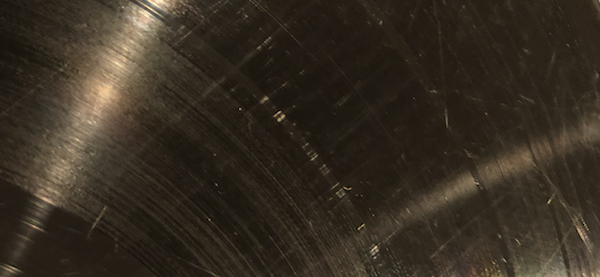
There's one kind of recording that fared worse than most, and that's simply miked, seriously holographic recordings, mostly classical music, though I first heard what I'm about to describe on Stereo Concert, The Kingston Trio (Capitol ST1183) released in 1959. It was the first time Kingston Trio fans got to hear the group in stereo. It was clearly a simply miked production (probably a spaced pair of omni's, according to Stereophile editor and professional recording engineer John Atkinson) that produces spectacularly vivid three dimensional imaging, though when any one of the trio moves, the soundstage imagery dramatically shifts. Some of the music and especially the humor is terribly dated but if you want to hear your system do its thing spatially this one is great! The SC-1's click remover did its usual great job removing my copy's pops and clicks but it also noticeably flattened the stage along with the vocal images' palpable three-dimensionality. Despite the ridiculous claims of "100% transparency" made by some for digitized analog, this kind of real time processing clearly shows what's lost in the process. The better, more vivid the stereo, the more you can hear what's lost.
How Does it Work?
According to SweetVinyl’s Dan Eakins:
“The SugarCube algorithm instead of identifying frequencies or bands of audio with problems looks for events in the time domain and then corrects the audio to remove them by interpolating the slope of the preceding audio. These repairs are so small and distinct that humans can’t perceive them and is actually how a sound engineer would remove them manually.
“Clicks and Pops are distinct from music in that musical sounds typically have an attack and decay that look quite different over time than clicks and pops. (Music has repeating patterns while clicks and pops are isolated impulses that stand out in duration and strength.)
“Our algorithm hunts in real time for candidates to repair and then applies pre-defined rule sets on these to make sure they are not music. This is pretty straightforward for most instruments - but some things can look like clicks and pops. For instance a drumstick on a drum rim, a muted horn, where the attack and decay are roughly symmetrical. We have identified many of these and update the software rules as we find corner cases.”
According to Eakins there are automatic algorithm updates. The unit must be on the update to occur but the company recommends turning it on and off as you normally do your other gear. Once booted up the next time you use it, as long as it’s connected to the Internet and no audio is playing, it will automatically check and update the system, which takes around an hour.
Conclusion
The SweetVinyl team has been working on this “real time pop and project for a few years now, improving all aspects of the design and bringing each update to audio shows so we can all hear how the project has progressed.. These guys are committed audiophiles and vinyl fans who bring to this years working in Silicon Valley so what you have here is a product that is technically finessed in the digital domain, informed by experience and commitment in the analog world and built to the level audiophiles expect at an unexpectedly reasonable price.
They've taken their time with this product and I believe all of their hard work has paid off—at least in terms of the product itself. How audiophiles will react is something I can't predict but I think many will react as I did and come to see this is an indispensible addition to their vinyl playback systems. It will certainly change how I go used record shopping—especially in the bargain bins.
Click on the link below to hear 1:54 of the Mercury “Grand Canyon Suite” in various states of “click repair” as follows:
0-26 “bypass”
26-32 SC-1 “in”, no click remover
32-41 click remover “in”
41-46 just the clicks
46-55 click remover “in”
56-1:02 click remover “out”
1:03-1:54 your call!
 | |||||||||
|

| ||||||||



























|
Equipment Reviews | |
The Gruvy Awards | |
Blogs Analog Tips | Columns Music | |
Show Reports | |
News Resources |
 © 2026 AnalogPlanet
AVTech Media Americas Inc.
All rights reserved