


Mobile Fidelity’s UltraDisc One-Step 180g Editions of Michael Jackson’s Career-Defining Albums Off the Wall and Thriller Are Both Stunning Upgrades, and the 180g 2LP Original Master Recording Edition of Dangerous Is Right Behind Them
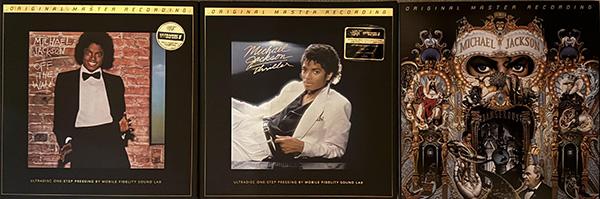
The prospect of reviewing a trio of audiophile editions of albums that are generally revered as near-perfect recordings and top-tier productions is, needless to say, quite daunting. Add to that the challenge of two of them being Michael Jackson’s most iconic, career-defining albums, and you know that the bar needed to be raised pretty high to make the cut as audiophile-worthy super deluxe editions, especially when they’re being presented by Mobile Fidelity Sound Lab (a.k.a. MoFi).
To cover these MoFi releases the right way, AP editor Mike Mettler tasked me with handling the core reviews of their Off the Wall and Thriller One-Steps, while he tackles the Original Master Recording edition of Dangerous in his Footnotes that appear after the end of the main review section (and he adds his own thoughts on both the Wall and Thriller One-Steps there as well).
For additional perspective on the impact of all three of these MJ albums which were all initially released on Epic, August 1979’s Off the Wall is a Diamond platinum seller, meaning it has sold 10 million copies to date in the U.S. alone (as of 2025). Add to that total at least another 10 million sold elsewhere worldwide for a global total of more than 20 million units sold to date. Meanwhile, November 1982’s Thriller, long acknowledged as the world-champion best-selling non-compilation album of all time, has sold some 70 million copies worldwide (34 million of them in the U.S.), and it also won eight Grammy Awards. Finally, November 1991’s chart-topping Dangerous has only grown in stature in the interim, and it’s certified as selling 8 million copies in the U.S. alone, and 32 million worldwide. So, not bad at all, to say the least.
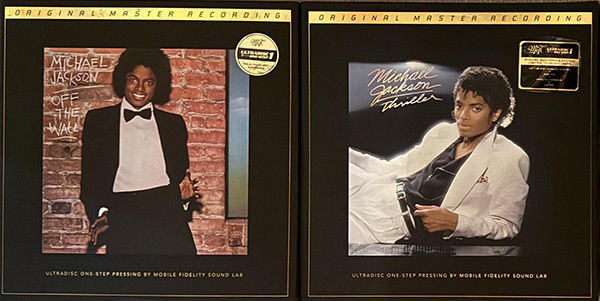
Let’s first explore the underlying DNA for the first two MoFi MJ One-Step double LPs here. From official descriptions on MoFi’s site, we gain insight into how these One-Steps were created. The site confirms that these Mobile Fidelity’s UltraDisc One-Step 180g LP collections are sourced from the original master tapes, housed in a deluxe slipcases, and pressed on MoFi SuperVinyl at Fidelity Record Pressing. Both Wall and Thriller feature special foil-stamped jackets and, quote, “faithful graphics.” Wall is a limited edition capped at 6,000 copies, while Thriller has a run of 40,000 copies — not surprising, given its stature and history.
MoFi’s site also explains the sonic food chain (if you will) used for crafting the vinyl pressings of these editions. For Off the Wall, they used the “¼in 30ips analog master to DSD 256 to analog console to lathe.” For Thriller, they used the “½in 30ips analog master to DSD 256 to analog console to lathe.”
To put all that phraseology into more laymanesque terms for those of you who may not be as familiar as we are with these processes, it is our understanding that these recordings were taken from the respective quarter-inch and half-inch 30ips (inches per second) analog master tapes. They were then transferred to the DSD 256 format. DSD stands for Direct Stream Digital, which is Sony/Philips’ proprietary codec that was originally introduced for the SACD format many decades back. The essential benefit of this technology’s underlying sampling rate of 2.8224MHz is that it’s about 64 times greater than the 44.1kHz sampling rate used for the standard compact disc.
Hence, DSD captures much more information than a standard CD does, and thus can theoretically deliver a richer, even more audiophile-worthy listening experience. In fact, certain digital music fans consider DSD the closest thing to the analog experience. And, as we’ve learned from engineers like Miles Showell at Abbey Road Studios, he cuts his half-speed-master vinyl editions exclusively from digital transfers due to stability issues and other processing benefits — a philosophy that MoFi likely agrees with. In fact, and to MoFi’s credit, they issued the following useful explainer video on their YouTube channel that details exactly why they chose their approach.
The next part of MoFi’s single-line source/process descriptor is also very interesting: “to analog console to lathe.” That is, once they have the files transferred on the computer, then it can be inferred that they play the music back through an analog console, feeding the final music signal to the vinyl lacquer cutting lathe.
This is significant — and here’s why. I learned about this concept while recording my old band’s last album at The Plant Studios (a.k.a. The Record Plant) in Sausalito, California, in the early 2000s. Our engineer Justin Phelps (Chuck Prophet, Cake, Joe Satriani; he now has his own successful studio in Portland, Oregon, called The Hallowed Halls) had us cut basic tracks on analog tape, as well as hi-res digital for backup. We recorded overdubs in another smaller, less costly studio (also at hi-res), and then the whole final multi-track assemblage was fed through the studio’s analog board to for the mixdown to analog tape.
The resultant hybrid recording was rich and round. Phelps explained to me that much of the warmth on recordings we love actually comes from the electronics inside the mixing board. Upon hearing that, I eventually bought a boutique Dan Alexander Audio preamp for my home studio made from repurposed classic Neve mixing board parts. So, with all that in mind, I really do appreciate this extra step MoFi has taken here on a very personal level.
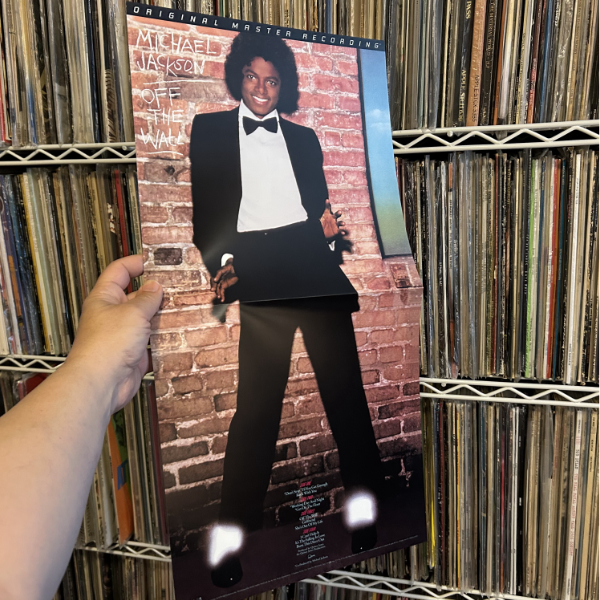
And now, to the other important MoFi MJ One-Step stats. Each LP comes housed in its own respective protective audiophile-grade inner sleeve and individual single-pocket oaktag-stock album jackets that fit neatly inside the hardbound One-Step series outer-shell packaging. SRPs for One-Steps typically run $125, but Thriller actually goes for $100, and it can be ordered from Music Direct here, and/or via the MD link graphic embedded in the extended tracklisting section below. The one catch for the Off the Wall One-Step is that it is currently sold out on the MoFi site, and we’re awaiting word from the company as to whether they plan a repressing. That said, a good number of copies of the Wall One-Step are indeed available on Discogs, ranging between $174 and $310 as of this posting — a price range that is not entirely unreasonable, all things given. (All the related stats for the very-much-available Dangerous OMR appear in the Footnotes section below.)
Now it’s time for the One-Step reviewing! There is not much to be said about the artistic credibility underlying both Off the Wall and Thriller. Both albums are important, influential releases — not only for MJ the artist’s career arc, but for the state of popular music as we know it in general.
As far as the original LPs’ respective sound quality goes, both Off the Wall and Thriller are excellent-sounding recordings to begin with. These were albums helmed by one of the great producers of our times — Quincy Jones (Ray Charles, Brothers Johnson, Herb Alpert, Count Basie, Frank Sinatra) — along with one of the best audio engineers, Bruce Swedien (Sarah Vaughan, Paul McCartney, Barbara Streisand, George Benson).
Both of these UltraDisc One-Step vinyl pressings are exemplary, dead-quiet, and well-centered, and I have absolutely no problems on that front. The noise floor compared to stock versions of these albums on the Epic label is a no-contest scenario. MoFi’s SuperVinyl formulation used in making the UltraDisc One-Step editions are super-quiet, and thus far more definitive in that sense.
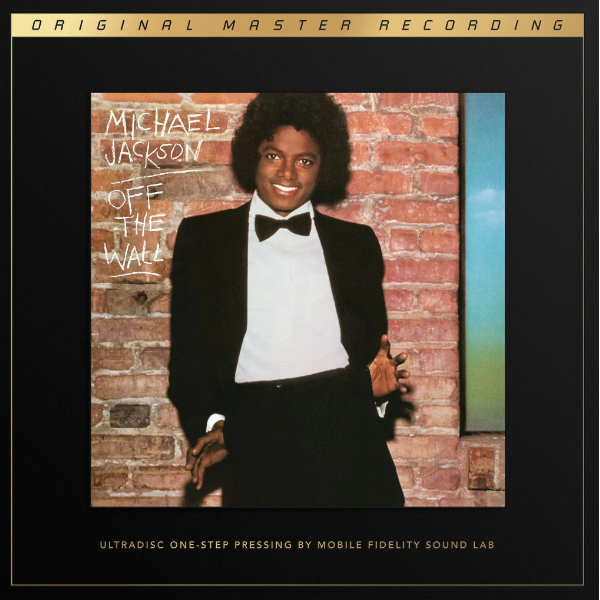
Every MJ fan has a favorite LP from his catalog, and over time, I’ve grown to appreciate Off the Wall for the sea change album that it is. This 1979 album pointed to the artist’s future, establishing him as a powerhouse separate from his talented brothers (and, frankly, most other artists of the time). For me, Off the Wall feels organic and timeless.
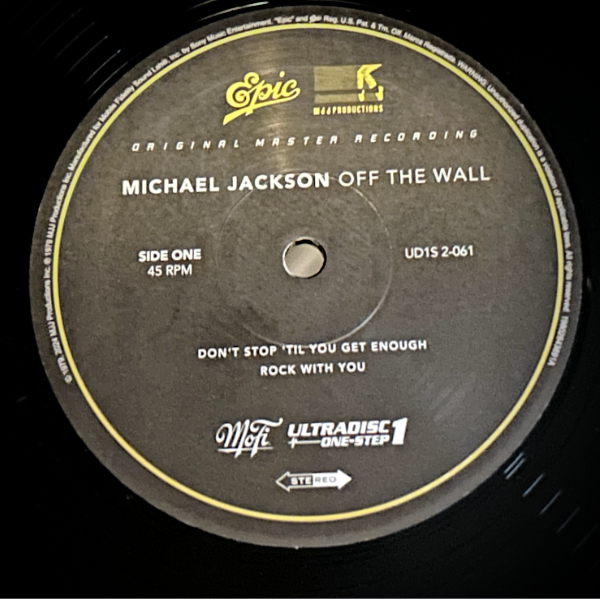
And thus, I have greatly enjoyed the sonic power MoFi achieved with their One-Step presentation of Off the Wall. I think the 2LP design that has both LPs spinning at 45rpm was a smart decision, delivering a distinct sonic punch closer to the pure analog vibe most of us are seeking from this sort of special-edition pressing.
Right from the opening notes of “Don’t Stop ’Til You Get Enough” (LP1, Side 1, Track 1), the aural assault is evident. The percussion that’s percolating away in each channel is super-distinct, while the funky bass and drums glue your attention to the center stage. This one-two-punch of track sequencing, which goes right into the ever-iconic “Rock With You” (LP1, Side 1, Track 2), is more impactful than ever.
When I put on the final side of LP2, I was a little taken aback, as if it was the first time I was hearing “I Can’t Help It” (LP2, Side 4, Track 1). I immediately heard that moody analog synthesizer sound you might remember from vintage Stevie Wonder recordings — well, he did co-write the tune, after all! — and produced in such a way that you could have dropped it into one of his own classic early ’70s albums.
The MoFi edition of Off the Wall is overall a far richer listening experience than my stock original 1979 Epic pressing. The bass is generally fatter, the soundstage wider, and the music overall feels less compressed. Happily, even when played at high volume levels, the MoFi One-Step edition remained quite warm-sounding and enjoyable to the ear.
As to my ratings, I am happy to give the Music of Off the Wall a solid 10, and the One-Step sound at least a 9.5, saving a little wiggle room for a potential future updated and/or expanded edition.
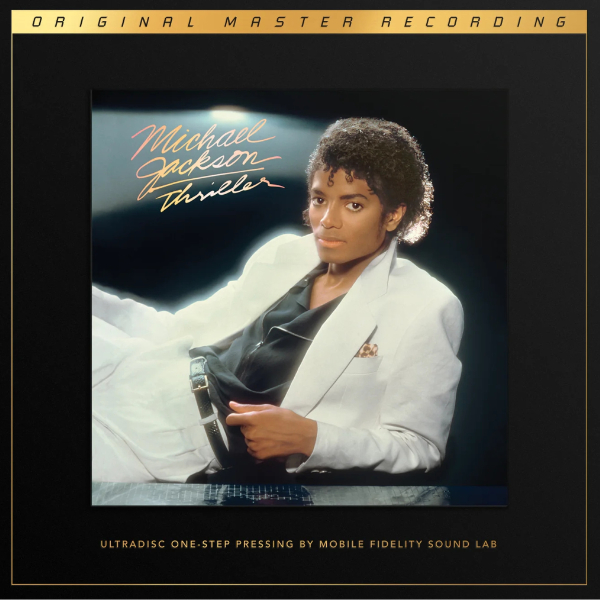
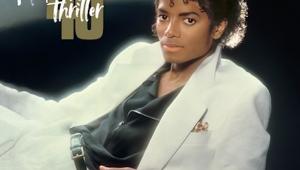
Thriller, of course, was inescapable for many years after its 1982 release. It certainly was a vivid part of the soundtrack of my college years — and, for much of the 1980s, for that matter. I didn’t need to even own the album then, as the music was always being played pretty much everywhere you turned: clubs, parties, record stores, radio stations, restaurants — you name it!
Meticulously crafted, Thriller still sounds solid after all these years. In fact, I am enjoying it more today, as I can now listen to this album more objectively and free of the sensation and hype surrounding it at the time of its ubiquity. Even the sugar-sweet track featuring vocals from Paul McCartney, “The Girl Is Mine” (Side 1, Track 3), sounds charming now — whereas, back in the day, I used to cringe when it came on. (That said, I still can’t make it through “Say Say Say,” their subsequent collaboration that appeared on Macca’s October 1983 Capitol LP Pipes of Peace).
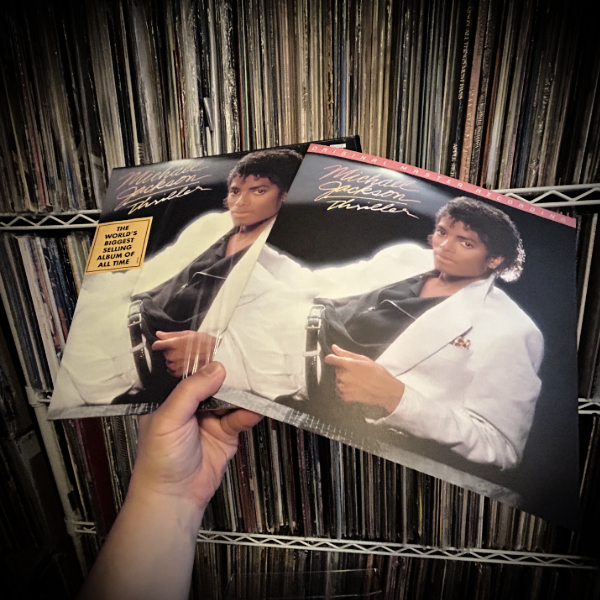
For this review, I went out and purchased a brand-new stock copy of Thriller on Epic, which again underscores the challenge in reviewing an album like this: even a standard $23.99 1LP edition of this recording sounds pretty great, so perfect was the original production!
The differences, however, are in the fine details — and, fortunately, there are enough points of differentiation to make the MoFi One-Step edition worthy of your attention and money. For example, those low, opening synthesizer hits at the start of “Beat It” (Side 2, Track 1) sound quite awesome, fat, and full — as do the track’s massive electric guitars.
The stereo separation apparent on Thriller is overall more distinct on the MoFi One-Step edition than on the standard pressing. “Billie Jean” (Side 2, Track 2) sounds especially wonderful when you crank it up a bit on your stereo — and those synthesizer parts at the beginning of it feeling especially full, capturing more of the feel of the instrument being played through an amp in the studio. The funky guitar riffing also jumps out of the speakers super sweetly.
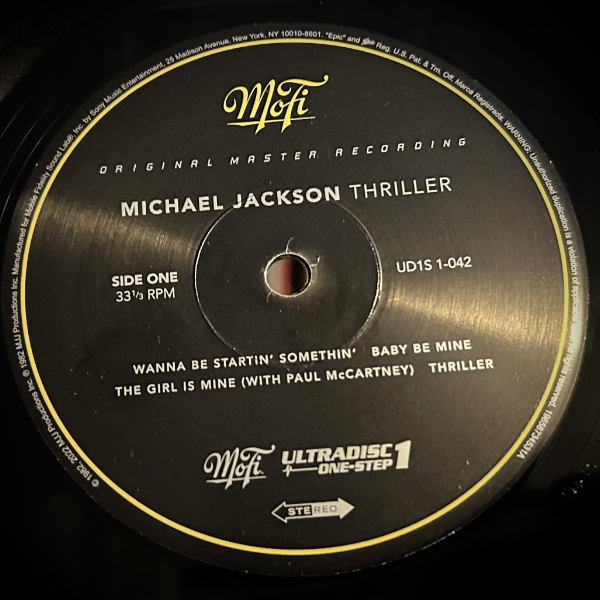
All throughout Thriller, Michael Jackson’s voice jumps out of the speakers in a more three-dimensional manner on the One-Step — and this makes a lot of sense as pop recordings go, since his vocals are the star.
Vincent Price’s laughs and the closing of the casket at the end of the title track (Side 1, Track 4) sound super-realistic here. Jackson’s sort of Elvis-esque yelping moments on album-opening track “Wanna Be Startin’ Somethin’” (Side 1, Track 1) sound more natural and lifelike than they do on the stock version.
When I turned up the volume loudly on my amp, both versions of Thriller revealed a bit of sharp edginess, which is not my favorite thing to endure. That said, the standard Epic LP sounded quite a bit harsher than the MoFi pressing. As for my ratings, the Music is a 9, and the One-Step Sound is 9.5. The chasm between the MoFi edition and the standard Epic reissue isn’t large, given the outstanding quality of the source material to begin with, but the MoFi is better. It sounds really, really good.
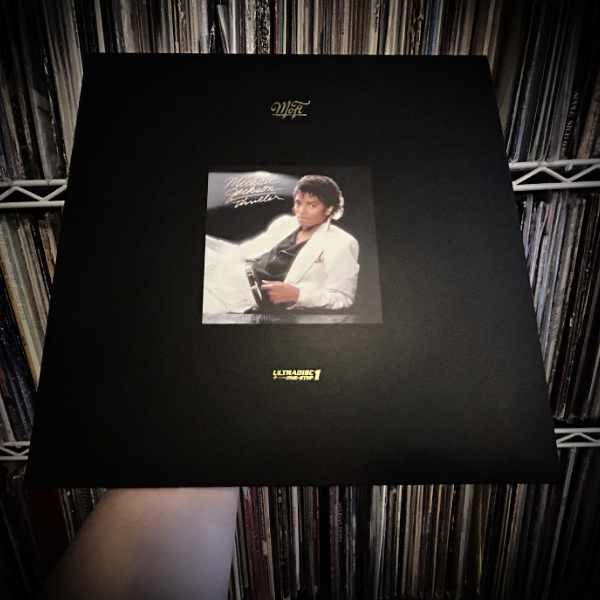
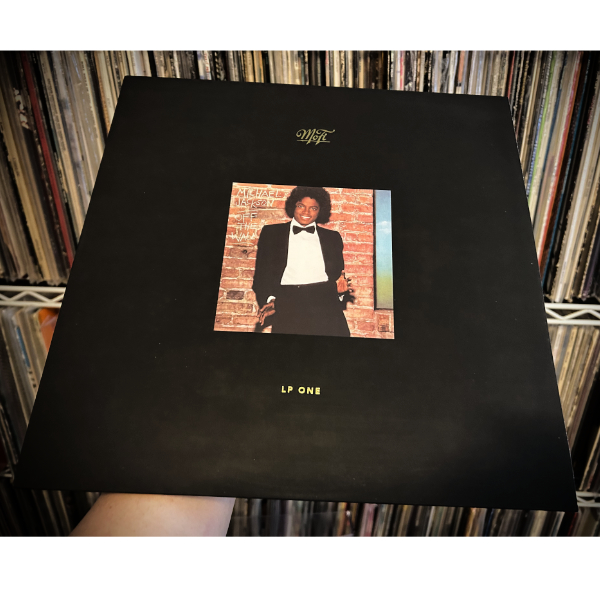
The inner cover design — which is basically a flat black oaktag sleeve with a CD-sized matte image of the original album cover art centered in the middle — is indeed dramatic-looking, and it does conform with the design of other One-Steps like MoFi’s Van Halen reissue series and their recently released One-Step for My Morning Jacket’s Z. That said, I would have preferred those replicated cover images to be bigger on the sleeve cover, if not covered the entirety of them, but I do get why MoFi are keeping them uniform for the overall design concept of the One-Step series. (And, like AP editor Mettler, I also appreciated the full-size, four-sided inserts that did indeed replicate the cover art in full and also included the lyrics and track-by-track credits.)
As to whether you need to get these two UltraDisc One-Step editions of Michael Jackson’s two greatest solo releases, that is always a personal decision. If I had to choose between the two, Off the Wall would be my hands-down recommendation, and it is well worth shelling out the extra bucks to get it in hand right now. But, of course, Thriller is what it is — the most popular non-compilation album of all time — so if you want to hear what is quite possibly the best-sounding version of it to date, the MoFi One-Step is totally right for you.
Author bio: Mark Smotroff is an avid vinyl collector who has also worked in marketing communications for decades. He has reviewed music for eCoustics, among others, and you can see more of his impressive C.V. at LinkedIn.
MM Footnotes Special: AP editor Mike Mettler adds: Once again, Mark’s assessments of both Off the Wall and Thriller are very much on the mark (pun intended). Quincy Jones’ original production palettes for both albums are in-studio benchmarks in their own respective ways, and I can say that both of these One-Steps are absolutely steps up from my original and reissued Epic copies of both LPs. LP1, Side 1 of Off the Wall — especially the percussion elements that permeate into the outro on “Don’t Stop ’Til You Get Enough,” as well as the string accents, handclaps, The Seawind Horns, and John Robinson’s in-the-groove pocket drumming on “Rock With You” — is impeccable.
On Side 2 of Thriller, the side opener “Beat It” teems with those layered MJ vocals on the chorus (backed by a haunting keyboard line), and Michael’s wide-panned repeat of the title phrase ahead of the break before Eddie Van Halen’s signature guitar tone owns the center-right guitar solo — as buttressed by Steve Lukather’s grinding main electric guitar riff that punctuates the entire song. The next track, “Billie Jean,” has the character of the opening drumming from Ndugu Chancler and accompanying shaker shakes on lock. It’s one of Michael’s career-best full-song vocal performances, imo, from all his “woo” and “hee-hee” accents to how his honest, unprocessed lead vocals on the verses ratchet up from measured to more frenetic as the song carries onward.
For my own ratings, I give the Music on Off the Wall a 9.5, and the One-Step Sound a 10. Thriller gets a 10 for Music, and also a 10 for the One-Step Sound because it is better than the original. Besides, I always prefer to listen to the best option possible for any of my favorite LPs, regardless of the quantity of incremental differences. Better is better, and both of these MJ One-Steps carry through on that premise.
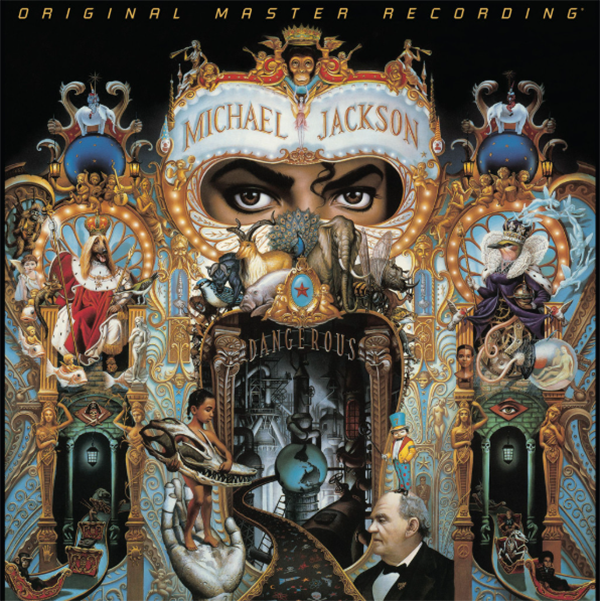
As for the MoFi edition of 1991’s Dangerous, the stats are these: Sourced from the original masters and pressed at Fidelity Record Pressing in California, the 180g 33rpm 2LP set is housed in a Stoughton gatefold jacket. Now, the provenance info for the Dangerous 2LP MoFi set is quite interesting — and not all that surprising, really, given all the hows, whys, and wheres related to the myriad ways the original album was recorded. All of that background recording minutiae is likely among the main reasons why Dangerous appears as an Original Master Recording edition and not as a pricier One-Step. The SRP for the MoFi Dangerous is $59.99, and it can be ordered from Music Direct here, and/or via the link graphic that appears after the full tracklisting section that follows these footnotes.
Now to those provenance details, which tell more of the pre-tale. Ready? Here we go. “Jam,” “Why You Wanna Trip on Me,” “In the Closet,” “She Drives Me Wild,” “Remember the Time,” “Can't Let Her Get Away,” and “Dangerous” all came from ½in 30ips analog masters with Dolby SR noise reduction to DSD 256 to analog console to lathe. “Heal the World” and “Keep the Faith” are courtesy Mitsubishi X-86 HS ¼in 48kHz 16-bit digital to DSD 256 to analog console to lathe. “Black or White,” “Who Is It,” and “Give in to Me” come via ½in 30ips analog masters to DSD 256 to analog console to lathe. “Will You Be There” and “Gone Too Soon” come from ¼in 30ips analog masters with Dolby SR noise reduction to DSD 256 to analog console to lathe. Got all that? Good. (Revisit Mark’s earlier dissection of what “to analog console to lathe” means, if need be.)
The bottom line is that the Dangerous source material was not “uniform” to begin with, but that doesn’t compromise the listening experience. Right out of the box, “Jam” (LP1, Side 1, Track 1), has some of the heaviest low-end on any of these three MoFi MJ LPs — and that bass oomph carries through here and there on the other three sides. Michael’s tortured lead vocal starts a bit back in the mix until it moves forward on the snarling chorus. Tip: Make sure you have your volume-level sweet spot dialed in to avoid distortion each time the title word gets repeated. (I found 67 to be the right “loudness” level for me.)
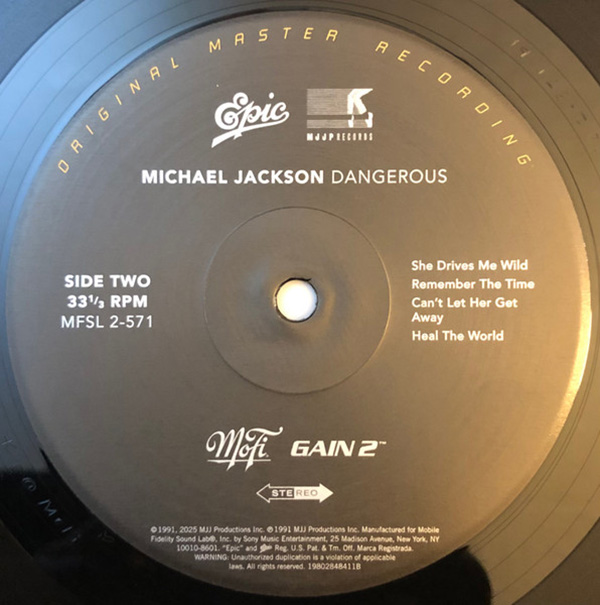
“Remember the Time” (LP1, Side 2, Track 2) funks things up (or is that down?) in all the right ways, benefitting greatly from the Teddy Riley school of rhythm ’n’ synth accentuating. (“Do you? Do you?”) Finally, the starkness of “Black and White” (LP2, Side 3, Track 1) actually starts with the guitar-centric “this is the best part!” sequence many people may not recall that leads into the joyful/rueful point/counterpoint verses and rough ’n’ tumble bridge. Also listen for those supportive acoustic guitar accents and percussive elements, as there’s a lot more going on in this song than you may think. (“On a global scale / I’d rather hear both sides of the tale.”)
My Dangerous MoFi ratings are as follows: The Music gets an 8.5, and the OMR Sound gets a 9. It’s not quite up to the One-Step level of both Off the Wall and Thriller, but Dangerous is still top-notch for what it is.
So, now that all of that sonic MJ biz is settled — shall we dare hope the powers that be at MoFi are able to swing being able to put out August 1987’s Bad next, either as a One-Step or OMR edition? Only time, and licensing efforts, will tell.
MICHAEL JACKSON
OFF THE WALL
180g 45rpm 2LP (Epic/MJJP/Mobile Fidelity)
MUSIC: 10
SOUND: 9.5
Original album produced by Quincy Jones
Original album co-produced by Michael Jackson
Original album engineered by Bruce Swedien
Mastering & Lacquer Cutting by Krieg Wunderlich, Mobile Fidelity
Reissue vinyl pressed at Fidelity Record Pressing, Oxnard, California
LP1, Side 1
1. Don’t Stop ’Til You Get Enough
2. Rock With You
LP1, Side 2
1. Workin’ Day And Night
2. Get On The Floor
LP2, Side 3
1. Off The Wall
2. Girlfriend
3. She’s Out Of My Life
LP2, Side 4
1. I Can’t Help It
2. It’s The Falling In Love
3. Burn This Disco Out
MICHAEL JACKSON
THRILLER
180g 33⅓rpm 1LP (Epic/MJJP/Mobile Fidelity)
MUSIC: 9
SOUND: 9.5
Original album produced by Quincy Jones
Original album co-produced by Michael Jackson
Original album engineered by Bruce Swedien
Mastering & Lacquer Cutting by Krieg Wunderlich, Mobile Fidelity
Reissue vinyl pressed at Fidelity Record Pressing, Oxnard, California
Side 1
1. Wanna Be Startin’ Somethin’
2. Baby Be Mine
3. The Girl Is Mine (With Paul McCartney)
4. Thriller
Side 2
1. Beat It
2. Billie Jean
3. Human Nature
4. P.Y.T. (Pretty Young Thing)
5. The Lady In My Life

MICHAEL JACKSON
DANGEROUS
180g 45rpm 2LP (Epic/MJJP/Mobile Fidelity)
MUSIC: 8.5
SOUND: 9
Original album produced by Michael Jackson
Original album co-produced by Bill Bottrell, Bruce Swedien, Teddy Riley
Original album engineered by Bruce Swedien
Mastering & Lacquer Cutting by Krieg Wunderlich (assisted by Shawn R. Britton and Neil Harris, Mobile Fidelity
Reissue vinyl pressed at Fidelity Record Pressing, Oxnard, California
LP1, Side 1
1. Jam
2. Why You Wanna Trip on Me
3. In the Closet
LP1, Side 2
1. She Drives Me Wild
2. Remember The Time
3. Can’t Let Her Get Away
4. Heal The World
LP2, Side 3
1. Black Or White
2. Who Is It
3. Give In To Me
LP2, Side 4
1. Will You Be There
2. Keep The Faith
3. Gone Too Soon
4. Dangerous


















 |
Equipment Reviews | |
The Gruvy Awards | |
Blogs Analog Tips | Columns Music | |
Show Reports | |
News Resources |
 © 2026 AnalogPlanet
AVTech Media Americas Inc.
All rights reserved